spectrafit vs. lmfit: a complex, 8-peak spectrum
Synthetic example
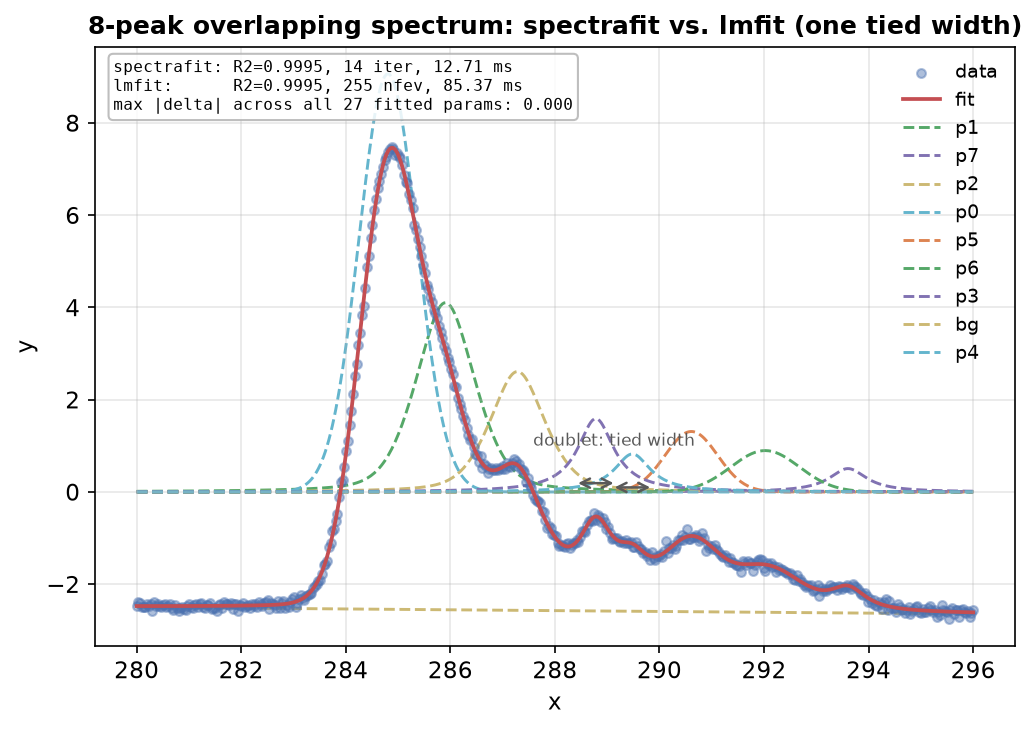
The 8-peak XPS-style spectrum below is built from local numpy formulas with known truth parameters — chosen so both backends' fits can be checked against a known answer, not a sweep proving spectrafit/lmfit agreement across arbitrary real spectra.
Quick example
An XPS-style, 8-peak, three-lineshape spectrum with a tied spin-orbit
doublet linewidth, fit independently by spectrafit and by a hand-built
lmfit composite — the genuinely harder sibling of
spectrafit_vs_lmfit_moderate.md.
Peak formulas shared by both backends (spectrafit's own convention: amplitude
is the peak height at center, never an integrated area):
# Peak formulas -- identical to spectrafit-core's own convention
# (docs/reference/models/index.md / python/oracles/models.py): ``amplitude``
# is the peak HEIGHT at ``center``
# (never an integrated area), and ``sigma`` is the Gaussian standard deviation
# / Lorentzian HWHM (never a FWHM). Defined locally rather than imported from
# ``python/oracles/models.py`` -- that module is internal benchmark-harness
# code, not a dependency of this public gallery -- so this script stays
# trivially runnable AND the lmfit oracle stays genuinely independent of
# spectrafit-core's own implementation.


def gaussian(x, amplitude, center, sigma):
    """Gaussian peak: ``amplitude`` at ``center``, std-dev ``sigma``."""
    return amplitude * np.exp(-0.5 * ((x - center) / sigma) ** 2)


def lorentzian(x, amplitude, center, sigma):
    """Lorentzian peak normalized to ``amplitude`` at ``center`` (HWHM ``sigma``)."""
    return amplitude / (1.0 + ((x - center) / sigma) ** 2)


def pseudo_voigt(x, amplitude, center, sigma, fraction):
    """Pseudo-Voigt: ``fraction``*Lorentzian + (1-``fraction``)*Gaussian, peak ``amplitude``."""
    mix = float(np.clip(fraction, 0.0, 1.0))
    z = (x - center) / sigma
    lorentz = amplitude / (1.0 + z**2)
    gauss = amplitude * np.exp(-0.5 * z**2)
    return mix * lorentz + (1.0 - mix) * gauss


def linear(x, slope, intercept):
    """Linear background ``slope``*x + ``intercept``."""
    return slope * x + intercept


PEAK_FN = {"gaussian": gaussian, "lorentzian": lorentzian, "pseudo_voigt": pseudo_voigt}
MODEL_TYPE = {
    "gaussian": ModelType.GAUSSIAN,
    "lorentzian": ModelType.LORENTZIAN,
    "pseudo_voigt": ModelType.PSEUDO_VOIGT,
}
The same three local formulas back both backends' synthetic data below — no built-in lmfit or spectrafit convenience function is used to generate it, so both fits start from an identical, apples-to-apples ground truth.
def synthesize_data() -> tuple[np.ndarray, np.ndarray]:
    """Synthesize the 8-peak + linear-background spectrum (with noise).

    Sums every ``TRUE`` component plus the linear background, then adds
    Gaussian measurement noise (``sigma=0.06``, seeded for reproducibility).
    """
    rng = np.random.default_rng(11)
    x = np.linspace(280.0, 296.0, 480)
    y_true = np.zeros_like(x)
    for pid in PEAK_ORDER:
        kind, true_params = TRUE[pid]
        y_true = y_true + PEAK_FN[kind](x, **true_params)
    y_true = y_true + linear(x, **BG_TRUE)
    noise = rng.normal(0, 0.06, len(x))
    return x, y_true + noise


x, y = synthesize_data()
p3 and p4 are the two lines of one spin-orbit doublet, and physically
they must share the same natural linewidth — that's what the ExprEdge
tying p4.sigma to p3.sigma below is actually encoding, not just a
syntax demo of the mechanism from shared_params.md.
def build_graph() -> FitGraph:
    """Fresh FitGraph: 8 peaks (3 lineshape families) + linear bg + 1 ExprEdge tie."""
    nodes = []
    for pid in PEAK_ORDER:
        kind, _ = TRUE[pid]
        guess = GUESS[pid]
        parameters = {
            "amplitude": Parameter(value=guess["amplitude"], min=0.0),
            "center": Parameter(value=guess["center"]),
            "sigma": Parameter(value=guess["sigma"], min=1e-3),
        }
        if kind == "pseudo_voigt":
            parameters["fraction"] = Parameter(
                value=guess["fraction"],
                min=0.0,
                max=1.0,
            )
        nodes.append(
            ModelNodeSpec(id=pid, model_type=MODEL_TYPE[kind], parameters=parameters),
        )
    nodes.append(
        ModelNodeSpec(
            id="bg",
            model_type=ModelType.LINEAR,
            parameters={
                "slope": Parameter(value=BG_GUESS["slope"]),
                "intercept": Parameter(value=BG_GUESS["intercept"]),
            },
        ),
    )
    return FitGraph(
        nodes=nodes,
        expr_edges=[
            # p4 (the 2p1/2-like doublet partner) shares p3's natural linewidth --
            # the same tie pattern as shared_params.py, applied for a physical
            # (not merely illustrative) reason.
            ExprEdge(target_node="p4", target_param="sigma", expression="p3.sigma"),
        ],
    )
As in the moderate example, lmfit's built-in peak models normalize by area rather than height, so the composite here is built by hand from the same formulas above, with the tie re-expressed as an lmfit parameter expression via the exact dotted-to-underscore translation the real oracle backend uses.
def build_lmfit_composite() -> tuple[lmfit.Model, lmfit.Parameters]:
    """Hand-built lmfit composite mirroring python/oracles/backends/_lmfit.py.

    Same loop structure as ``LmfitBackend.build``: one ``lmfit.Model`` per
    node (prefixed with the node id, which already matches ``_lmfit.py``'s
    ``f"p{i}_"`` convention here since the graph's own node ids are
    ``p0``..``p7``), summed with ``+``, ``.make_params(**guess)`` per node,
    then the tie applied via the same dotted-to-underscore regex translation
    ``_lmfit.py`` uses for ``expr_edges`` (its lines ~91-103).
    """
    composite: lmfit.Model | None = None
    params: lmfit.Parameters | None = None
    for pid in PEAK_ORDER:
        kind, _ = TRUE[pid]
        m = lmfit.Model(PEAK_FN[kind], prefix=f"{pid}_")
        composite = m if composite is None else composite + m
        pars = m.make_params(**GUESS[pid])
        pars[f"{pid}_amplitude"].set(min=0.0)
        pars[f"{pid}_sigma"].set(min=1e-3)
        if kind == "pseudo_voigt":
            pars[f"{pid}_fraction"].set(min=0.0, max=1.0)
        params = pars if params is None else params.update(pars) or params

    # PEAK_ORDER is non-empty, so the loop above always ran at least once --
    # both are genuinely never None here. `X.update(Y) or X` is runtime-safe
    # (dict.update always returns None, so `or` always falls through to the
    # just-mutated X) but a type checker can't verify that from the pattern
    # alone; asserting is the actual narrowing point, not a defensive check
    # against a real possibility.
    assert composite is not None
    assert params is not None

    bg_model = lmfit.Model(linear, prefix="bg_")
    composite = composite + bg_model
    bg_pars = bg_model.make_params(**BG_GUESS)
    params.update(bg_pars)

    # Apply the ExprEdge as an lmfit parameter expression, translating
    # spectrafit's dotted "node.param" syntax into lmfit's "node_param"
    # syntax -- the exact regex `_lmfit.py` applies to every expr_edge.
    expr_edge = {"target_node": "p4", "target_param": "sigma", "expression": "p3.sigma"}
    lmfit_target = f"{expr_edge['target_node']}_{expr_edge['target_param']}"
    lmfit_expr = re.sub(r"\b(p\d+)\.(\w+)\b", r"\1_\2", expr_edge["expression"])
    params[lmfit_target].set(expr=lmfit_expr)

    return composite, params
With both backends fit from the same starting guess, the report below compares chi2, iteration/evaluation counts, wall time, and all 27 fitted parameters between the two independent solvers.
def run_and_report(
    x: np.ndarray,
    y: np.ndarray,
    n_reps: int = 5,
) -> tuple[FitResult, ModelResult, float, float, float, float]:
    """Fit both backends ``n_reps`` times, print the side-by-side report.

    Returns ``(sf_result, lm_result, sf_median_time, lm_median_time, lm_r2,
    max_delta)`` -- everything the tie-verification step and the
    ``__main__`` plotting block need, so neither has to re-run either
    backend or recompute the per-parameter comparison.
    """
    data = MeasurementData(x=x.tolist(), y=y.tolist())

    sf_times: list[float] = []
    sf_result = fit(build_graph(), data)  # warm-up, untimed
    for _ in range(n_reps):
        start = time.perf_counter()
        sf_result = fit(build_graph(), data)
        sf_times.append(time.perf_counter() - start)
    sf_median_time = sorted(sf_times)[len(sf_times) // 2]

    lm_times: list[float] = []
    composite, params = build_lmfit_composite()
    lm_result = composite.fit(y, params, x=x)  # warm-up, untimed
    for _ in range(n_reps):
        _, fresh_params = build_lmfit_composite()
        start = time.perf_counter()
        lm_result = composite.fit(y, fresh_params, x=x)
        lm_times.append(time.perf_counter() - start)
    lm_median_time = sorted(lm_times)[len(lm_times) // 2]

    lm_best_fit = np.asarray(lm_result.best_fit, dtype=float)
    lm_chi2 = float(np.sum((y - lm_best_fit) ** 2))
    lm_n_iter = int(getattr(lm_result, "nfev", 0) or 0)

    print(f"{'':30s} {'spectrafit':>25s} {'lmfit':>25s}")
    print(f"{'success':30s} {sf_result.success!s:>25s} {lm_result.success!s:>25s}")
    print(f"{'chi2':30s} {sf_result.chi2:25.6f} {lm_chi2:25.6f}")
    print(
        f"{'n_iter (spectrafit) / nfev (lmfit)':30s} {sf_result.n_iter:25d} {lm_n_iter:25d}",
    )
    print(
        f"{'median wall time (ms)':30s} {sf_median_time * 1e3:25.3f} {lm_median_time * 1e3:25.3f}",
    )
    print()

    print(f"{'parameter':34s} {'spectrafit':>12s} {'lmfit':>12s} {'|delta|':>12s}")
    max_delta = 0.0
    for pid in PEAK_ORDER:
        kind, _ = TRUE[pid]
        names = list(
            PEAK_FN[kind].__code__.co_varnames[1 : PEAK_FN[kind].__code__.co_argcount],
        )
        for pname in names:
            sf_val = sf_result.parameters[f"{pid}.{pname}"].value
            lm_val = float(lm_result.params[f"{pid}_{pname}"].value)
            delta = abs(sf_val - lm_val)
            max_delta = max(max_delta, delta)
            label = f"{pid}.{pname} ({LABELS[pid]})"
            print(f"{label:34s} {sf_val:12.4f} {lm_val:12.4f} {delta:12.2e}")
    for bname in ("slope", "intercept"):
        sf_val = sf_result.parameters[f"bg.{bname}"].value
        lm_val = float(lm_result.params[f"bg_{bname}"].value)
        delta = abs(sf_val - lm_val)
        max_delta = max(max_delta, delta)
        print(f"{'bg.' + bname:34s} {sf_val:12.4f} {lm_val:12.4f} {delta:12.2e}")
    print()
    print(
        f"Largest single-parameter disagreement (spectrafit vs. lmfit): {max_delta:.4f}",
    )

    lm_ss_res = float(np.sum((y - lm_best_fit) ** 2))
    lm_ss_tot = float(np.sum((y - np.mean(y)) ** 2))
    lm_r2 = 1.0 - lm_ss_res / lm_ss_tot

    return sf_result, lm_result, sf_median_time, lm_median_time, lm_r2, max_delta


sf_result, lm_result, sf_median_time, lm_median_time, lm_r2, max_delta = run_and_report(
    x,
    y,
)
Printed numbers alone can't distinguish "close because both converged correctly" from "close by coincidence in a shallow, near-degenerate cost surface" — so both the tie itself and the aggregate agreement are checked in code, with a tolerance shaped by what this harder, overlapping problem can actually guarantee.
def verify_tie_and_assertions(
    sf_result: FitResult,
    lm_result: ModelResult,
    lm_r2: float,
) -> float:
    """Assert both fits succeeded and the ``p4.sigma = p3.sigma`` tie holds exactly.

    A loose ``R2`` tolerance (``< 0.02``), deliberately -- see the module
    docstring's honesty note: 8 overlapping peaks with one tied linewidth is
    a harder, potentially locally-non-unique landscape than this gallery's
    smaller examples, so we check "compatible", not "identical" per parameter.

    Returns ``p3.sigma`` (== ``p4.sigma`` by the tie) for the plotting step.
    """
    sf_p3_sigma = sf_result.parameters["p3.sigma"].value
    sf_p4_sigma = sf_result.parameters["p4.sigma"].value
    print("Tie verification (spectrafit ExprEdge, p4.sigma = p3.sigma):")
    print(f"  p3.sigma = {sf_p3_sigma:.8f}")
    print(f"  p4.sigma = {sf_p4_sigma:.8f}")
    print(f"  Difference = {abs(sf_p3_sigma - sf_p4_sigma):.2e}")
    print()

    assert sf_result.success
    assert lm_result.success
    sf_r2 = sf_result.r_squared
    assert abs(sf_r2 - lm_r2) < 0.02, (
        f"Aggregate fit quality (R2) should be close even if individual overlapping "
        f"peak parameters are not: spectrafit R2={sf_r2:.6f}, lmfit R2={lm_r2:.6f}"
    )
    assert abs(sf_p3_sigma - sf_p4_sigma) < 1e-6

    return sf_p3_sigma


sf_p3_sigma = verify_tie_and_assertions(sf_result, lm_result, lm_r2)
Why this works
spectrafit_vs_lmfit_moderate.md
already cross-checks spectrafit against a hand-built lmfit
composite on a moderately busy spectrum. This example goes further: an
8-peak, three-lineshape-family, overlapping spectrum with a linear background
and a physically-motivated tied linewidth — the kind of "real-world messy"
spectrum a single clean 2- or 4-peak demo never has to confront. It is the
genuinely harder sibling, not a repeat.
The scenario. An XPS-style core-level region built from eight overlapping components:
| Node | Lineshape | Role |
|---|---|---|
p0 |
Gaussian | dominant instrumental-broadening-limited peak |
p1, p2 |
pseudo-Voigt | mixed Gaussian/Lorentzian chemical-state components |
p3, p4 |
Lorentzian | one spin-orbit doublet — same natural linewidth by physics |
p5, p6 |
Gaussian | shake-up satellites |
p7 |
Lorentzian | trace / plasmon-loss tail |
bg |
Linear | slowly-varying background |
p3 and p4 are the two components of one spin-orbit doublet: physically,
they share the same natural (lifetime-broadened, Lorentzian) linewidth, so
p4.sigma is tied to p3.sigma via a graph-level ExprEdge — the same
mechanism documented in shared_params.md, applied here
for a physical reason rather than only as a syntax demo.
Two independent fits, one dataset. The same synthetic data is fitted
twice: once with spectrafit_core.fit() (Rust "lm" solver, the tied
linewidth enforced via ExprEdge), and once with a hand-built lmfit
composite that mirrors the real oracle backend at
python/oracles/backends/_lmfit.py — one lmfit.Model(fn, prefix=...) per
node summed with +, and the tie re-expressed as an lmfit parameter
expression via the exact dotted-to-underscore regex translation that backend
uses for expr_edges ("p3.sigma" → "p3_sigma").
What just happened
-
Data creation — eight overlapping peaks (three Gaussian, three Lorentzian, two pseudo-Voigt) plus a linear background, spanning a 16-unit window with peak spacing (1–1.5) comparable to peak width (0.4–0.65) — a genuinely overlapping, not just adjacent, spectrum.
-
build_graph()— an 8-nodeFitGraphplus oneExprEdgetyingp4.sigmatop3.sigma, following exactly the pattern inshared_params.py. -
build_lmfit_composite()— the independent oracle, built by hand from the same local peak formulas (never imported from spectrafit-core), so the two fits share a model but not an implementation. The tie is applied withparams["p4_sigma"].set(expr="p3_sigma")after translating the dotted spectrafit expression through the same regexpython/oracles/backends/_lmfit.pyuses for everyexpr_edgesentry. -
Side-by-side report — success, chi2, iteration counts (
n_iterfor spectrafit,nfevfor lmfit — the two solvers do not count "iterations" the same way, so only the wall-clock timing and chi2/\(R^2\) are apples-to-apples), and every one of the 27 free parameters, spectrafit vs. lmfit, with their absolute difference. -
What was actually observed (read this before trusting any 8-peak tied fit's agreement in general). On this particular scenario, from this particular starting guess, spectrafit's Rust
"lm"solver and lmfit's SciPyleastsqwrapper converged to values agreeing to within \(2 \times 10^{-4}\) on every parameter and matching \(R^2\) to four decimal places — tighter agreement than the module docstring's caution would necessarily predict. That is not a general guarantee: overlapping peaks trade amplitude and width against their neighbors along near-degenerate directions of the cost surface, and a different noise draw, a different initial guess, or a different tied pair could easily land the two independent solvers in different corners of a shallow valley — close in chi2, not necessarily close in every individual parameter. The script's own assertions reflect that: a loose \(R^2\)-agreement check (< 0.02), not a tight per-parameter one, because a tight per-parameter assertion is not something either solver's local optimizer actually guarantees on a problem this overlapping. spectrafit was also markedly faster in wall-clock terms here (single-digit milliseconds vs. tens of milliseconds for lmfit's much higher function-evaluation count) — consistent with, but not a substitute for, the project's own aggregate speed comparison on the Performance page. -
Tie verification —
p4.sigmaandp3.sigmaare asserted identical to machine precision on the spectrafit side (theExprEdgecontract, not a statistical claim), independent of however close or far the two backends land from each other on the rest of the parameter space.
See also
- Related examples:
spectrafit_vs_lmfit_moderate.md(the simpler lmfit cross-check this one builds on),shared_params.md(theExprEdgetied-parameter mechanism used here),confidence_intervals.md(turningstderrinto a reportable uncertainty for a fit like this one). - Reference: Model Composition — DAG IR
(why spectrafit composes models as a DAG rather than lmfit's
model1 + model2operator overloading), Benchmark engine (the real lmfit oracle backend this script'sbuild_lmfit_composite()mirrors). - API docs:
ExprEdge,FitGraph,ModelNodeSpec,Parameter,fit. - Glossary: Glossary — definitions for this page's
project-specific terms (
oracle,chi2,XPS).