
zirkel
Makes sure a complex or ambiguous task is clarified, explored and decomposed before anyone starts executing it.
The name. A Zirkel is the pair of dividers used in Anreissen — scribing the layout onto a workpiece before a single cut is made. It does not remove material; it decides where the material will be removed, and everything downstream follows the line it scribed. That is this plugin's job: clarify, explore and decompose are the layout, and execution follows a line that was drawn deliberately rather than found by cutting.
- Use when the task is complex or ambiguous enough that the first idea should not be trusted: scope is unclear, or more than one approach is viable and nobody has weighed them.
- Not when you want the repo's real module and import map — use
befund(befund-stage-map) — or a change built and landed rather than a question reasoned out — usearbeitsplan. A simple, well-specified, single-step task needs neither.
Use case
Situation. A feature has four plausible designs and the cheapest one is also the one everybody reaches for first. You want the alternatives scored against each other before anyone commits to code. Call. /zirkel:zirkel-explore-branches How should zirkel persist and surface branch-comparison results to the user?Writes. .zirkel/runs/<run-id>/state.json and .zirkel/runs/<run-id>/branch-comparison.html. Next. Take the selected branch (highest total, ties broken by lower risk) into zirkel-decompose-chain, or let zirkel-solve reuse the persisted run for the same task text.
{"ok": true, "check": "branch-scores", "result": {"scored": [
  {"name": "Inline guard-only summary", "feasibility": 9, "impact": 3, "risk": 2, "total": 14, ...},
  {"name": "Standalone D3 branch-comparison viewer", "feasibility": 6, "impact": 9, "risk": 4, "total": 19, ...},
  {"name": "Radar chart for N-axis comparison", "feasibility": 7, "impact": 4, "risk": 7, "total": 18, ...},
  {"name": "Defer to a future cross-plugin dashboard", "feasibility": 8, "impact": 2, "risk": 3, "total": 13, ...}],
 "selected": "Standalone D3 branch-comparison viewer", ...}}
Output of python3 -B plugins/zirkel/scripts/zirkel.py branch-scores - on the explore.branches of plugins/zirkel/scripts/fixtures/sample_explore_state.json, reflowed to one branch per line with biggest_blocker text elided.
Why this exists
Ad hoc prompting for complex or ambiguous tasks tends to skip steps under pressure — clarification gets rushed, alternatives don't get explored, self-consistency checks quietly don't happen. zirkel composes the standard reasoning techniques into one fixed pipeline so a task can't silently skip a stage, and enforces every guarantee with executable code rather than prose a model could ignore under load — the difference explained below.
zirkel applies techniques from prompt-engineering theory — clarification, tree-of-thoughts exploration, chain decomposition, chain-of-thought / self-consistency / PAL reasoning, RAG-style grounding, ReAct investigation, APE prompt optimization — as composable skills, unified by a Clarify → Explore → Decompose → Execute → Revise pipeline.
The distinguishing property of this plugin: its guarantees are enforced by executable code, not by prose. Every numeric bound is a named constant, every "MUST NOT / MUST refuse / MUST pause" rule is a conditional that exits non-zero, and every persisted artifact is validated on read and write. A skill cannot quietly skip a rule — the guard's non-zero exit is observable.
What it is not
- Not a repository-architecture mapper.
zirkel-map-relationshipstraverses relationships whose entities are already established — deriving a repo's real import/module graph from source ("map this repo's architecture", "show me the real module boundaries", "map stages and wires") belongs tobefund-stage-map, which parses imports per language and writes the stage graph other skills consume. - Not for simple, well-specified, single-step tasks.
zirkel-solveruns the full pipeline; it exists for tasks complex or ambiguous enough to need staged decomposition, not ones that don't. - Not for well-trodden single-step reasoning.
zirkel-reason-verifyclimbs its rung ladder only where a concrete failure-mode signal (multi-step arithmetic, a costly wrong early assumption, a precision-critical calculation, an image/diagram input) makes the extra reasoning worth its cost. - Not for tuning a one-off prompt.
zirkel-optimize-instructionneeds representative real test cases to score APE candidates against; without them it has nothing to optimize toward.
Install
/plugin marketplace add Anselmoo/werkstoff
/plugin install zirkel@werkstoff
zirkel ships no PreToolUse hook, so installing it changes nothing by itself — its guarantees run only when a skill invokes the guard CLI or a workflow script (see What is enforced, and what is not).
Requirements
Python 3, standard library only. Workflow scripts require the Workflow tool; without it, every skill has a manual path that calls the same Python guards.
Local development
Point Claude Code at a checkout without registering the marketplace:
claude --plugin-dir /path/to/werkstoff/plugins/zirkelExample Prompts
Say any of these to Claude Code once the plugin is installed — they're plain-language prompts, not exact phrasing Claude has to match. Claude routes them to the skill below by intent.
Run the full pipeline
"help me think through this, it's complex and I'm not sure of the right approach"Triggers
zirkel-solve— runs the full Clarify → Explore → Decompose → Execute → Revise pipeline.
Explore before committing
"before we commit to an approach, explore a few different ones"Triggers
zirkel-explore-branches— proposes and scores multiple viable approaches instead of anchoring on the first.
Every zirkel-explore-branches run can also persist a self-contained HTML report — scripts/build_branch_comparison_html.py renders the run's state.json as a small-multiples grouped-bar D3 chart, one card per branch, so the scores never live only in chat history:
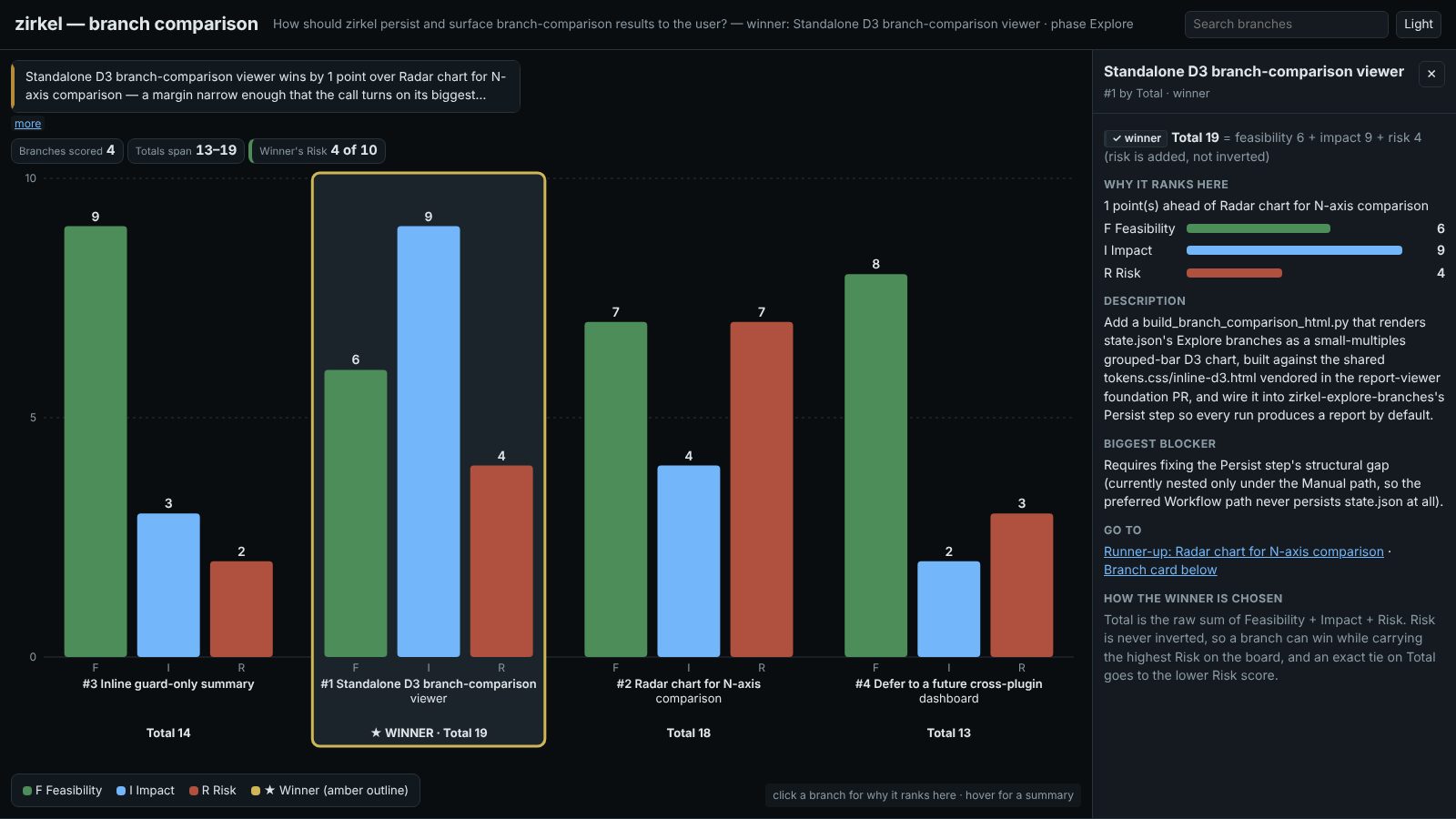
That image is reproducible rather than a one-off capture — the run it renders is committed at scripts/fixtures/sample_explore_state.json (four branches whose Totals are 14 / 19 / 18 / 13, so the winner takes it by a single point over the runner-up and the report's verdict has to name a blocker rather than a walkover). The builder reads a staged run at <repo>/.zirkel/runs/<run-id>/state.json, which is where the fixture has to be copied first:
RUN=9f2b6b1e-1c2b-4c3a-9c3e-2f6a2d6b7a10
mkdir -p "/tmp/zirkel-demo/.zirkel/runs/$RUN"
cp plugins/zirkel/scripts/fixtures/sample_explore_state.json \
   "/tmp/zirkel-demo/.zirkel/runs/$RUN/state.json"
python3 plugins/zirkel/scripts/build_branch_comparison_html.py /tmp/zirkel-demo \
    --run-id "$RUN" \
    --template plugins/zirkel/assets/branch-comparison-viewer.html \
    --d3 plugins/zirkel/assets/inline-d3.html \
    --tokens plugins/zirkel/assets/tokens.css
# -> /tmp/zirkel-demo/.zirkel/runs/<run-id>/branch-comparison.html
Clarify a fuzzy scope
"add caching to the reporting pipeline — the scope is fuzzy, help me pin it down before anything gets built"Triggers
zirkel-clarify-scope— surfaces ambiguous phrasing and unstated success criteria before any work starts.
Break a problem into stages
"break this into steps — what depends on what"Triggers
zirkel-decompose-chain— splits the problem into a 2-5 stage pipeline with explicit input/output contracts per stage, and derives which stages can run in parallel from the dependency graph.
Score and fix a draft
"score this draft against these criteria and fix what's weak"Triggers
zirkel-draft-revise— rates 1-5 against each criterion, revises only what falls at or below threshold, and reports exactly what changed (capped at 2 revision cycles).
Ground every claim
"don't make this up — ground every claim in the actual code or docs"Triggers
zirkel-ground-evidence— requires a file:line, URL, or explicitly-flagged prior knowledge behind every factual claim, and refuses to assert anything unverified.
Investigate step by step
"I don't know where the problem is — go find it"Triggers
zirkel-investigate-dynamically— runs a Reasoning/Action/Observation loop where each observation decides the next step, for cases where the sequence of actions can't be planned upfront.
Trace a multi-hop chain
"trace how A affects D through the whole dependency chain"Triggers
zirkel-map-relationships— extracts indexed relationship triples and traverses them hop by hop, citing the triple index at every hop.
Combine the best of two approaches
"the winner's good, but can we fold in what I liked from the runner-up?"Triggers
zirkel-negotiate-tradeoffs— synthesizes a hybrid from 2-3 already-scored branches, but only presents it if it actually beats every source branch on at least one axis.
Tune a reusable prompt
"find the best wording for this system prompt — I have test cases"Triggers
zirkel-optimize-instruction— generates one candidate per APE framing, scores each against your real test cases, and critiques the winner. Needs representative test cases; not for one-off prompts.
Guard against a silent reasoning error
"walk through this calculation carefully, I can't afford a wrong assumption here"Triggers
zirkel-reason-verify— climbs a 4-rung ladder (zero-shot → Chain-of-Thought → self-consistency → PAL) matched to the actual failure-mode risk, applying Multimodal-CoT first if there's an image or diagram involved.
Anchor a fuzzy output format
"I can't describe the format, but here's an example — make it look like this"Triggers
zirkel-calibrate-format— anchors the target shape to 2-5 concrete input/output examples instead of more prose, enforcing at least one near-boundary example so the set actually pins the decision.
Write up a finished run
"summarize what we just did for the PR"Triggers
zirkel-summarize-trace— produces a fixed 7-section record (asked, assumed, weighed, run, produced, revised, not done) after azirkel-solvepipeline finishes.
Check one blocking assumption
"before we rely on this, verify it's actually true"Triggers
zirkel-verify-assumptions— checks exactly one named assumption against real evidence in at most 3 steps; for more than one uncertainty, invoke it once per uncertainty.
zirkel-solve composes the rest of the pipeline automatically — you rarely need to name one of the other 13 technique skills directly unless you want just that one step (see the full table below).
Components
Skills (14)
| Skill | Use it when |
|---|---|
zirkel-solve | A task is complex AND ambiguous AND needs staged work — runs the whole pipeline. |
zirkel-clarify-scope | Phrasing is ambiguous, success criteria unstated, scope underspecified. |
zirkel-explore-branches | Multiple viable approaches; anchoring on the first is a risk. |
zirkel-decompose-chain | A problem must become a 2-5 stage pipeline with per-stage contracts. |
zirkel-draft-revise | A draft needs scoring 1-5 against criteria and selective revision. |
zirkel-ground-evidence | Claims must trace to a source; unsupported ones must be refused. |
zirkel-investigate-dynamically | The next action depends on the last result (ReAct loop). |
zirkel-map-relationships | The answer needs multi-hop traversal through indexed triples. |
zirkel-negotiate-tradeoffs | After Explore, synthesize a hybrid of 2-3 branches. |
zirkel-optimize-instruction | Tune the exact wording of a reusable prompt with real test cases (APE). |
zirkel-reason-verify | A concrete failure-mode signal calls for CoT / self-consistency / PAL. |
zirkel-calibrate-format | An output shape is easier to anchor with 2-5 examples than prose. |
zirkel-summarize-trace | Capture a finished zirkel-solve run as a fixed 7-section record. |
zirkel-verify-assumptions | Check exactly one named assumption in ≤3 steps. |
Agents (3)
- branch-proposer — proposes one branch under an assigned angle, or scores one branch in isolation (used by
zirkel-explore-branches). - instruction-candidate — drafts / scores / critiques one APE candidate (used by
zirkel-optimize-instruction). - reasoning-path — one isolated reasoning attempt under one strategy (used by
zirkel-reason-verify's self-consistency tier).
What is enforced, and what is not
zirkel registers no PreToolUse hook — nothing here is a denial at the tool-call layer. Instead, every skill invokes a guard at each decision point, and the guard's non-zero exit is what makes a rule observable rather than aspirational.
Enforcement layer
scripts/zirkel_lib.py— the guard library: all numeric bounds as named constants, all rules as functions that raiseGuardError.scripts/zirkel.py— the CLI every skill invokes (python3 ${CLAUDE_PLUGIN_ROOT}/scripts/zirkel.py <check> -). Exit 0 = pass, exit 2 = rule violated, exit 3 = usage error.scripts/test_zirkel.py— 53 assertions proving each guard both accepts valid input and refuses invalid input. Run:python3 scripts/test_zirkel.py.workflows/*.js— parallel orchestration for the fan-out skills (solve,explore-branches,reason-verify,optimize-instruction), each embedding the same bounds as JS constants withthrowguards.
How enforcement works
Skills call the guard CLI at each decision point. For example, zirkel-decompose-chain does not merely tell the model to keep 2-5 acyclic stages — it runs:
echo '{"stages":[...]}' | python3 -B "${CLAUDE_PLUGIN_ROOT}/scripts/zirkel.py" decompose -which validates stage count, entry point, dangling references, and cycles (via Kahn's algorithm), returns the topological waves, and exits non-zero if the graph is invalid. The model must fix the plan before proceeding — the rule is mechanically enforced.
Rules enforced in code (non-exhaustive):
- Clarify: confidence < 70 → flagged; known fact < 90 → ⚠️; blocking uncertainty →
must_pause. - Decompose: 2 ≤ stages ≤ 5; ≥1 entry point; no dangling deps; acyclic.
- Explore: default 3 branches; cap = min(6, config); Total = raw sum (Risk not inverted); highest-total wins, ties → lower risk.
- Draft-revise: 1-5 scale; default threshold 3; revise only ≤ threshold; changes list required; ≤ 2 cycles.
- Reason-verify: rung gates; Rung 2a = exactly 3 strategies; multimodal-CoT precedence.
- Verify-assumptions: ≤ 3 steps; one assumption per invocation; confidence gate 90.
- Ground-evidence: inline citation per claim; exact RAG refusal template.
- Map: ≤ ~50 triples; every hop cites a real triple index.
- Optimize: exactly 5 framings; tie-break by framing precedence.
- Negotiate: precondition winner-selected; hybrid must outperform every source on ≥1 axis.
- Summarize-trace: exactly 7 sections; omit "Approaches weighed" iff no Explore; "What was revised" always present; every dag stage listed.
- Solve: phase order; blocking pause; topological waves; runtime mode dispatch.
- Write scope: path traversal, absolute paths, and out-of-dir targets rejected before any write.
Settings
.claude/zirkel.local.md — copy it into your project and set max_branch_count in its frontmatter to lower the Explore ceiling. The effective cap is always min(6, max_branch_count).
The report
Every zirkel-explore-branches run can persist a self-contained HTML report comparing branch scores — see the screenshot and build command under Explore before committing in Example Prompts above.
Design decisions
(spec was silent here)
Where the spec was silent, these choices were made and are noted here:
- Enforcement lives in a Python guard CLI (
scripts/zirkel.py) plus JS workflow guards. Python is invokable directly via Bash from any skill without the Workflow tool, so the guarantees hold even when workflows aren't available. The four fan-out skills also shipworkflows/*.jsthat re-encode the same constants — belt and suspenders. - Risk is never inverted, anywhere. The spec mandates Total = F + I + R with Risk not inverted, and highest total wins. For internal consistency, zirkel treats "outperform on an axis" (in
zirkel-negotiate-tradeoffs) as a strictly higher number on that axis for all three axes, Risk included. This is the only convention that keeps selection and hybrid-comparison coherent. - Persisted state lives under
.zirkel/(git-ignored). The state artifact's gating fields (run_id,raw_task,phase,explore_ran) are mandatory and validated on both read and write; a record missing one is rejected, never defaulted or repaired. Writes go only throughstate-write, which enforces write scope before touching disk. blockingis a required first-class field on every uncertainty, not inferred from confidence. Confidence < 70 forces flagging;blocking: trueforces the pipeline pause. They are independent gates, so both are explicit.- Six proposer angles (conservative, ambitious, pragmatic, contrarian, minimal, maximal) back the branch cap of 6, so a maxed-out Explore still has a distinct angle per branch.
- Second revision cycle is the hard ceiling (
DRAFT_MAX_REVISION_CYCLES = 2): the first pass plus one escalation. If criteria still fail after two cycles, the skill reports the residual rather than looping. - Execution mode is a first-class key (
mode+mode_decided_at: "runtime"), validated bystage-dispatch, so "decide the mode at runtime" is checkable rather than aspirational.
Verifying a change to this plugin
python3 plugins/nacharbeit/scripts/nacharbeit_lint.py plugins/zirkel --docs-root docs
python3 plugins/zirkel/scripts/test_zirkel.py                     # -> "53 passed, 0 failed"
python3 plugins/zirkel/scripts/test_build_branch_comparison_html.py
bash scripts/ci/check-js-syntax.sh                                  # workflows/*.js shape
License
MIT