
takt
Refuses an edit or dispatch that runs ahead of a step the repository said must come first.
The name. Takt is the beat: in music the measure that paces a piece, and on a line the Taktzeit that paces production — the interval every station is built around, so a station cannot run ahead of the one feeding it. This plugin is the shop-floor half. It holds no opinion about what the work is, only about what may not begin yet.
- Use when one step must precede another (the design council before UI code) and a sentence in a SKILL.md has not been enough to make it happen.
- Not when you want the beats authored for you — use
arbeitsplan, which compiles them and leaves takt to enforce — or want a handoff proven rather than ordered — useandon.
Use case
Situation. The repo declares that UI code comes after cupertino-council. Claude goes to edit a component before the council has run. Call. The ui-before-council beat from "Declaring beats" in .claude/takt.local.md, and the call it denies: Edit src/ui/Button.tsx. Writes. Nothing. takt only reads and refuses; you write the declaration, and whatever performs the beat creates .takt/council-done. Next. Run the beat, create its marker, retry the edit. If the order genuinely does not apply, TAKT_DISABLE_GUARD=1 bypasses the guard.
takt: 'src/ui/Button.tsx' runs ahead of beat 'ui-before-council'. cupertino-council runs
before UI code, never after. Required marker '.takt/council-done' does not exist. ...
stderr of plugins/takt/hooks/takt_guard.py (exit code 2), run on the README's own ui-before-council declaration below; wrapped here and the escape-hatch tail elided.
Why this exists
Several skills in this marketplace already declare where in a build they belong. cupertino-council says to use it "at UI/frontend build-time, before writing any code ... Always run before code, never after — retrofitting the council onto finished code defeats the purpose." cupertino-backwards says "Use FIRST." zirkel-clarify-scope scopes a task "before any work begins."
Nothing enforces any of it. A declaration written as prose is a sentence a model may skip under load, and this repository has measured what that costs: a rule stated as prose in a SKILL.md is the baseline, a guard behind a fenced python3 block is invoked about one run in three, and a PreToolUse hook of type: "command" blocks on the first attempt. takt is the difference between a documented beat order and an enforced one.
It owns no skills and no agents. It is one hook and a declaration format, because the beats it enforces span plugins — a council from one, an audit from another, a proof from a third — and no single plugin honestly owns that order.
What it is not
takt is not a planner. It enforces an order somebody else decided; it never decides one, and it ships no skills and no agents on purpose — the beats it enforces span plugins, so no single plugin honestly owns that order.
arbeitsplancompiles a problem into a workflow and writes the beat declaration takt then enforces. If you want the beats authored for you, that is the plugin; takt is the runtime underneath it.zirkelreasons about what to do. takt has no opinion about whether an order is wise, only about whether it was followed.andonproves a wire is actually proven. takt only asks whether a marker exists — it never inspects what the marker claims.nacharbeit,lehre,cupertinoeach gate their own domain's rules. takt gates the order between them, which is the only thing none of them can see.
takt also never writes a file, including the markers themselves. Whatever performs a beat creates its marker; takt reads and refuses, nothing else.
Install
/plugin marketplace add Anselmoo/werkstoff
/plugin install takt@werkstoff
takt is inert until a repository declares its beats, so installing it changes nothing until .claude/takt.local.md exists.
Declaring beats
Create .claude/takt.local.md with one fenced json block:
```json
{
  "beats": [
    {
      "id": "ui-before-council",
      "tools": ["Write", "Edit", "MultiEdit"],
      "paths": ["*.tsx", "*.jsx", "*.vue", "*.svelte", "src/ui/*"],
      "require": ".takt/council-done",
      "reason": "cupertino-council runs before UI code, never after."
    }
  ]
}
```| Field | Meaning |
|---|---|
id | Name reported in the denial |
tools | Tool names the beat applies to; defaults to Write, Edit, MultiEdit |
paths | fnmatch globs matched against the edited file, for the edit tools |
skills | fnmatch globs matched against the dispatched name, for Skill/Task/Agent |
require | Marker path that must exist before the call is allowed |
reason | Sentence included in the denial, explaining the order |
Whatever performs the beat creates the marker — mkdir -p .takt && touch .takt/council-done. takt never writes files; it only reads and refuses.
runId — for a declaration that describes one run
A marker is an existence check, so by default it is permanent: once .takt/council-done exists it satisfies its beat forever. That is right for a durable project fact ("the design council has run for this UI"), and wrong for a declaration that describes a single run — a marker left by last week's run would satisfy today's beat, and the gate would pass without the step ever happening.
An optional top-level runId namespaces every relative marker under .takt/<runId>/:
```json
{
  "runId": "ap-2026-09-12-a3f1",
  "beats": [
    {
      "id": "land-after-referee",
      "tools": ["Skill", "Task", "Agent"],
      "skills": ["arbeitsplan-run"],
      "require": "refereed",
      "reason": "candidates are refereed before one is landed."
    }
  ]
}
```- Omit it and nothing changes. A declaration with no
runIdresolves markers exactly as before; this is the case every existing declaration is in, andhooks/test_takt_guard.pypins it under the nameBACKWARD. - A new
runIdinvalidates every earlier run's markers at once, because they live in a different directory. Staleness stops being a thing to remember. runIdbecomes a path component, so it must match[A-Za-z0-9._-]{1,64}and contain no... Anything else denies rather than being sanitised — sanitising a path invites a bypass.- An absolute
requireis always taken literally,runIdor not. An explicit path is an explicit path.
Generated declarations are the reason this exists: arbeitsplan compiles beats from a workflow spec, and a generator that reused one run's markers in the next run would produce a file that looks enforced and enforces nothing.
when — a beat scoped to one state of the repository
A beat matches a dispatch by name, and a name is not a step. When four stacked arbeitsplan waves all dispatch arbeitsplan:candidate-builder, the beat for wave 2 also matches wave 1's builders and denies them, waiting on a marker that cannot exist yet. An optional when limits a beat to the time a JSON file holds given values:
"when": {"path": "analysis/arbeitsplan/run_scope.json",
         "equals": {"runId": "ap-2026-09-22-6cb2", "phase": "build-w2"}}
Omit it and nothing changes. A beat without
whenapplies exactly as before.pathabsent means the state does not hold, so the beat does not apply. This is the same reading as a missing.claude/takt.local.md. For arbeitsplan it means no phase is in flight, so there is nothing to order.Everything else fails closed, and each of these denies:
- a
whenthat is not{path, equals} - an absolute path or one containing
.. - an empty
equals - a
paththat exists but does not hold a JSON object
scripts/validate_beats.pyflags the malformed shapes before the declaration goes live.- a
emit_beats.py scopes every arbeitsplan phase beat this way, to the per-phase lock worktree_pool.py open writes. Delegate beats stay unscoped: their job is to gate the start of the run.
A single call can touch several files: a MultiEdit may carry its paths in an edits array rather than one top-level file_path. Every path a payload exposes is collected, and a beat is violated if any of them is gated.
Matching is fnmatch, never regex. Every silent-failure regex form this repository has been burned by is a regex-only failure mode that a glob cannot express.
Example Prompts
Say any of these to Claude Code once the plugin is installed — they're plain-language prompts, not exact phrasing Claude has to match. Claude routes them to the skill below by intent.
Declare the beats for a repository
"set up takt so UI code can't be written before the design council has run"Writes a
.claude/takt.local.mdbeat with the UI globs and arequiremarker, after which the hook refuses a matching edit until that marker exists.
Understand a refusal
"takt just blocked my edit — what beat am I running ahead of?"The denial names the beat id, the reason, and the missing marker; the escape hatch is
TAKT_DISABLE_GUARD=1when the order genuinely does not apply.
Hooks
One PreToolUse hook, type: "command", matching Skill|Task|Agent|Write|Edit|MultiEdit. Never type: "prompt" — a prompt hook asks a model to decide, which is the model-mediated path this plugin exists to replace.
- Inert when
.claude/takt.local.mdis absent: the call is allowed before it is even inspected. - Fail-closed once that file exists: any internal error denies rather than silently allowing, naming the escape hatch. So does an indeterminate payload — if a beat gates the call but no file path (or, for a dispatch, no skill or agent name) can be determined from it, takt refuses. A call that cannot be checked against a gate the repository opted into is precisely the bypass this plugin exists to prevent.
- Escape hatch:
TAKT_DISABLE_GUARD=1, or remove the declaration file.
The beat graph
takt enforces an order it never authors, and until now the only way to learn what it was blocking was to trip over a denial. assets/beatgraph-viewer.html renders that order: every declared beat, whether its marker exists yet, and which plugin produces it.
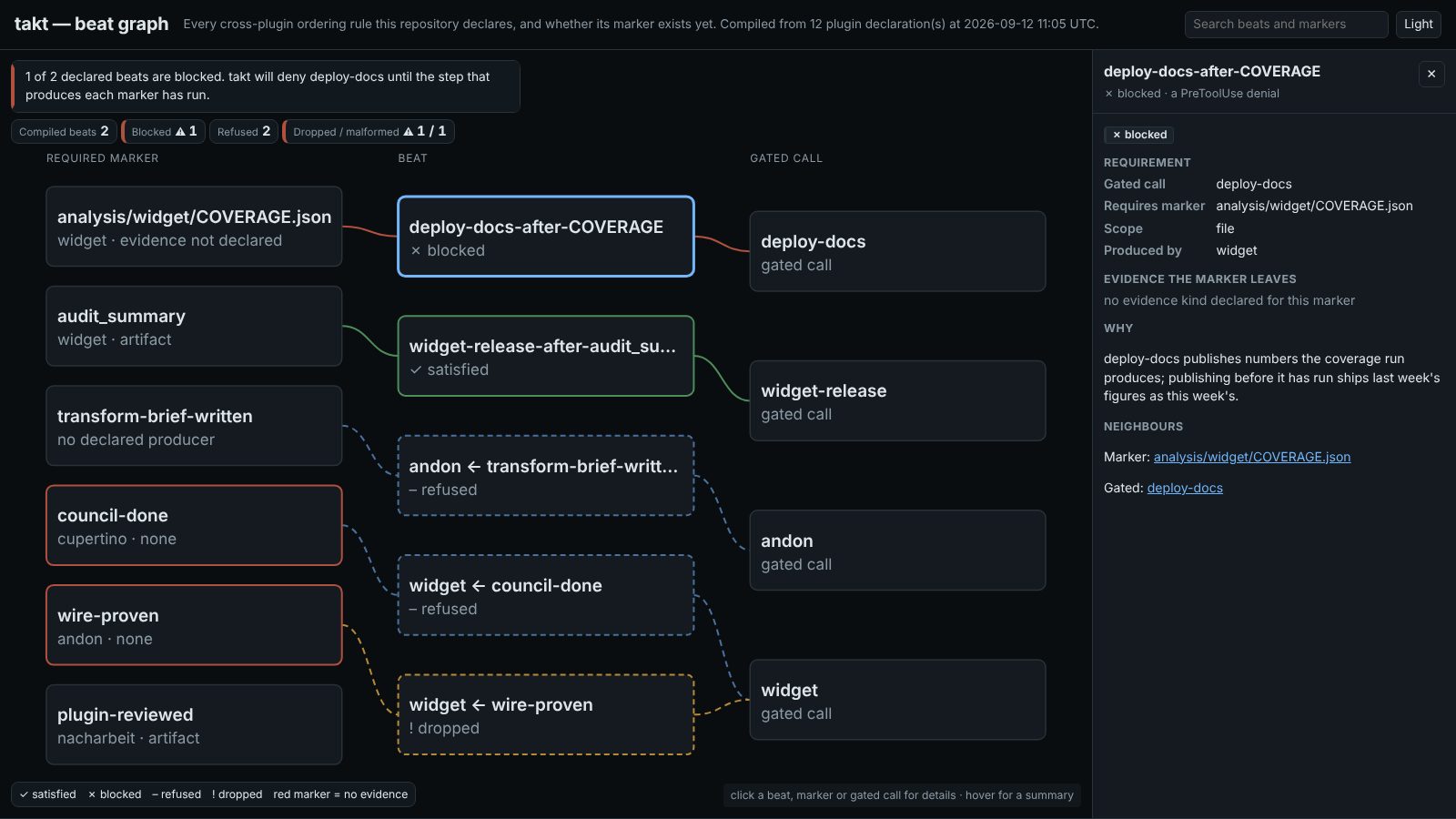
python3 plugins/takt/scripts/build_beatgraph_html.py --repo . --out /tmp/beatgraph.htmlThe screenshot above is rendered from committed demo data at scripts/fixtures/beatgraph-demo.json, so it is reproducible rather than a picture of one machine on one day. That fixture is synthetic and says so, and deliberately carries every state the page can render: a blocked beat, a satisfied one, two refusals, and both evidence kinds. A demo missing a state cannot show what that state looks like.
It is synthetic because this repository's own live graph currently compiles zero beats — every cross-plugin ordering rule here is either already enforced in code or has a producer that leaves no evidence. build_beatgraph_html.py --repo . renders that real state, and the page says plainly that no beats is a result, not an omission.
The beat list is the compiler's, imported from arbeitsplan/scripts/emit_beats.py rather than re-derived — the selftest asserts the two counts match. A page and a compiler that disagree about what is enforced is a page that lies, and this repo has already been burned once by a validator that drifted from the guard it validated.
State is carried by the word and the glyph; colour is a third channel on top of two that already work without it.
Testing
python3 plugins/takt/hooks/test_takt_guard.py          # denies AND allows; BACKWARD + STALE
python3 plugins/takt/scripts/validate_beats.py --selftest
python3 test/plugins/verify-hooks-deny.py plugins/takt
python3 test/plugins/verify-takt-payload-shapes.py
test_takt_guard.py is sabotage-tested, and the sabotage is worth running rather than trusting: make marker_path_for ignore run_id and the STALE cases must go red while every BACKWARD case stays green. An earlier draft of those cases stayed green under that sabotage — they were passing for the wrong reason, because a bare require resolved to a path nothing had created. Planting the stale marker at every location an earlier run could have left one is what makes them real.
validate_beats.py reports what the guard tolerates. The guard silently skips a beat that gates nothing, which is correct at runtime — refusing every other beat because one is malformed would be worse — and dangerous at authoring time, especially now that declarations can be generated.
The fixture at test/plugins/fixtures/hook-violation-takt/ is plugin-specific because takt is scope-conditional: probed with the generic fixture the hook correctly allows, which the harness would otherwise report as a hook that does nothing.
Related
For which beats are worth declaring, and where each plugin belongs in a build, see docs/orchestration/README.md and docs/orchestration/references/claude-md-block.md.