
befund
Makes a codebase describe its own health, with every finding tied to file:line evidence, and edits source only behind an authorization recorded on disk.
The name. A Befund is the written finding of an inspection — what was measured, where, and what it showed. It records a condition; it does not pass or reject the part. That distinction is this plugin's whole shape: it reports, with file:line evidence, and the go/no-go gauge that actually rejects work is lehre. A Befund nobody acts on is still a Befund, which is why every transformation here waits on a recorded authorization.
- Use when you inherit or distrust a repo and need its real structure, docs drift, idioms or business rules, each with a
file:linecitation, before anyone changes it. - Not when you want new code gated against a codified doctrine — use
lehre; or you want a set of approved fixes applied and each one proven as it lands — useandon.
Use case
Situation. A billing service was inherited from a team that has left. The fee and discount rules live only in the code and nobody trusts the wiki. You want them written down as testable rules before anyone refactors. Call. /befund:befund-extract-rules (or: "document the domain rules hidden in this code") Writes. BUSINESS_RULES.md, DATA_OBJECTS.md, business_rules_summary.json and business_rules.json under analysis/befund/ (the output_dir setting). Next. Turn each confirmed rule into a test. Fix the citation of each unconfirmed rule and re-run its judge step, or drop it; do not rely on it as written.
## Confirmed rules (2)

...
### RULE-003: Overdraft fee waiver on payroll accounts
**Priority:** P0
**Confidence:** High
**Citation:** `src/billing/overdraft.py:58`
**Specification:**
  Given an account flagged is_payroll = true with a negative balance
  When  the nightly overdraft-fee batch runs
  Then  no overdraft fee is charged (payroll accounts are fee-exempt by statute)
**Status:** confirmed
  Judge verdict pass (befund-p0-rule@1, score 0.85, uncalibrated): the judge
  re-read src/billing/overdraft.py:58 and verified the is_payroll exemption.
Excerpt from the rendered sample in plugins/befund/skills/befund-extract-rules/references/business-rules-report-sample.md.
Why this exists
A codebase self-assessment is only useful if its findings are trustworthy — a report that hallucinates a stale doc claim or an architecture violation costs more time to fact-check than it saves. befund ties every finding to file:line evidence read from the actual repository, keeps its CHECK phase strictly read-only, and gates the one place it can touch source (the FIX phase) behind explicit human authorization recorded on disk, not just a remembered "yes" earlier in the conversation.
What it is not
- Not a post-hoc design-handbook conformance checker or fixer.
befund-idiom-fixexplicitly excludes findings from acupertino-handbook-checkpass — that'scupertino-handbook-fix— andbefund-lint-auditexcludes auditing work against a domain handbook under.cupertino/— that'scupertino:cupertino-handbook-check. - Not an architecture/style-convention codifier.
befund-extract-rulesmines what the code decides — calculations, validations, state transitions — not how it is written; code style, naming, layering and dependency-direction conventions arelehre-codify's job. - Not a UI designer.
befund-ui-auditstatically audits existing markup for accessibility and design-token problems; designing an interface that does not exist yet iscupertino-councilat build time, and the end-to-end design pipeline that surface belongs to iscupertino-review. - Not a general fix-application or per-fix verification loop.
befund-transform-executeapplies exactly one human-authorized phase named inMODERNIZATION_BRIEF.mdand refuses without a numbered phase; applying a set of approved fixes across a repo and proving each one as it lands isandon-loop. - Not a remediator for other plugins' findings.
idiom-remediatoronly ever touches befund's own code-idiom findings — neverlehre's rule-card conformance findings (lehre's ownconformance-remediator) or cupertino handbook findings (cupertino's ownhandbook-remediator).
Install
/plugin marketplace add Anselmoo/werkstoff
/plugin install befund@werkstoff
The hook is inert until a befund remediator dispatch opens an edit-scope lock (befund-idiom-fix or befund-transform-execute running with idiom_fix.mode: fix / transform.mode: execute), so installing it changes nothing until one of those runs.
Local development
Point Claude Code at a checkout without registering the marketplace:
claude --plugin-dir /path/to/werkstoff/plugins/befundExample Prompts
Say any of these to Claude Code once the plugin is installed — they're plain-language prompts, not exact phrasing Claude has to match. Claude routes them to the skill below by intent.
Map the architecture
"map this repo's architecture"Triggers
befund-stage-map— import-graph-based stage/wire detection, not naive directory guessing.
Alongside the JSON stage graph, this skill renders a self-contained HTML viewer (build_stage_map_html.py) that lays the real dependency graph out as a live d3-force physics simulation on canvas: nodes cluster by actual connectivity instead of directory structure, so a tight interconnected core reads as a visible cluster. The map fills the first screen; clicking a stage (or arrowing to it and pressing Enter) opens its files, wires, neighbours and findings in a drawer beside it, and the findings and the stage table follow below.
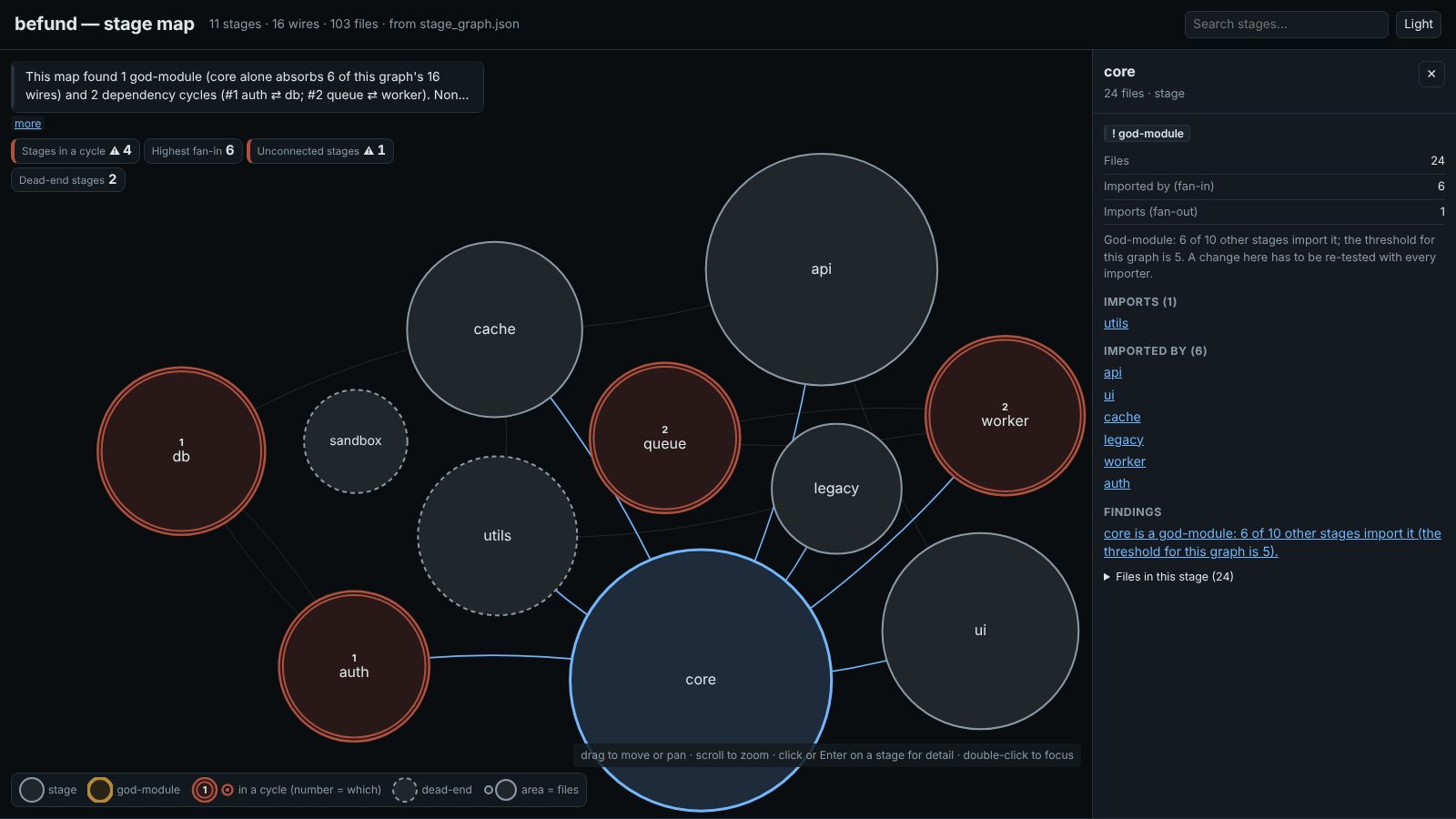
That picture is reproducible. The two inputs are committed beside the builder -- scripts/fixtures/sample_stage_graph.json (11 stages, 16 wires) and scripts/fixtures/sample_file_stage_index.json (the partial {file: stage} lookup) -- and they are deliberately a failing repository, not a clean one: one god-module (core, fan-in 6, over this graph's threshold of 5), two real mutual-dependency cycles (auth ⇄ db, queue ⇄ worker), one dead-end that imports nothing outward (utils), and one stage wired to nothing at all (sandbox). The graph passes befund_cli.py validate-artifact --kind stage_graph unmodified.
python3 -B "${CLAUDE_PLUGIN_ROOT}/scripts/build_stage_map_html.py" \
    --stage-graph "${CLAUDE_PLUGIN_ROOT}/scripts/fixtures/sample_stage_graph.json" \
    --file-stage-index "${CLAUDE_PLUGIN_ROOT}/scripts/fixtures/sample_file_stage_index.json" \
    --template "${CLAUDE_PLUGIN_ROOT}/assets/stage-map-viewer.html" \
    --d3 "${CLAUDE_PLUGIN_ROOT}/assets/inline-d3.html" \
    --tokens "${CLAUDE_PLUGIN_ROOT}/assets/tokens.css" \
    --out ./STAGE_MAP.html
scripts/test_build_stage_map_html.py re-derives those four findings from lib.graph's own find_cycles/find_god_modules on every run, so the fixture cannot quietly become a clean, prettier, useless one.
Run the auto-pilot
"run the auto-pilot"Triggers
befund-autopilot— full check → plan → gate → fix/validate, gated behind explicit settings before anything is written.
Check status
"where does befund stand"Triggers
befund-status— read-only board of what's been run and what's stale.
Sweep a portfolio
"sweep our whole portfolio of repos"Triggers
befund-portfolio— multi-repo dashboard, graded worst-signal-wins.
Check readiness first
"can befund actually analyze this codebase?"Triggers
befund-preflight— verifies language detection, tool availability, house-rules presence, and git/CI presence, then assigns a Ready/Ready-with-gaps/ Not-ready verdict per downstream skill.
Find architecture problems
"find god-modules or dependency cycles in this codebase"Triggers
befund-arch-health— reads the stage graph frombefund-stage-mapand confirms every candidate god-module or cycle against actual code, not just the graph.
Audit git/CI setup
"check our git remotes and CI setup for redundant mirrors"Triggers
befund-ci-topology— audits remote topology and CI config for redundancy and mirror risk, masking every credential to a short preview.
Find modernization opportunities
"find deprecated idioms and code smells in this repo"Triggers
befund-code-idiom— judges idioms against the actual language version declared in the repo's own manifest, never a fixed list, and separates fixable modernization from judgment-requiring smells.
Score complexity per module
"which module needs attention first? score complexity per stage"Triggers
befund-complexity-score— computes a relative complexity index (2.94 × KSLOC^1.10) per stage, and lists unmeasured stages plainly rather than inventing numbers.
Check documentation accuracy
"does our README still match what the code actually does?"Triggers
befund-docs-drift— extracts falsifiable claims from CLAUDE.md/README/ADRs and verifies each one against the cited code.
Mine the hidden business rules
"document the domain rules hidden in this code as testable specs"Triggers
befund-extract-rules— mines calculations, validations, and state transitions into Given/When/Then rules, looping to convergence and requiring a scored judge verdict to pass for any P0 rule.
Apply the modernization findings
"apply the modernization findings befund-code-idiom found"Triggers
befund-idiom-fix— applies only eligible modernization-category findings, gated behindidiom_fix.mode: fix, one remediator dispatch per (file, kind) cluster, then hands off toandon-verifyunverified.
Check our own conventions
"audit this code against our house rules"Triggers
befund-lint-audit— extracts discrete rules from.claude/house-rules.md(or CLAUDE.md as a fallback) and verifies violations, capped atlint_max_rulesdispatches.
Turn findings into a plan
"synthesize all the findings into a modernization brief"Triggers
befund-transform-brief— synthesizes stage-map, arch-health, and every other domain summary into a phased, ranked, read-only transformation plan.
Execute one authorized phase
"execute phase 3 from the modernization brief"Triggers
befund-transform-execute— applies exactly one human-authorized phase, gated behindtransform.mode: execute, a clean tree, and every Open Question resolved.
Audit UI accessibility
"check our components for accessibility issues and hardcoded design values"Triggers
befund-ui-audit— statically audits JSX/TSX, Vue/Svelte, HTML, and CSS/SCSS for accessibility and design-token problems, never running or rendering the app.
Set transform.mode: execute and list authorized phase numbers, or idiom_fix.mode: fix, in .claude/befund.local.md only when ready to apply a change — both default to a plan/propose-only mode that refuses to touch source.
Components
befund/
├── .claude-plugin/plugin.json
├── scripts/
│   ├── befund_cli.py     # single entry point, one subcommand per enforced rule
│   └── lib/                   # the actual logic: settings, gates, validators, formulas, graph...
├── skills/befund-*/SKILL.md   # 16 skills, one per spec entry
└── agents/*.md                     # 11 agents, one per spec entry
Skills (16)
befund-preflight, befund-stage-map, befund-docs-drift, befund-ci-topology, befund-lint-audit, befund-code-idiom, befund-extract-rules, befund-arch-health, befund-complexity-score, befund-ui-audit, befund-transform-brief, befund-transform-execute, befund-idiom-fix, befund-status, befund-portfolio, befund-autopilot.
Agents (11)
stage-mapper, arch-health-auditor, ci-topology-auditor, docs-drift-auditor, convention-auditor, idiom-auditor, business-rules-miner, complexity-surveyor, ui-auditor, idiom-remediator (write-capable), transform-executor (write-capable).
Every other agent is strictly read-only (Read, Glob, Grep, Bash for inspection only).
What is enforced, and what is not
Hooks
hooks/guard_target_edit.py (PreToolUse, matcher Write|Edit|MultiEdit) denies an edit into target-repo source unless a befund remediator dispatch has an edit-scope lock open — analysis/befund/edit_scope.json, written by befund_cli.py open-edit-scope immediately before befund-idiom-fix or befund-transform-execute dispatches idiom-remediator / transform-executor. While a scope is open it enforces, regardless of whether the dispatching skill cooperates with its own instructions:
idiom_fix.mode/transform.mode— the write is refused unless the matching mode is setrequire_clean_tree— the write is refused against a dirty tree unless disabled- the locked file list — a write outside the files the open scope named is refused
befund writing its own reports (inside output_dir, default analysis/befund) is never gated, scope lock or not. Once a scope is open, a resolved edit target is also checked for containment inside cwd before it is compared against own_output_dir or the lock's allowedFiles — this hook only ever gates writes into the target repository's own source, so a target outside the target repository entirely (/tmp, $HOME, an unrelated sibling repo) is allowed rather than swept into remediator-scope-enforcement as though it were in-repo source (issue #39); a target inside the repository but not named in the open lock is still denied. It fails closed once a scope is open — any unexpected exception denies rather than allows — with one exception: a missing or broken scripts/lib/ package (ModuleNotFoundError at import time) degrades to a stderr warning and an allow, since a packaging defect is not evidence the edit violates a rule, and blocking every future edit in every repo would be strictly worse than one missed check. Set BEFUND_DISABLE_GUARD=1 to bypass the hook for one call — see "Escape hatch" below.
How enforcement actually works (mapping rules to code)
| Rule (spec id) | Enforced by |
|---|---|
skill-reads-own-settings-before-running | settings.require_enabled() — check-enabled subcommand |
lint-max-rules-cap | lint_cap.cap_rules() — hard DEFAULT_MAX_RULES = 12, always returns a skipped list |
complexity-score-formula | formulas.complexity_index() — 2.94 × KSLOC^1.10, and validators.validate_complexity_score_summary recomputes it and rejects a mismatch |
language-detection-threshold | language_detect.detect_languages() — MIN_FILES_FOR_DETECTION = 3 |
cycle-definition-in-graph | graph.find_cycles() — Tarjan SCC, MIN_CYCLE_SIZE = 2 |
p0-rule-panel-confirmation | p0_panel.confirm_p0_rule() hands one judge report to judge_contract.decide (rubric befund-p0-rule@1), and validators.validate_business_rules_summary refuses any P0 rule whose p0_verdict is not a well-formed pass about that rule. The spec id predates the collapse of the two-judge panel into one judge; panel_confirmed is no longer honoured |
extract-rules-loop-convergence | rules_loop.RuleLoopController — hard MAX_ROUNDS_HARD_CAP = 4, 2 consecutive dry rounds to converge |
stage-graph-vs-stage-map-json | validators.validate_stage_graph rejects the artifact unless edgeCount == len(wires) |
file-stage-index-partial-coverage | attribution.attribute() returns "Unattributed" on any miss, never an error |
skip-verification-behavior | skip_verification.label_findings() — refuses a finding missing verified when skip_verification is false |
credential-masking-in-output | credentials.mask_url() / mask_text(); validators.validate_ci_topology_summary refuses any finding carrying raw_remote_url |
docs-drift-not-ci-specific | scope.exclude_ci_claims() |
idiom-fix-modernization-only | gates.filter_eligible_idiom_findings() |
transform-brief-gate-on-stage-graph | skill-level file-existence check, degrades to a short brief |
transform-brief-attributes-findings-via-lookup | attribution.attribute() |
transform-brief-work-item-ranking | formulas.work_item_rank() — fixed SEVERITY_WEIGHT map |
transform-brief-zeugnis-routing | transform_routing.route_zeugnis_finding() |
transform-execute-gate-transform-mode | gates.check_transform_mode() / check_phase_authorized() |
transform-execute-open-question-resolution | gates.check_open_questions_resolved() |
portfolio-grade-worst-signal-wins | portfolio.grade_repo() — Gray branch checked first, unconditionally |
portfolio-cwd-git-repo-check | gates.check_portfolio_scope() |
read-only-skills-no-mutation | tool restrictions in each SKILL.md / agent frontmatter (Read, Glob, Grep, Bash only) |
dirty-tree-gate | gates.check_dirty_tree() |
no-commit-or-push | no code path in any skill or agent invokes git commit/git push |
ui-audit-static-only | validators.validate_ui_audit_summary refuses a contrast finding without heuristic: true |
autopilot-gate-before-fix | gates.check_autopilot_fix_approved() |
status-no-fabrication | status.build_present_artifacts() — only includes a key when its sidecar file exists on disk |
| write-scope enforcement | write_guard.resolve_output_path() — rejects traversal, absolute paths, and any escape of output_dir before any write |
idiom_fix.mode / transform.mode / dirty-tree / edit-scope (regardless of skill cooperation) | hooks/guard_target_edit.py PreToolUse hook — see Hooks above |
Settings
All settings live in YAML frontmatter in .claude/befund.local.md, read fresh by every skill invocation via befund_cli.py get-settings. Absence of the file is a fully valid, fully-defaulted configuration — nothing is required to exist.
---
enabled: true                 # global off-switch; per-skill overrides supported (see below)
output_dir: analysis/befund  # every artifact this plugin writes lands here
skip_verification: false      # true = label findings unverified instead of adversarially refuting
lint_max_rules: 12            # cap on befund-lint-audit's finder dispatch
require_clean_tree: true      # dirty-tree gate for the two write-capable skills
transform:
  mode: plan                  # "execute" required to run befund-transform-execute
  authorized_phases: []       # phase numbers explicitly authorized for execution
idiom_fix:
  mode: propose                # "fix" required to run befund-idiom-fix
extract_rules:
  maxRounds: 4                 # hard-capped at 4 in code; this can only lower it, never raise it
autopilot:
  fix_approved: false          # persisted approval gate for autopilot's FIX phase
  approved_phases: []
---
Per-skill overrides: nest a block under the skill's id (e.g. befund-ui-audit:\n enabled: false) to disable just that skill.
The report
See the screenshot and reproducible rebuild command under "Map the architecture" in Example Prompts above — the stage-map viewer is the one HTML report this plugin ships.
Design decisions
(spec was silent here)
The behavioral spec states obligations, not implementation details. Where it left a concrete choice unstated, this is what was chosen and why:
output_dirdefault isanalysis/befund, matching the prior implementation's documented output location.- Settings parser is a small dependency-free YAML subset, not PyYAML. The plugin ships zero third-party Python dependencies;
scripts/lib/frontmatter.pyhandles flat scalars, one level of nested mapping, and simple scalar lists — everything every settings field in this plugin actually needs. It will not parse arbitrary YAML. - God-module fan-in threshold. The spec says "high fan-in/fan-out" with no number. This plugin flags a stage once its fan-in reaches
max(3, 0.5 × other_stage_count)— seeGOD_MODULE_FANIN_RATIO/GOD_MODULE_MIN_FANINinscripts/lib/graph.py.arch-health- auditorstill confirms or refutes every mechanically-flagged candidate against actual code before it becomes a finding, so this threshold only decides what gets a second look, not what gets reported. - Autopilot's "gate before FIX" is a persisted flag, not a remembered conversational yes. The spec says the skill "MUST ask the user to approve" — to make that mechanically checkable rather than trusting the model to recall it asked, approval must be recorded as
autopilot.fix_approved: true(and optionallyautopilot.approved_phases) in.claude/befund.local.mdbeforebefund_cli.py autopilot-fix-gatewill pass. - Zeugnis-installed detection is best-effort. There is no API a plugin script can call to query "is plugin X installed" from inside this session.
befund-autopilotchecks whether azeugnis:-prefixed skill appears in the current session's available-skills listing; if it does not, it reports "zeugnis not installed" and continues. This cannot be made fully mechanical without a host-level plugin registry API. - Portfolio report location.
befund-portfoliois the one skill whose output is not scoped to a single repo'soutput_dir— itsbefund-portfolio.htmllands in the portfolio directory itself, since it summarizes many repos at once. befund-code-idiom's version detection covers Python (pyproject.toml/setup.py), JavaScript/TypeScript (package.jsonengines.node), Go (go.mod), and Java (pom.xml) out of the box (scripts/lib/version_detect.py). A language outside this list getsversion: null, in which case the skill's own instructions require flagging only idioms deprecated across every version the language has shipped, never a version-specific one.- Credential preview length is clamped to 2–4 characters (
scripts/lib/credentials.py), matching the spec's "2-4 character preview" exactly rather than picking one fixed number. - CI-scope claim exclusion (
docs-drift-not-ci-specific) is a fixed set of path/keyword patterns (.github/workflows/,.gitlab-ci.yml,Jenkinsfile,.circleci/config.yml,azure-pipelines.yml, plus "git remote"/"mirror script"/"pipeline config" keywords) rather than a judgment call each run — seescripts/lib/scope.py.
Why this plugin is structured the way it is
Every skill in this plugin is a thin markdown workflow that calls into one shared Python library (scripts/lib/) through a single CLI entry point (scripts/befund_cli.py) for every rule that has to actually refuse something: a disabled skill, a dirty tree, an unauthorized transform phase, a missing gating field in a persisted artifact, a write path that escapes the plugin's output directory, a numeric threshold. The SKILL.md files describe workflow; the CLI enforces rules. A skill that gets a non-zero exit from the CLI is required to stop and surface the message — that is the refusal, not a suggestion the model can talk itself out of.
Verifying a change to this plugin
Static:
python3 test/plugins/lint-frontmatter.py plugins/befund
claude plugin validate plugins/befund --strict
python3 plugins/nacharbeit/scripts/nacharbeit_lint.py plugins/befund --docs-root docs
python3 test/plugins/verify-hooks-deny.py plugins/befund
python3 plugins/befund/hooks/test_guard_target_edit.py   # the hook denies AND allows
python3 plugins/befund/scripts/test_build_stage_map_html.py
python3 plugins/befund/scripts/lib/test_status.py
python3 plugins/befund/scripts/lib/test_staleness.py
Testing performed
Every subcommand above was exercised directly against both the passing and refusing case (clean settings vs. a disabled skill, a valid path vs. path traversal, a 2-cycle graph vs. a non-cycle, a single P0 judge vs. two agreeing judges, 15 extracted lint rules capped to 12, transform.mode: plan refused vs. execute + authorized phase accepted, a dirty non-git directory refused, autopilot.fix_approved defaulting to refused) — all producing the expected exit code and message. See scripts/befund_cli.py --help for the full subcommand list.
Behavioural cases
bash test/plugins/verify-clean-box.sh          # ALWAYS first
bash test/plugins/run.sh new-stage-map
bash test/plugins/run.sh new-ui-audit
Escape hatch
Set idiom_fix.mode: 'fix' or transform.mode: 'execute' (whichever applies) and, if the tree is dirty, require_clean_tree: false, in .claude/befund.local.md. That is the exact text hooks/guard_target_edit.py gives in every denial it emits: "If this edit is not one befund should be gating, set idiom_fix.mode: 'fix' or transform.mode: 'execute' (whichever applies) and, if the tree is dirty, require_clean_tree: false, in .claude/befund.local.md." Both write-capable skills already default to a plan/propose-only mode that refuses to touch source, and this only widens that mode explicitly.
There is also a hard kill switch: set BEFUND_DISABLE_GUARD=1 to bypass guard_target_edit.py for one call. Prefer the settings toggle above when the denial is about mode or a dirty tree — reach for BEFUND_DISABLE_GUARD=1 only when the denial itself is wrong, e.g. a genuinely correct edit tripping the hook's own-repository containment check (issue #39).