
matrize
Derives a design system once from reference exemplars you admire, names every element, and emits it to any target.
The name. A Matrize is the die: in stamping, the form that gives material its shape; in typefounding, the matrix from which every piece of type is cast. One master, many castings — which is exactly what this plugin is for. It measures the references someone actually admires, names what recurs, and cuts a single neutral master from which a DTCG token file, a stylesheet and a sketchbook are struck. A Matrize is itself struck by a Patrize: it is derived from a reference before it becomes the thing others are made from, the same two-step this pipeline runs.
- Use when a project is about to be styled ad hoc and you have references someone actually admires, and you want the decision made once, in writing, with its reasons.
- Not when you want to check whether code still matches a system, or to find which of the repo's own divergent variants should win — use
passung; to design one screen from taste principles before code, usecupertino.
Use case
Situation. You have collected eleven references (a house token file, a competitor app, a print brochure) and need to know what they actually do before anyone picks a red or a card radius. Some of them only exist as screenshots. Call. /matrize:matrize-decode decode these referencesWrites. <design root>/system/DECODE.md (default root .design/): a summary table, the Design Cards grouped by dimension, and a closing "Findings that cannot set a token" section. A decode-referee re-derives every card from its cited source first; the fan-out agents hold no Write. Next. Answer each question in the "cannot set a token" section (measure the radius from declared CSS, or drop it), then run /matrize:matrize-name.
"scope": "11 references, 34 cards, 4 dimensions — decoded 2026-09-11, refereed by decode-referee",
"gradeCOnly": [
  { "token": "radius.card", "reference": "competitor-app",
    "wouldSet": "6px, read off a 2x screenshot (±2px unresolvable)" },
  { "token": "space.gutter", "reference": "competitor-app",
    "wouldSet": "24px, estimated from a single view" },
  ...
]
Excerpt from plugins/matrize/scripts/fixtures/derivation-demo.json, the demo data the derivation viewer renders; trimmed and reflowed.
Why this exists
One sentence is the whole scope, and it is also the refusal test:
Derive a design system from exemplars, name every element, and emit it to any target.
Anything that is not derive, name, or emit does not belong here.
The failure this plugin prevents is not bad taste. It is a skipped decision phase: developers style before they decide, so every project ends up styled ad hoc with nothing shared between them, and the reasons — why this red, why this spacing step, why this radius — survive only as a comment nobody reads, or not at all.
This workshop has already lived that failure in its own tree. tools/design-tokens/tokens.css carries a real derivation: one aerogel chemistry per categorical slot, a five-hue cap the material itself imposes, measured WCAG ratios per token, and a proof that the three-step ramp is contrast mathematics rather than style. All of it lives in a 67-line CSS comment that the file's own text describes as linked from nothing — and because CSS is the only representation, the docs-site copy is a hand-maintained mirror that has already drifted and the SVGs hardcode the palette.
So the two invariants that shape everything below:
The source of truth is not CSS. Tokens live in a platform-neutral DTCG file. CSS, Tailwind, SCSS, JSON for Sphinx, TOML for a Rust server — all of these are formatter output, never input.
That is the architecture. The formatters that actually ship are css, vitepress, html and pdf (the sketchbook), and provenance (the graph viewer). Tailwind, SCSS, JSON and TOML are the same shape of work and are not built — named here as absent rather than listed as though emit could produce them, which is the same discipline the plugin applies to a rule with no card behind it.
Measurement and interpretation are separate phases. decode measures and cites; name interprets and justifies. Merging them makes a claim indistinguishable from a measurement, and the whole point is being able to tell those apart later.
What it is not
- Not a drift auditor. It never checks whether code still matches the system. matrize creates the system;
passungguards it. - Not
passung-canonize. That derives a form from the repository's own divergent sites and feeds an in-place rewrite. matrize derives from external reference exemplars and feeds an emit. matrize never scans a repo for divergence — the moment it does,/passung-scanowns the question instead. - Not
cupertino.cupertino-councildesigns one screen from taste principles before code;cupertino-handbook-draftdescribes one domain as it already is and explicitly disclaims researching external authority. Deriving from external exemplars is the thing that disclaimer leaves open. - Not
lehre.lehreenforces a doctrine at write time. matrize has no opinion about your code at all. - Not an icon library. It delivers an icon system — grid, keyline shapes, stroke weight, optical sizing, naming scheme, 8–12 seed icons — plus the growth rule every further icon is built by. Adopting an existing open icon set until a brand-owned one exists is a first-class output here, not an admission of failure.
Install
/plugin install matrize@werkstoffOr, for a checkout: claude --plugin-dir plugins/matrize.
The pipeline
preflight → survey → collect → decode → name → brief ⟨approval gate⟩
                                                  ↓
                                   ( echo | spread | retrofit )
                                                  ↓
                             tokens.json (DTCG) + asset manifest
                                                  ↓
             emit --target ⟨ html | pdf | css | vitepress | provenance ⟩
dolmetsch   cross-cutting, callable from any phase, reads LEXIKON.md
status      read-only, any time
Commands run in order, but each is standalone: stop, review, resume. Every one produces an artefact that stands on its own.
Two grades per reference, not one
collect records both, because they answer different questions:
| reliability | what the source supports |
|---|---|
| A | published guidelines, design-token files, documented specs — values usable as stated |
| B | declared CSS from a fetched page — usable as ratios, not as absolutes |
| C | screenshot measurement, visual estimate — direction only, never a token value alone |
| rights | what may be reproduced |
|---|---|
| R1 | values and prose both (public domain, permissive, or your own material) |
| R2 | values and rules extracted and restated; brief quotation with attribution; text never bundled or adapted |
| R3 | values measured and cited; nothing reproduced |
The two are orthogonal, and conflating them is a real trap: a CC BY-NC-ND design reference is grade A for reliability and forbidden for derivative text at the same time. A Design Card that would set a token from a grade-C source alone is rejected and surfaced as an open question rather than quietly rounded into a number.
Every rule carries its anti-rule
A rule without a stated failure case is decoration, so it is not emitted. The anti-rule is the load-bearing half:
- "Red stays the only dominant action colour per view, never two at once."
- "Script face exclusively for the slogan, never as a headline substitute."
- "Alert green never in the same view as beginner green."
And a rule whose purpose can name neither a measured property of the target (contrast, measure, touch-target size) nor a named design principle is a copy, not a rule — design-critic rejects it on exactly that test. That is what keeps this from being a copying machine with a lexicon.
Required coverage
A system that omits any of these is incomplete, and brief says so: states (focus, disabled, loading and empty — not just hover and press), contrast (computed, not asserted), motion (duration, easing, distance, staggering, plus the anti-rule), inverse/dark as a named mode, content rules (character budgets, tone, orthography), and provenance (a spacing grid that is merely plausible is not the same as one that is derived).
Example Prompts
Say any of these to Claude Code once the plugin is installed — they're plain-language prompts, not exact phrasing Claude has to match. Claude routes them to the skill below by intent.
Find out what can honestly be extracted here
"before we start: what can matrize actually measure from these references, and what would only be a guess?"Triggers
matrize-preflight: per-phase Ready / Ready-with-gaps / Not-ready, each reference graded for extraction reliability and for rights, and any existing CSS/token footprint already in the repo.
Lift an ad-hoc project into the taxonomy without changing how it looks
"take this project's scattered CSS and name it as a system — same pixels, just organised and justified"Triggers
matrize-retrofit: maps existing declarations onto the taxonomy and proves zero visual diff, rather than redesigning anything.
Measure the references before interpreting them
"read these references and tell me what they actually do — ratios and relations, with a confidence rating per line"Triggers
matrize-decode: Design Cards with source, selector-or-page reference, and a reliability grade; a second agent re-derives each one from the cited source.
Name what recurs, with the failure case
"give every recurring element a name, a purpose, a rule and an anti-rule"Triggers
matrize-name: writesLEXIKON.md, machine-addressable sodolmetschcan read it;design-criticrejects any rule that is really a copy.
See genuinely different directions side by side
"show me four properly different directions for this, not four shades of the same one"Triggers
matrize-spread: divergent idioms in one fixed shell so they stay comparable, each with a bounded specimen zone, plus a forced-choice block.
Turn vague direction into precise terms
"make it airier — and tell me what that means in actual numbers"Triggers
matrize-dolmetsch: translates both ways againstLEXIKON.md, and says so plainly when a term is not in the lexicon rather than guessing.
Produce the approval artefact
"emit the sketchbook as a landscape PDF I can put in front of the client"Triggers
matrize-emit: headless Chrome print-to-pdf honouring@page, with the approval block that names the decision-maker and the gate criteria.
The sketchbook — the Specimen
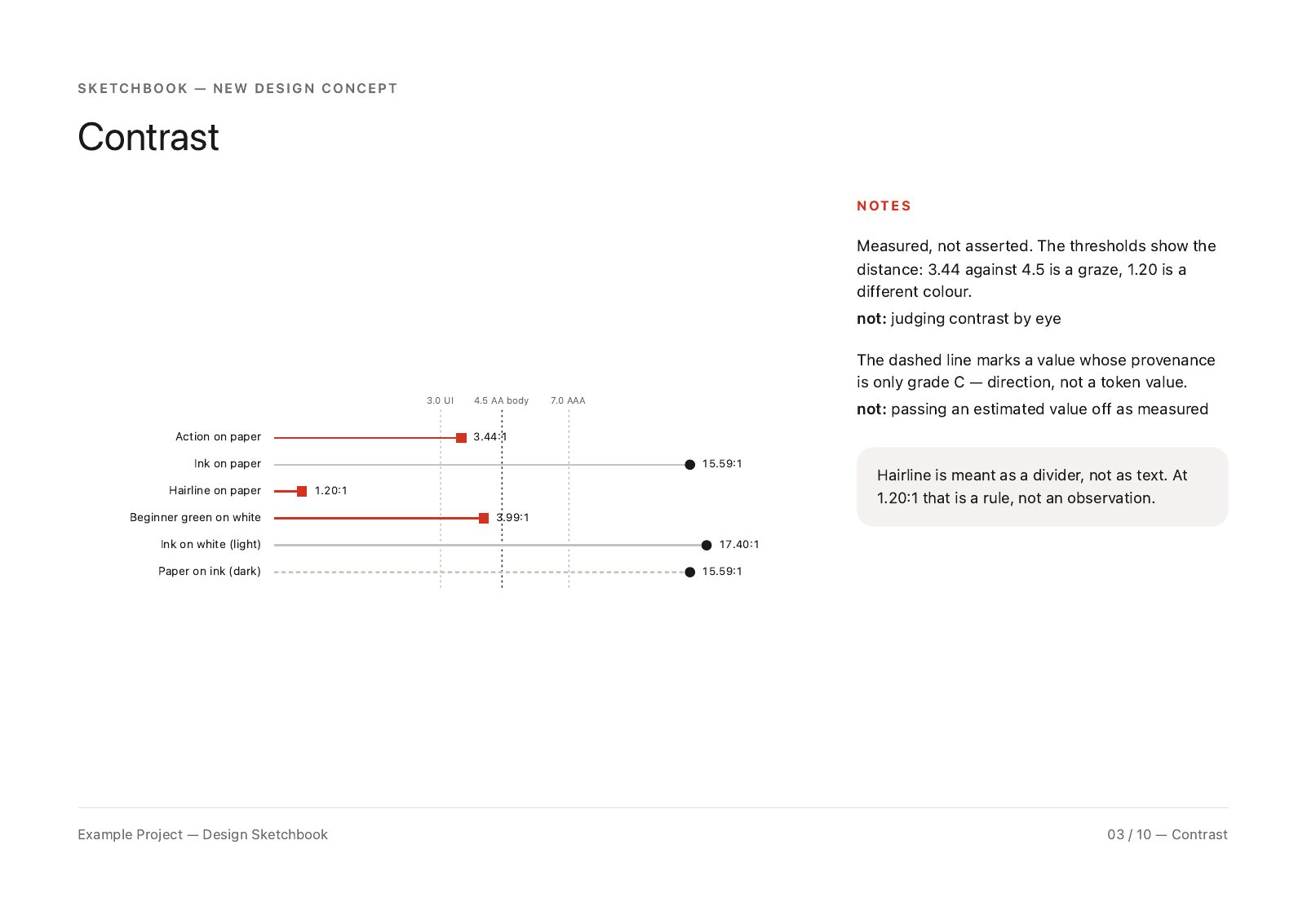
Landscape A4 at √2, measured off a real reference rather than assumed — a generic landscape scaffold uses 16:10, and the reference does not. One building block per spread, a 66/34 split between specimen canvas and NOTES margin, numbered callouts in the margin, a tinted box for the derived observation, and the approval block that makes the whole thing a gate rather than a gallery.
The reference uses the callout number in two weights — filled pins the artwork, outlined opens the margin entry. Only the outlined half ships: the filled .pin has a style and no emitter, because a spread addresses its canvas by key rather than authoring it as SVG here, so there is nowhere to carry the coordinates. Named as a gap rather than described as if it worked.
python3 plugins/matrize/scripts/build_sketchbook_html.py \
  --data plugins/matrize/scripts/fixtures/sketchbook-demo.json --out /tmp/sketchbook.html
The screenshot above is page 3 of that file, rendered through the same print path the pdf target uses. Recording it matters: the previous image was captured from a build whose footer still read 03 / 08, the current code renders 03 / 10, and nothing noticed — because the command that produces the HTML was written down and the command that produces the image was not.
"/Applications/Google Chrome.app/Contents/MacOS/Google Chrome" --headless=new --disable-gpu \
  --no-pdf-header-footer --print-to-pdf=/tmp/sb.pdf file:///tmp/sketchbook.html
pdftoppm -f 3 -l 3 -jpeg -jpegopt quality=82 -scale-to-x 1602 -scale-to-y 1133 /tmp/sb.pdf /tmp/page
cp /tmp/page-03.jpg plugins/matrize/assets/sketchbook-screenshot.jpg
cp /tmp/page-03.jpg docs/plugins/assets/sketchbook-screenshot.jpg   # the docs copy is NOT synced by anything
Print, not the screen preview: @media screen wraps each spread in a shadowed card on grey, @media print is full-bleed, and the committed image is the print rendering.
Two modes. approval (default) is the reference's shape — no code anywhere, because it goes in front of a decision-maker. handoff adds a bottom-anchored snippet per spread and an export control, which is what a developer needs and a client does not.
Charts, where a measured value meets a fixed threshold. One primitive, four call sites — contrast, motion, type scale, spacing. Dot with a stem, never a bar, because a bar implies a meaningful zero and contrast's floor is 1.0. Log axis for ratios, because linearly a 15:1 pair eats the axis and squeezes the interesting 2.5–5 band into a sliver. Colour is always redundant to position and shape and a printed value.
What the chart adds over a table is margin: 3.44 against a 4.5 threshold is a near miss fixed by darkening a few percent, and 1.20 is a different colour. A table prints "FAILS" for both.
Text into illustration. Prose past its slot budget stops being read, so an over-budget NOTE is rendered as a do/don't figure instead — but only when the entry carries a structured rule and anti-rule to draw. With nothing to draw it flags the overrun and leaves the prose alone. Inventing a figure the lexicon never described is the same defect as a rule with no card behind it.
The demo data is committed and deliberately shows a failing system: the action red clears AA only at large sizes, one duration sits past the Doherty threshold, one spacing step is off the grid, and one note runs past its budget with nothing to draw.
Branding a surface, and what gets enforced
The question "may we have six or eight categorical hues?" turned out to be the wrong one. Measured with scripts/cvd.py — CIEDE2000 under a Viénot-1999 dichromat simulation, the metric this workshop's own token file already names — every categorical palette here sits below the separation floor, the five-hue scale included:
| palette | n | worst deuteranopia | worst protanopia |
|---|---|---|---|
| the shipped five-hue scale | 5 | 5.70 | 5.30 |
| a six-fill canvas set | 6 | 3.40 | 3.41 |
| a seven-role set | 7 | 4.10 | 3.96 |
| an eight-entry hashed palette | 8 | 3.50 | 1.96 |
Widening the cap does not fix that; it makes the worst pair monotonically worse. What carries the accessibility claim is the rule the token file already states — colour is never the only channel — and unlike a hue count, that is decidable.
scripts/redundancy.py decides it, narrowly: a palette indexed by a computed key, or three-plus sibling rules setting nothing but colour, with no second channel where the category is rendered. A legend does not count — a legend maps name to hue, and reading a chart requires the inverse. Anything it cannot decide returns undecided, which is never reported as a violation.
The hook's third rule denies a write introducing colour-only encoding into a file the project has declared a branded surface (surfaces: in .claude/matrize.local.md). It never sweeps a repository it was not pointed at. A Write carries the whole file so the full check runs; an Edit carries a fragment with no use sites, so only the self-contained palette-index pattern is checked there — stated rather than implied.
scripts/emit_vitepress.py is the applying half: it turns a theme's hand-copied literals into references to the token set. It proposes the mapping by value-matching, which the provenance graph refuses to do — the difference is what the result is used for. There a match became an asserted edge; here it is a proposal a human reviews, and every ambiguity is reported rather than resolved.
The vocabulary
references/vocabulary/ carries the domain layer: one file per dimension — colour, grid and spacing, typography, motion, icons — plus visual-asset-taxonomy.md, the parent the five hang off.
Each file names the terms a design system actually uses, the pairs people confuse, and ends with Decoding notes: what that dimension yields from a reference and at what grade. So matrize-decode knows the base unit is inferable at grade B by taking the GCD of observed spacing — and that a GCD of 1 means there is no grid, which is itself the finding — without rediscovering it per run.
Every term carries a kind, and the kind is a routing rule rather than a note:
| kind | where it goes | what refuses it |
|---|---|---|
token | a stored value — tokens.json | — |
derived | computed from tokens; never stored separately | V-VOCAB-NOT-A-TOKEN |
rule | a constraint — a lexicon entry, and it needs an anti-rule | V-VOCAB-RULE-NO-ANTIRULE |
property | observed or measured; not stored at all | V-VOCAB-NOT-A-TOKEN |
A rule-kind term with no anti-rule is mis-classified, not merely incomplete. A derived or property term sitting in tokens.json is a value that will drift from whatever it was derived from.
The taxonomy's Origin column bounds what can be promised at all: derivable classes are delivered whole, drawn classes only as a system plus seeds and a growth rule, captured and shot classes as rules and never as assets. That is the honest reason this plugin ships an icon system rather than an icon library.
The vocabulary is compiled, and it refuses
Until it was compiled, all of the above reached the pipeline as prose inside four SKILL.md files — which the werkstoff workshop has measured as the weakest enforcement layer there is, beneath a fenced command. So the most load-bearing content in the plugin was the least enforced content in it.
scripts/vocabulary.py parses the six files into a registry — 223 dimension terms (token 78 · rule 65 · property 62 · derived 18) and 31 asset classes — and scripts/validate_tokens.py checks every token against it. The PreToolUse guard then refuses a write to <root>/system/tokens.json that contradicts it, because a rule that must hold regardless of model cooperation belongs in a hook.
python3 plugins/matrize/scripts/vocabulary.py --selftest          # 35 checks
python3 plugins/matrize/scripts/vocabulary.py --audit <tokens.json>
python3 plugins/matrize/scripts/validate_tokens.py <tokens.json>  # 36 cases
Three properties are worth stating because each is a trap this plugin walked into first.
It is parsed at runtime, never compiled to a committed JSON. One source, so there is no second copy to drift.
A parser that extracts nothing makes every rule pass vacuously. The selftest asserts per-file counts measured by hand (46 / 38 / 36 / 46 / 57), and a file yielding zero terms is a parser failure rather than an empty file. The same discipline covers the validator: if the registry cannot be built, V-VOCAB-REGISTRY fails closed instead of letting the other twelve rules quietly disappear. No findings and no checks look identical from the outside.
Headers are found by the separator row, never by the first cell. motion.md's Principles table carries an ordinary data row beginning | Origin | Motion emanates…, and a parser that whitelists first cells re-latches there, invents a table boundary, and drops two thirds of that table — raising nothing. The selftest keeps the wrong parser executable and fails if it does not misbehave.
What the vocabulary does NOT do
It does not propose a term for a token. Matching custom-property names against the registry bound 1 of the 50 declarations this repository's token file held when that was measured (it has 57 since the retrofit), because names are roles (--space-1, --bg) and the vocabulary names concepts (Spacing step, Surface / background). The binding is interpretation, and invariant I3 keeps interpretation in a separate artefact written by a separate agent. --audit reports what is named and what is not, and proposes nothing.
Homonyms are real and are reported rather than resolved: Opacity is derived in color-system.md and property in motion.md, so every concept is addressed as term + dimension. A project that genuinely needs a concept the vocabulary lacks declares the extension with its reason and the card that decided it; matrize-status reports those as the vocabulary's backlog.
Three presentation classes, chosen by the shape of the question
| class | form | answers |
|---|---|---|
| Ledger | finite report: a figure plus tables that hold everything the figure shows; the page script (the report kit) only opens a drawer on a click | a finite list of measured claims against fixed thresholds |
| Specimen | static document, landscape, set in the system's own tokens | what the design looks like |
| Viewer | interactive, screen only | where a value came from and what depends on it |
The test that sorts them is falsifiable: print it. If nothing is lost, it should not have been interactive. The derivation-health report loses nothing that its tables do not also hold, so it is a Ledger — and a finite ledger has a property a screen can destroy, in that it is complete and it ends. That is why the drawer adds no fact the tables below the figure lack.
The report renders through the report kit, so it does ship a script, and the claim about injection is the checkable one: the data rides in one escaped JSON island, and the contrast figure is drawn from ratios contrast.py computed, never typed. The figure fills the first screen; clicking a pair opens its ratio, its thresholds and the nearest passing foreground beside it, and everything it shows is also in the tables below.
The provenance graph — the interactive artefact
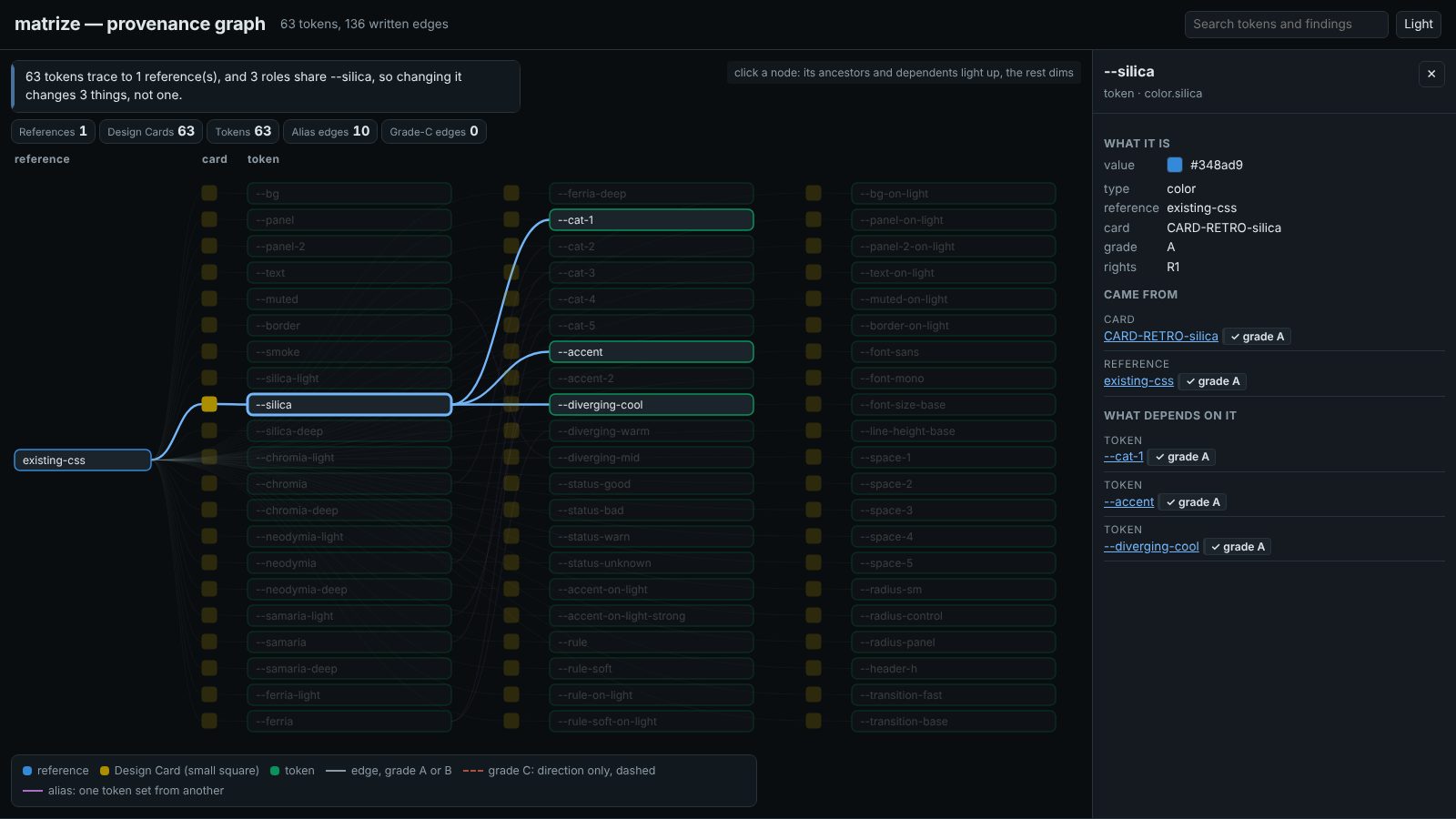
The sketchbook is print-first, because an approval artefact ends as a PDF in front of someone who does not get a localhost URL. A graph earns the exception to being read end to end: it has no readable static layout, and the reader arrives with a target question rather than reading it end to end — why is this token this value, and what breaks if I change it? Click any node and both answers light up at once.
python3 plugins/matrize/scripts/retrofit_css.py tools/design-tokens/tokens.css --out /tmp/tokens.json
python3 plugins/matrize/scripts/build_provenance_html.py --tokens /tmp/tokens.json --out /tmp/prov.html
Edges are read, never inferred. They come from each token's written edge field and from DTCG {ref} aliases. Nothing here matches values across files — and --paranoid makes that refusal testable by re-deriving the graph the wrong way and reporting the disagreement. On this repository's own tokens it finds four:
value-matching would MERGE 2 distinct roles that share one value: radius.sm, space.1
value-matching would MERGE 2 distinct roles that share one value: radius.panel, space.2
value-matching would COLLAPSE 2 roles aliasing color.ferria into one node …
value-matching would COLLAPSE 3 roles aliasing color.silica into one node: color.accent,
  color.cat-1, color.diverging-cool — so "what breaks if I change color.silica?" would
  answer 1 instead of 3
That is the whole argument for writing edges rather than reconstructing them, measured on real material instead of asserted. The selftest asserts both cases against the actual file: 4px must stay two nodes, and --silica must show three dependents.
Grade travels with the edge, so a grade-C origin is drawn dashed — reusing the 4,3 dash that already means unproven elsewhere in this workshop.
The icon system, and gradients
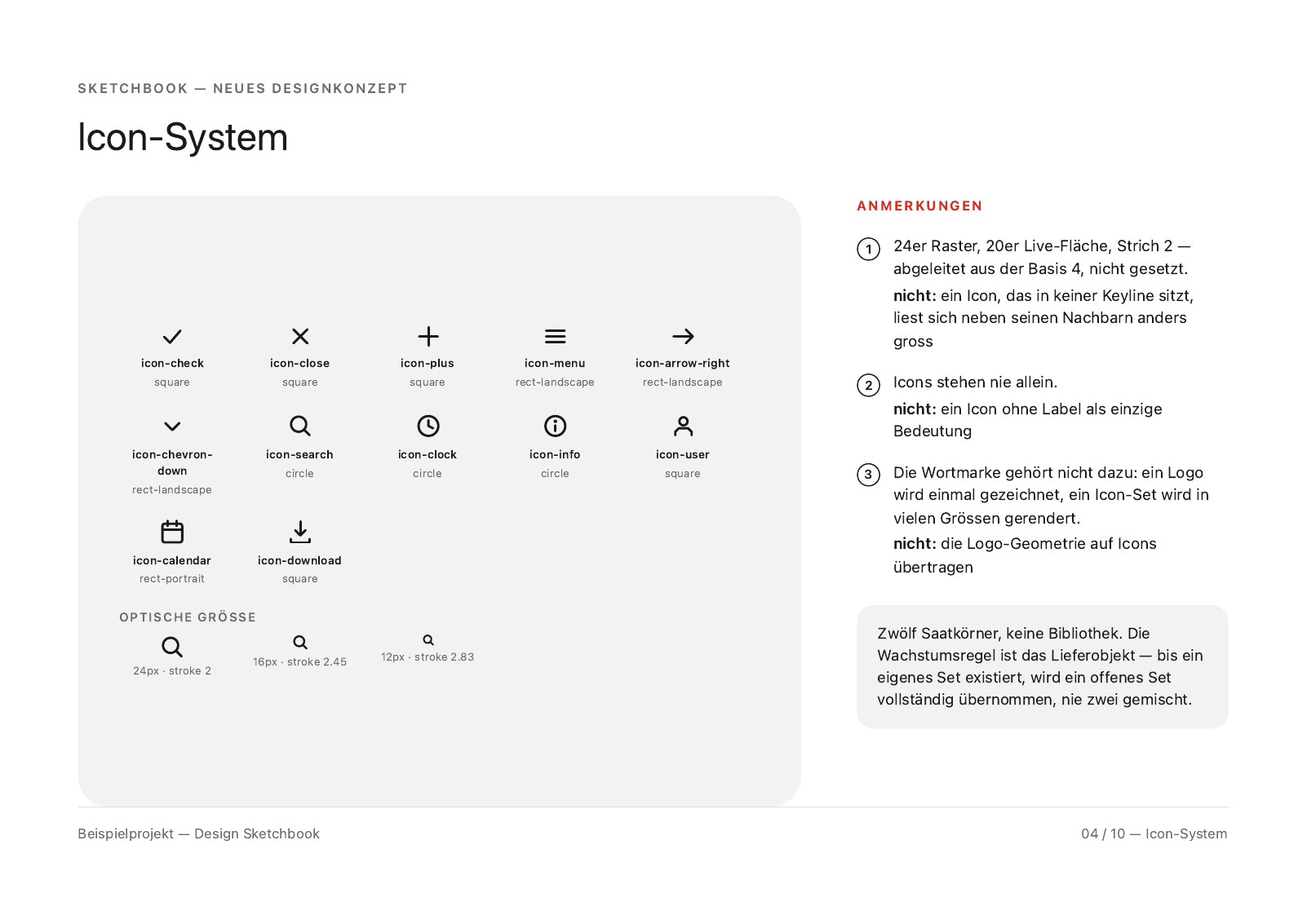
The grid is derived, not decreed. Grid = 6× the system's spacing base, live area 5×, padding 0.5×, stroke = base/2. A 4px base lands on the 24/20/2/2 convention Feather, Lucide and Tabler already share — so the derivation agrees with the ecosystem instead of fighting it, and an 8px base yields a 48 grid without anyone re-deciding.
A brand mark is not an icon. A logo is drawn once at one size and may keep its own geometry; an icon set is rendered at many sizes, so it needs uniform stroke and shared keylines or it stops reading as one family. This repo's own mark is 32-grid at 2.75 stroke and deliberately sits outside the system.
Geometry is checked, not asserted. Every seed is defined as primitives rather than a path string, so the same data renders and validates: inside the live area, on the subdivision, filling one of four keylines. icons.py --selftest plants an off-grid point, an off-subdivision point and a bad keyline, and requires each to be caught.
Twelve seeds, never a library. The growth rule is the deliverable. Until a brand-owned set exists, adopt one open family wholesale — mixing two is visible immediately at the terminals — and record it as a reference with its rights grade.
Gradients are tokens, and they carry the exception. Stops are references to roles, so changing a role changes the gradient. Nothing is invented: a role set with no deeper step yields no gradient and a finding saying why. A gradient whose endpoints are indistinguishable is caught as a flat fill, and a third stop is challenged in its own purpose text. Every one ships the anti-rule that matters here — never in an illustration zone, where tone comes from flat colour and overlap rather than a blend.
The retrofit proof, on this repository's own tokens
retrofit is proven, not asserted, and on real material: tools/design-tokens/tokens.css — 57 declarations, thirteen synced consumers (twelve plugins plus docs/.vitepress/theme/tokens.css, per .rrt.toml's artifact_targets).
python3 plugins/matrize/scripts/retrofit_css.py tools/design-tokens/tokens.css --out /tmp/tokens.json
python3 plugins/matrize/scripts/prove_retrofit.py tools/design-tokens/tokens.css /tmp/tokens.json
Three arms, because one is not enough:
| arm | asserts | catches |
|---|---|---|
| 1 textual | every declaration reappears with an identical value | a dropped, added or altered token |
| 2 structural | every var(--x) round-trips as a DTCG reference | a retrofit whose output is right and whose source of truth is wrong |
| 3 visual | renders byte-identical at 1600×900 | cascade effects the first two cannot see |
Arm 2 is the one worth explaining. Arm 1 does catch crude flattening — rewriting --accent: var(--silica) as a hex is a textual change. What it cannot see is a token file storing the literal string "var(--silica)" instead of the reference {color.silica}: the CSS is byte-identical, the render is byte-identical, and the token file now holds an opaque string with no edge in it. The system has forgotten that accent is silica — which is the answer to "what breaks if I change silica?" — and every non-CSS formatter emits that string into a target where var() means nothing.
Arm 3 carries its own instrument check, because two blank pages are also byte-identical. The fixture must render differently with and without the tokens, or the pass is vacuous.
Current result on this repo: zero visual diff, structure preserved, all 10 aliases intact.
Hooks
One PreToolUse hook, hooks/matrize_guard.py, type: "command". It is inert unless the configured design root exists — it never polices an unrelated project that merely has the plugin installed — and it denies exactly two things:
- any write or edit under
<root>/references/**— references are read-only, which is how the copyright boundary is carried mechanically rather than by good intentions; - any write to
<root>/system/tokens.jsonor<root>/out/**while aspreadchoice record is unanswered — an n-proposal portfolio with no forced choice is a procrastination machine.
It denies nothing else. A guard that policed every write outside the design root would police your whole repository the moment it was installed.
The derivation-health report
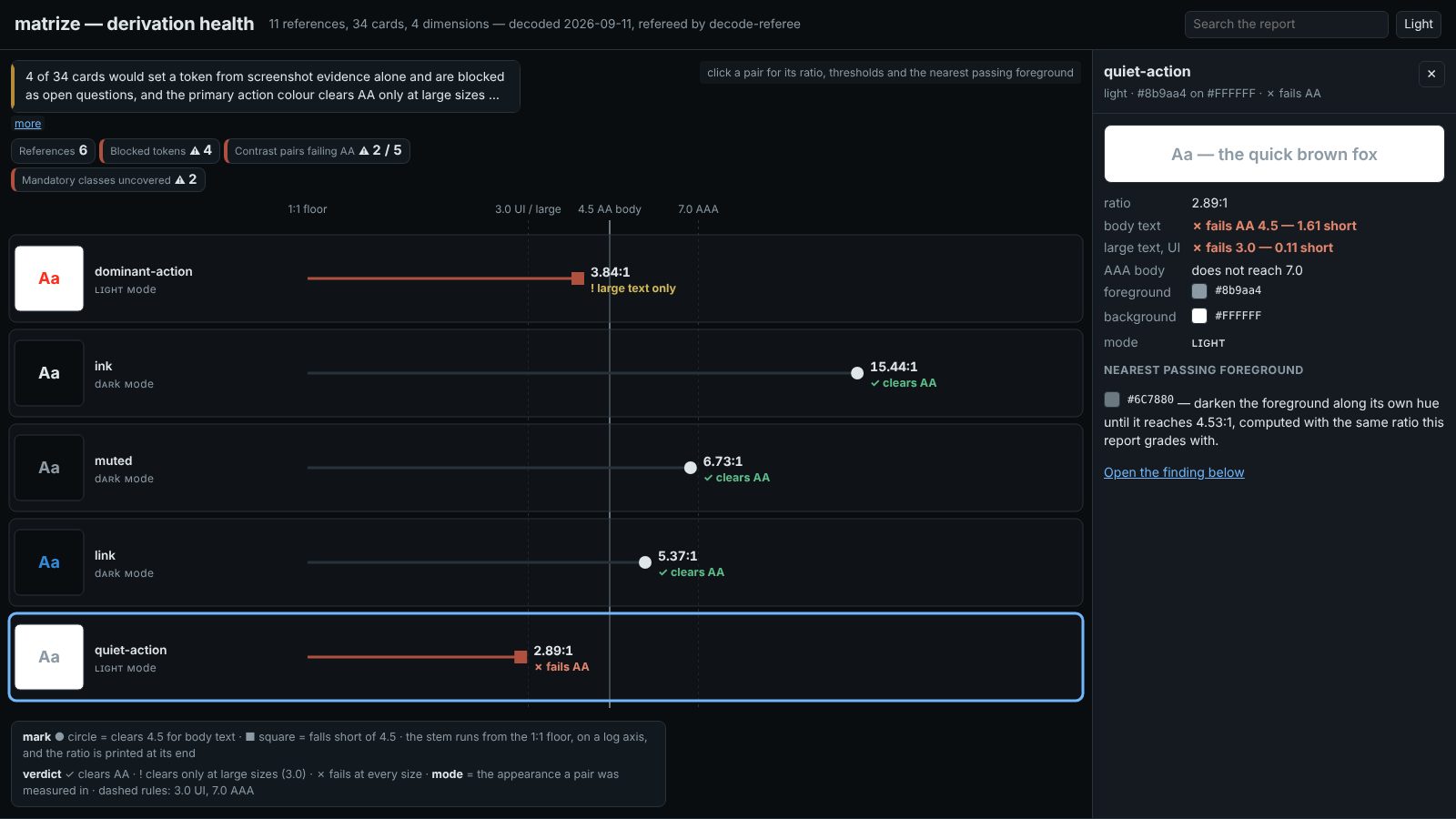
It charts what the pipeline knows about its own evidence: which references were decoded, their grades, which tokens rest on grade-C evidence alone, and which contrast pairs fail. Ratios are computed by scripts/contrast.py and cannot be supplied — the builder rejects input that states one, because a number a human typed is a claim and a number the script derived is a measurement.
The demo data is committed, so the screenshot above is reproducible:
python3 plugins/matrize/scripts/build_derivation_html.py \
  --data plugins/matrize/scripts/fixtures/derivation-demo.json --out /tmp/derivation.html
It deliberately shows a failing run rather than a clean one — four tokens blocked and a primary action colour that clears AA only at large sizes. A demo in which nothing is wrong demonstrates nothing.
Fan-out safety
decode fans out one reference-decoder per reference: first batch 4, escalating ×1 → ×2 → ×4, hard cap 16. The circuit breaker trips when accepted cards fall strictly below two-thirds of measurable cards, judged per batch rather than cumulatively — a reference that could not be fetched or read at all is excluded from the denominator instead of being counted as a rejection. The correct response to a tripped breaker is a revised rubric, never more agents.
Every agent is read-only. Agents return structured results and the orchestrating skill writes the artefacts, so reference content — which is untrusted input, and can contain instruction-shaped text — has no path to disk through an agent.
Running it outside werkstoff
Nothing here depends on this repository. Install the plugin, and optionally drop this in the target project's .claude/settings.json to declare the same boundary the hook enforces:
{
  "permissions": {
    "allow": ["Read(**)", "Write(.design/system/**)", "Write(.design/out/**)",
              "Edit(.design/system/**)", "Edit(.design/out/**)"],
    "deny": ["Edit(.design/references/**)", "Write(.design/references/**)"]
  }
}
That guards the file tools only; a shell command that writes a file goes through Bash permissions instead. The hook is what actually refuses.
Verifying a change to this plugin
python3 plugins/nacharbeit/scripts/nacharbeit_lint.py plugins/matrize --docs-root docs
python3 test/plugins/lint-frontmatter.py plugins/matrize
python3 test/plugins/lint-release-wiring.py
python3 plugins/matrize/hooks/test_matrize_guard.py
python3 test/plugins/verify-hooks-deny.py plugins/matrize
claude plugin validate plugins/matrize --strict
Escape hatch
MATRIZE_DISABLE_GUARD=1 disables the hook entirely. It is named in every deny message the guard emits. The guard fails closed: if it cannot decide, it denies and tells you which variable turns it off.