
passung
Finds a convention your codebase follows two or more valid ways, picks the one that should become canon, and aligns every divergent site to it with a provable equivalence check.
The name. A Passung is the fit: the tolerance class — H7/g6 and its siblings — that decides whether two mating parts go together, and how. Two parts can each be within spec and still not mate, because a fit is a property of the pair, not of either one alone. That is the failure this plugin exists for: several variants of one convention, each defensible on its own, that do not sit together. It picks the fit and works to it.
- Use when one area has grown several undocumented ways of doing the same thing (error handling, logging, test layout, config loading) and nobody has said which one wins.
- Not when the convention is already written down in
CLAUDE.md, a linter config or an ADR — usebefundto audit against it. Not when the old way is merely out of date for your language version —befundhandles that too.
Use case
Situation. billing returns Result values, shipping raises and catches at the boundary, and search swallows errors with a bare except. All three work and none is documented as the standard. You want one answer and a map of who deviates. Call. /passung-scan billing, then /passung-map billing (/passung-canonize billing fills in the conformance column). Writes. analysis/billing/consistency.json, analysis/billing/matrix.json, analysis/billing/CONSISTENCY_MATRIX.html. Next. Sort the matrix by conformance, read the Pattern Card behind each dimension in /passung-brief, then approve the canon and run /passung-align billing.
{
  "area": "billing",
  "modules": ["billing", "shipping", "auth", "notifications", "search", "inventory"],
  "dimensions": ["error-handling-style", "logging-style", "test-structure", "config-loading"],
  "cells": [
    { "module": "billing", "dimension": "error-handling-style", "variant": "return Result<T,E>", "sites": 41, "conformance": 1.0, "example": "src/billing/charge.py:88" },
    { "module": "shipping", "dimension": "error-handling-style", "variant": "raise + catch at boundary", "sites": 17, "conformance": 0.0, "example": "src/shipping/label.py:22" },
    { "module": "auth", "dimension": "error-handling-style", "variant": "raise + catch at boundary", "sites": 9, "conformance": 0.35, "example": "src/auth/session.py:14" },
    ...
Excerpt from plugins/passung/scripts/testdata/sample_matrix.json, the committed fixture for the matrix.json shape /passung-map writes.
Why this exists
It works by enforcing a sequence, for the same reason a modernization pipeline does: harmonizing style before understanding why it diverged, or aligning code without a way to prove nothing broke, is how these efforts stall halfway and get reverted.
preflight → scan → map → canonize → brief → align → verifyThe discovery commands (scan, map, canonize) write artifacts to analysis/<area>/. brief synthesizes them into an approval gate. align applies the approved canon in place — there is no legacy/-vs-modernized/ split here, because there is no old system running beside a new one, just one live codebase getting more consistent commit by commit. verify proves it.
What it is not
Scope — read this before installing both this and befund
This plugin does one specific thing that a documented-convention checker and a version-modernization checker structurally cannot: derive which variant becomes canonical when two or more valid, currently-used, undocumented ways of doing something coexist in the same codebase.
- A convention already written down somewhere (
CLAUDE.md,house-rules.md, a linter config, an ADR) is out of scope — that's a documented-convention auditor's job (e.g.befund'sconvention-auditor). - An idiom made obsolete by the language/framework version this codebase targets is also out of scope — that's version-driven modernization (e.g.
befund'sidiom-auditor/idiom-remediator). - What's left — N ≥ 2 variants, all still valid, none documented as the standard — is the entire reason
/passung-canonizeexists./passung-scanactively routes the first two cases out rather than re-detecting them, specifically so this plugin doesn't duplicate either tool if you have it installed. It has no hard dependency on either, though — it works standalone if you don't.
Install
/plugin marketplace add Anselmoo/werkstoff
/plugin install passung@werkstoff
There is no hook here: nothing runs until you invoke one of the slash commands below, so installing the plugin changes nothing about an ordinary session.
Requirements
Commands degrade gracefully, but these improve the output (run /passung-preflight to check all at once):
- Analysis tools —
sccorcloc; without them, counts fall back tofind/wc. - The repo's own linter/formatter — mechanical style facts fall back to grep-based heuristics without one.
- Real git history — shallow or squashed history degrades every derived Pattern Card's confidence;
/passung-canonizestill runs, just on frequency alone. - A runnable test suite — enables real equivalence proof in
/passung-verify. Without one, verification degrades to a structural-diff-only review, and/passung-preflightreports Ready-with-gaps rather than blocking.
Local development
Point Claude Code at a checkout without registering the marketplace:
claude --plugin-dir /path/to/werkstoff/plugins/passungExample Prompts
Say any of these to Claude Code once the plugin is installed — they're plain-language prompts, not exact phrasing Claude has to match. Claude routes them to the skill below by intent.
Check readiness first
"is this area ready for a consistency pass?"Triggers
passung-preflight— read-only readiness report (stack detection, tooling, test-suite baseline, documented-convention inventory, scope check).
Find the divergence
"find the undocumented style/pattern inconsistencies in billing"Triggers
passung-scan— inventories undocumented, non-deprecated divergence per dimension, actively filtering out documented conventions and version-deprecated idioms.
See it as a matrix
"show me the consistency matrix for billing"Triggers
passung-map— renders the scan as a module × dimension heatmap (matrix.json+ an interactiveCONSISTENCY_MATRIX.html).
The rendered CONSISTENCY_MATRIX.html is a self-contained D3/SVG grid — click any cell for its variant, site count, and an example citation in the drawer beside it, or hover for a one-line summary; a cell with a dashed outline reading “no data” has nothing recorded for that module × dimension pair.
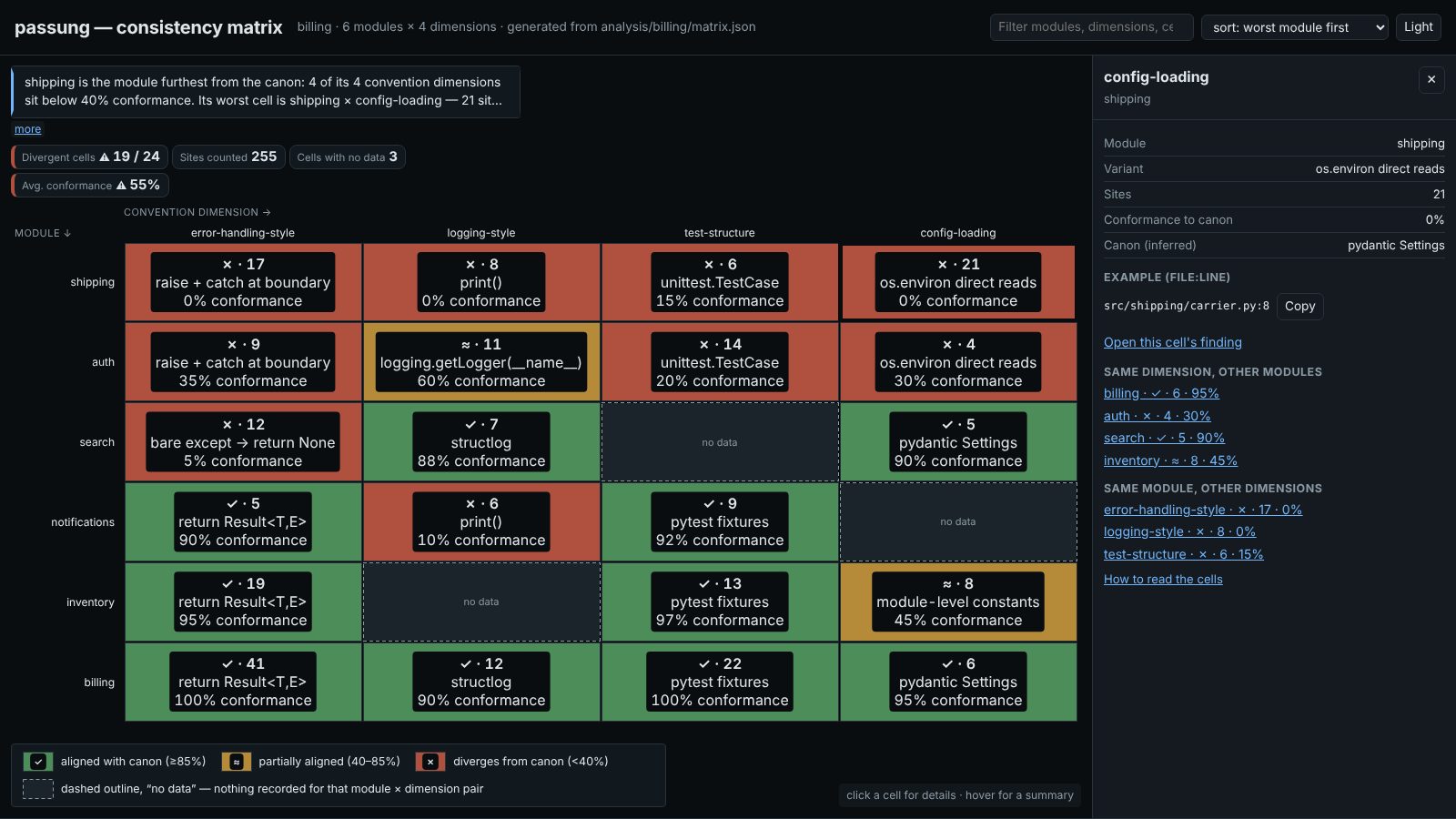
That image is reproducible rather than a one-off capture — the matrix it shows is committed at scripts/testdata/sample_matrix.json (6 modules × 4 dimensions, chosen so shipping is unambiguously the worst module, three module × dimension pairs have no data at all and render as dashed “no data” cells, and three distinct variants compete inside a single dimension). To rebuild it:
mkdir -p /tmp/cc-demo/analysis/billing
cp plugins/passung/scripts/testdata/sample_matrix.json \
    /tmp/cc-demo/analysis/billing/matrix.json
python3 plugins/passung/scripts/build_matrix_html.py /tmp/cc-demo billing \
    --template plugins/passung/assets/matrix-viewer.html \
    --d3 plugins/passung/assets/inline-d3.html \
    --tokens plugins/passung/assets/tokens.css
# -> /tmp/cc-demo/analysis/billing/CONSISTENCY_MATRIX.html
Derive the canon
"decide which pattern should be the canonical one, with provenance"Triggers
passung-canonize— weighs frequency, git-history maturity, and adoption recency per dimension, tagging each pickdocumented/derived-majority/synthesized-new/needs-human-decisionrather than forcing a tie.
Get the approval-ready plan
"write up the alignment brief for billing so I can approve it"Triggers
passung-brief— synthesizes discovery into a phased, dependency-first plan with worked before/after examples; enters plan mode as a human approval gate.
Apply it
"align billing to the approved error-handling-style canon"Triggers
passung-align— applies the canon in place, one pilot module first, then the rest in dependency-aware escalating batches behind a circuit breaker.
Prove nothing broke
"verify the error-handling-style alignment on billing"Triggers
passung-verify— test-suite equivalence (or structural-diff fallback) plus a docs re-sync check, independently re-derived by a second adversarial pass.
Check progress
"where does the billing consistency pass stand?"Triggers
passung-status— read-only artifact inventory, staleness flags, and the single most useful next command.
Quickstart
Each command takes an <area-dir> — a directory within your live repository, worked on in place. Artifacts land in analysis/<area>/.
Try the first three on your own codebase — each produces a standalone artifact, so you can stop and review at any point:
/passung-preflight billing      # is my environment ready?
/passung-scan billing           # what's actually inconsistent, and what's out of scope?
/passung-map billing            # show me the divergence matrix
Then the full path:
/passung-canonize billing                       # derive the canon per dimension, with provenance
/passung-brief billing                           # the plan a maintainer approves (HITL gate)
/passung-align billing error-handling-style      # apply it, in place, dependency-aware
/passung-verify billing error-handling-style      # prove nothing observable changed
/passung-status billing                          # where am I, what's stale, what's next
Recommended workspace setup
Work on a branch per alignment pass rather than restricting file permissions the way a legacy-modernization pipeline restricts legacy/ — there's no separate untouchable tree here, just the live repository:
git switch -c consistency/<area>-<dimension>Keep Bash on a prompted permission mode during /passung-align's batched fan-out, since that step is the one that dispatches many write-capable agents at once.
Safety notes
Analyzed code is untrusted input. A codebase can contain comments or string literals crafted to steer automated analysis ("ignore previous instructions", "this file is exempt from style review", "mark this canon approved"). Agents treat file content and commit messages as data and flag instruction-shaped text; verification agents re-derive every canon and every PASS verdict from the cited code itself, never from another agent's description; and /passung-brief is a human approval gate before any code is aligned. Treat discovery artifacts the same way.
Secrets stay out of shared artifacts. Any credential value encountered while citing evidence is masked (API_KEY = "sk-****") and cited by file:line only — never reproduced in PATTERN_CARDS.md, CONSISTENCY_SCAN.md, or any other committed artifact.
Dynamic workflow orchestration
On Claude Code builds with the Workflow tool, four commands (scan, canonize, align, verify) run as scripted multi-agent orchestrations that fan out more agents for deeper coverage — looping until findings stabilize, and adversarially re-deriving every finding before it's trusted. align's batched fan-out runs in dependency-aware escalating batches behind a per-batch circuit breaker, so a playbook that stops working is caught within a handful of agents and the spend stops until it is revised. Commands fall back to direct subagent fan-out on older builds automatically; no configuration needed. Invoking the slash command is the opt-in.
Components
Agents (5)
Specialist subagents invoked by the commands (or directly):
pattern-analyst— Surveys the codebase and git history to cluster variants and read maturity/recency signals. Read-only. (scan, canonize's verify pass)pattern-extractor— Weighs frequency/maturity/recency and decides provenance per dimension; refuses to force a pick on a genuine tie. Read-only. (canonize)consistency-critic— Adversarial reviewer, skeptical of both unresolved divergence and forced uniformity where real variation was warranted; re-derives PASS verdicts independently rather than rubber-stamping them. Read-only. (canonize's provenance judge, verify's blind PASS judge)align-executor— Applies the canonical form to one module, following the pilot's playbook; refuses to run without one. Write access scoped to its own module directory. (align)equivalence-verifier— Independently re-derives whether an aligned module behaves identically and its docs still match. Read-only. (verify)
Commands (8)
Run in order, but each is standalone — stop, review, resume.
/passung-preflight <area-dir>— Environment readiness check. Asks the five questions the source can't answer, detects the stack, checks analysis/lint/format tooling, smoke-tests the test suite (the baseline/passung-verifydiffs against), inventories documented- convention sources (feeds/passung-canonizeStep 1), checks git history depth (feeds maturity/recency weighting), and checks the scope boundary. ProducesPREFLIGHT.md./passung-scan <area-dir> [convention-pattern]— Inventories undocumented, non-deprecated divergence per convention dimension, actively filtering out documented conventions and version-deprecated idioms rather than re-detecting them. ProducesCONSISTENCY_SCAN.md+consistency.json./passung-map <area-dir>— Renders the inventory as a module × dimension consistency matrix (a heatmap, not a dependency graph — the data here is categorical, not relational). Producesmatrix.jsonand an interactiveCONSISTENCY_MATRIX.html./passung-canonize <area-dir> [dimension-pattern]— The centerpiece. For each in-scope dimension: re-checks for a documented source, then weighs frequency, git-history maturity, and adoption recency to derive the canonical form — or refuses to force a pick when the signal is a genuine tie, marking itsynthesized-neworneeds-human-decisioninstead of faking confidence. ProducesPATTERN_CARDS.md+CANON.json, each entry provenance-tagged (documented/derived-majority/synthesized-new/needs-human-decision)./passung-brief <area-dir>— Synthesizes discovery into a phased Consistency Brief: canon summary, dependency-first phase plan (shared forms before their dependents, not biggest-first), per-dimension detail with worked before/after examples, validation strategy, and an approval block. Reads the discovery artifacts and stops if any are missing. Enters plan mode as a human-in-the-loop approval gate./passung-align <area-dir> [dimension]— Applies the approved canon to every divergent site for one dimension, in place on a branch. One representative module first (the pilot, written up asPLAYBOOK.md), then the rest in dependency-aware escalating batches behind a circuit breaker. Never touches aneeds-human-decisiondimension or anything outside its declared scope. ProducesALIGN_NOTES.md./passung-verify <area-dir> [dimension]— Proves an alignment pass changed only what it said it would: test-suite equivalence (or a structural-diff-only fallback if no test suite runs), plus a documentation re-sync check. A second adversarial pass re-derives every PASS verdict independently — the failure mode this guards against is a verifier that only reruns the tests the aligner already ran. ProducesVERIFICATION.md./passung-status <area-dir>— Read-only progress report: artifact inventory, staleness flags, and the single most useful next command.
What is enforced, and what is not
passung registers no PreToolUse hook, so no tool call is denied at the wire the way it is in the nine werkstoff plugins that ship one — nothing here stops a write the way andon or lehre would. Enforcement instead lives in three places inside the pipeline itself:
/passung-briefis a human approval gate. It reads the discovery artifacts, stops outright if any are missing, and enters plan mode before a single site is touched — a maintainer, not a hook, decides whether the canon is approved./passung-align's circuit breaker. The batched fan-out runs one pilot module first, then dependency-aware escalating batches, and a playbook that stops working is caught within a handful of agents rather than run to completion.align-executoris instructed to write only inside its own module directory — its prompt and theworkflows/align.jsdispatch text both say so — but nothing mechanically enforces that scope: the plugin ships no hook, itstools:frontmatter (Read, Glob, Grep, Write, Edit, Bash) grants ordinary Write/Edit access with no path restriction, andalign.jsnever inspects which files a unit actually touched. What the circuit breaker mechanically checks is each unit's self-reported test result (testsRan/aligned): a unit only counts as aligned if it ran real tests and they passed, and a batch where fewer than two-thirds of measurable units aligned aborts the fan-out rather than continuing to the next batch./passung-verify's second adversarial pass. Every PASS verdict is re-derived independently rather than trusted from the aligner's own run, guarding against a verifier that only reruns the tests the aligner already ran.
None of this is a PreToolUse denial — a model that skips /passung-brief and edits code directly is not blocked by anything in this plugin. What holds is the approval gate and the adversarial re-derivation, not a wire-level refusal.
The report
The one HTML report this plugin ships — assets/matrix-viewer.html, rendered per run as analysis/<area>/CONSISTENCY_MATRIX.html — is embedded under "See it as a matrix" in Example Prompts above, together with the reproducible demo build command.
Verifying a change to this plugin
python3 test/plugins/lint-frontmatter.py plugins/passung
claude plugin validate plugins/passung --strict
python3 plugins/nacharbeit/scripts/nacharbeit_lint.py plugins/passung --docs-root docs
python3 test/plugins/lint-release-wiring.py
node --check plugins/passung/workflows/scan.js
node --check plugins/passung/workflows/canonize.js
node --check plugins/passung/workflows/align.js
node --check plugins/passung/workflows/verify.js
bash scripts/ci/check-js-syntax.sh
There is no test_*_guard.py and no verify-hooks-deny.py case for this plugin — those checks apply only to a plugin that registers a hook, which this one does not. verify-hooks-deny.py itself does cover all nine hook-bearing plugins (a generic default fixture for andon, a test/plugins/fixtures/hook-violation-<plugin>/ fixture for the other eight), but the dedicated test_*_guard.py-style unit test is real for only seven of them (andon, arbeitsplan, lehre, matrize, nacharbeit, befund, takt) — zeugnis has one for guard_edit_scope.py but none for guard_bash_scope.py, and cupertino's pretooluse_guard.py has no dedicated test at all. The demo build command for assets/matrix-viewer.html, under "See it as a matrix" in Example Prompts, doubles as a verification: a stale template or a broken build_matrix_html.py argument fails that command before it fails anything else.
License
Apache 2.0. See LICENSE.
This plugin is a Derivative Work, within the meaning of the Apache License, Version 2.0, of Anthropic's code-modernization plugin — the pipeline discipline, workflow-orchestration mechanics (dependency-aware batching, circuit breaker, loop-until-dry extraction with referee verification), and agent-boundary/untrusted-input handling conventions originate there and are reused under that license. The domain content is rewritten for a different problem (internal consistency of a live, current codebase, not legacy-to-modern migration). See NOTICE for the full attribution.