
zeugnis
Audits code that looks right and is not, and counts a finding only after an independent pass has re-checked it.
The name. A Zeugnis is the mill certificate — the EN 10204 Werkszeugnis or Abnahmepruefzeugnis in which a supplier declares what a material actually is. Its grades are the point: 2.1 is the supplier's own word, 3.1 is their own inspector, and 3.2 requires an independent one. A claim is worth what the party behind it is worth. That is this plugin's rule — no finding counts until a pass that did not produce it re-checks it, which is why every audit here has a separate Verify phase.
- Use when AI-written code passes review and CI but you doubt it: tests that run a path without asserting anything meaningful, docstrings or schemas that drifted, dependency names that may not exist, agent loops with no bound.
- Not when a README or ADR no longer matches the code — use
befund; or you need proof that one specific change or wire is correct — useandon.
Use case
Situation. An agent wrote a pricing module and its tests, and CI is green. You want to know whether the tests would notice a broken discount, whether its docstrings still say what the code does, and whether the retry loop it left behind can run away. Call. /zeugnis:zeugnis-cycleWrites. analysis/zeugnis/ledger.json (pass-by-pass state), one line per pass in analysis/zeugnis/reports/ZEUGNIS_CYCLE.md, and each audited domain's report and <domain>_summary.json beside it. Next. An escalated finding was reopened past max_reopens and needs a human; the cycle will not close it by itself. For open findings, start a new zeugnis-cycle invocation, which gets a fresh pass cap.
"passes": [
  ...
  {"passNumber": 4, "domain": "agentic_reliability", "closed": 1, "fixOrDraftOutcomes": 1},
  {"passNumber": 5, "domain": "code_change_review", "closed": 0, "fixOrDraftOutcomes": 0}
],
"findings": {
  ...
  "agentic-2": {"status": "open", "domain": "agentic_reliability", "category": "missing-escalation", "severity": "Medium", "evidence": "src/loop/runner.py:60", "reopenCount": 0},
  "code-1": {"status": "escalated", "domain": "code_change_review", "category": "silent-fallback", "severity": "High", "evidence": "src/ingest/parser.py:130", "reopenCount": 4}
}
Excerpt from plugins/zeugnis/scripts/fixtures/sample_burndown_ledger.json, the shape analysis/zeugnis/ledger.json takes.
Why this exists
AI-generated code fails in characteristic ways that don't show up in a normal lint/test pass: a plausible-looking but nonexistent package name, a test that executes a code path without actually asserting anything meaningful about it, a docstring or type hint that quietly drifted from what the function now does, or an agent/skill definition with an unbounded retry loop and no way to escalate. zeugnis looks specifically for these four failure modes, treats every finding as unconfirmed until an independent verification pass re-checks it, and never lets a timeout or an unreachable registry masquerade as a real verdict in either direction.
What it is not
zeugnis's four audits are narrow by design. Two adjacent jobs are explicitly out of scope and deferred to sibling plugins:
- Not a prose-documentation-drift checker.
zeugnis-contract-drift's scope is "structural, machine-checkable declarations only" — type hints, docstrings, and API/OpenAPI/GraphQL schemas against real call-site or handler usage. A claim inCLAUDE.md,README.md,ARCHITECTURE.md,DECISIONS.mdor an ADR file no longer matching the code isbefund:befund-docs-drift's job, not zeugnis's. - Not a verifier of a specific change, fix, wire, or numeric claim.
zeugnis-assertion-auditjudges only whether the tests would catch a bug — it is explicitly "not for proving that a specific change, fix, wire, or numeric claim is correct." That adversarial verification isandon:andon-verify's job.
Install
/plugin marketplace add Anselmoo/werkstoff
/plugin install zeugnis@werkstoff
Both PreToolUse hooks are inert until the target repository already has an analysis/zeugnis/ directory, so installing the plugin changes nothing until a zeugnis audit skill has actually run once.
Requirements
Python 3.11+ (stdlib only — no third-party dependencies for any enforcement script). Network access is required for zeugnis-dependency-audit's registry lookups and zeugnis-preflight's reachability check; both are read-only GET requests bounded by a timeout and degrade to "skipped" rather than failing the run when network access isn't available.
Local development
Point Claude Code at a checkout without registering the marketplace:
claude --plugin-dir /path/to/werkstoff/plugins/zeugnisExample Prompts
Say any of these to Claude Code once the plugin is installed — they're plain-language prompts, not exact phrasing Claude has to match. Claude routes them to the skill below by intent.
Check for hallucinated dependencies
"check if any of our dependencies are hallucinated"Triggers
zeugnis-dependency-audit— flags package names that don't exist in the real registry, independently re-verified before being reported.
Check test strength
"would our tests actually catch a bug here?"Triggers
zeugnis-assertion-audit— mutation-testing pass checking whether tests assert anything meaningful, not just execute the code.
Kill the survivors with a real mutation tool
"run mutmut on src/shop/pricing.py and write the tests that kill what survives"Triggers
zeugnis-mutation-harden— runs the real tool on a freshgit archivecopy as a background script, proves every new test by applying its mutant, and reports the score per module before and after, with untested mutants, equivalents and unreached survivors listed apart.
Run the full cycle
"run the zeugnis cycle on this repo"Triggers
zeugnis-cycle— bounded self-optimization loop: re-runs all four audits pass by pass, optionally applying fixes, until convergence.
Check status
"where does zeugnis stand on this repo"Triggers
zeugnis-status— read-only dashboard: what's run, what's stale, what to run next.
Check for contract drift
"check if our type signatures and docstrings still match how the code is actually called"Triggers
zeugnis-contract-drift— compares type hints, docstrings, and API/OpenAPI/GraphQL schemas against real call-site or handler usage, independently re-verified by default.
Audit the plugin's own agent design
"is our own agent design safe — any unbounded retries or missing escalation paths?"Triggers
zeugnis-agentic-reliability— audits this repo's own skill/agent/workflow definitions for unbounded retry loops, unwired Find/Verify phases, and excessive tool grants.
Quick pre-commit check
"is this diff okay to commit?"Triggers
zeugnis-code-change— runs only the domains whose file patterns match what actually changed, and always produces an advisory verdict that never blocks the commit.
Check readiness first
"is zeugnis set up correctly in this repo?"Triggers
zeugnis-preflight— five independent readiness checks, one verdict per domain skill, before any audit actually runs.
Run zeugnis-preflight first if you're not sure the plugin's checks can even run in this repo — it's read-only and never blocks the other four.
Components
Skills (9)
| Skill | What it does |
|---|---|
zeugnis-preflight | Five independent readiness checks; four per-domain readiness verdicts. |
zeugnis-dependency-audit | Flags hallucinated / typosquat-adjacent manifest dependencies via bounded, read-only registry lookups. |
zeugnis-assertion-audit | Mutation-testing pass (cites a mutation-harness results file when given one, else LLM-reasoned) to check whether tests would actually catch bugs. |
zeugnis-mutation-harden | Runs a real mutation tool (mutmut 3) on fresh archive copies, writes the tests that kill the survivors, proves each kill, and reports score per module before and after. |
zeugnis-contract-drift | Flags drift between type hints/signatures/docstrings/schemas and actual usage. |
zeugnis-agentic-reliability | Audits this repo's own skill/agent/workflow files for four reliability defect categories. |
zeugnis-code-change | Fast, changed-files-scoped advisory pass, for a pre-commit sanity check. |
zeugnis-cycle | Bounded self-optimization loop: re-runs audits pass by pass, optionally applying fixes, until convergence or a pass cap. |
zeugnis-status | Read-only dashboard: what's run, what's stale, what to run next. |
Agents (6)
dependency-auditor, assertion-auditor, contract-auditor, agentic-reliability-auditor each do the Find/Verify judgment work for their domain and cannot write or modify files (enforced by their tools: frontmatter — none of them has Write or Edit). zeugnis-remediator has Edit and only ever receives one already-located, already-scoped finding at a time. mutation-killer has Write and Edit for one lane of surviving mutants; the test-scope lock lets it write only under that lane's test roots, up to its budget, and never into source.
What is enforced, and what is not
How enforcement works (not just documentation)
Every MUST-NOT / refuse / halt rule in this plugin's behavioral spec is enforced by code that can actually refuse, not by a sentence a model reads and might still violate:
scripts/lib/constants.py— every numeric bound (registry timeout, max cycle passes, max reopens) is a named constant with a hard ceiling, not a number quoted in prose.scripts/lib/schema.py— the shared finding schema (severity/title/evidence/category/fixability) is validated on every write, for every domain; a finding missing a gating field is dropped with a warning, never repaired or defaulted.scripts/lib/ledger.py—zeugnis-cycle's pass cap and reopen thrash-guard are enforced by functions that raise (CycleBoundExceededError) rather than loop conditions a session could misjudge.scripts/lib/paths.py— every write this plugin makes is validated against path traversal and absolute-path escapes before it happens, both foranalysis/zeugnis/output and for remediation targets inside the repo.scripts/lib/registry.py— a registry timeout can only ever produce"skipped"; there is no code path from a timeout to an affirmative "hallucinated" or "exists" verdict.hooks/hooks.json— twoPreToolUsecommand hooks (scripts/hooks/guard_edit_scope.py,scripts/hooks/guard_bash_scope.py) enforcezeugnis-remediator's one-fix-per-finding scope, themutation-killer's test-path scope and the fixable/draft-only domain split, refuse install/publish Bash commands from the audit agents, and allow a mutation tool's mutating verbs only inside a harness copy — regardless of whether the agent's own system prompt is followed. Both hooks are inert (exit 0) unless the working directory or one of its ancestors has ananalysis/zeugnis/directory, and both fail closed on any internal error, naming an explicit escape hatch in the denial message.scripts/lib/mutation_scope.py— the one lexical question the Bash guard, the edit guard andmutation_harden.pyall ask: is this path inside a marker-bearinggit archivecopy underanalysis/zeugnis/mutation/<runId>/, with no symlink below the repository root?os.path.normpath, neverPath.resolve(), for the reason its docstring gives.scripts/lib/mutation_results.py— areal-toolfinding must cite the tool's output, and a mutation_harden kill must have a proof. The citation is re-derived from mutmut's own.metasidecar (hash and status); the proof must show the new test passing unmutated and failing with the mutant applied.
The report
scripts/build_burndown_html.py renders ledger.json's recorded pass history into a self-contained HTML report (analysis/zeugnis/reports/BURNDOWN.html by default). Its Ledger view is the default: a single honest D3 line chart of cumulative closed findings, since ledger.json's passes array is the only place pass-over-pass history actually exists. Stat chips and the verdict float over the figure, and the findings with their evidence sit below it:
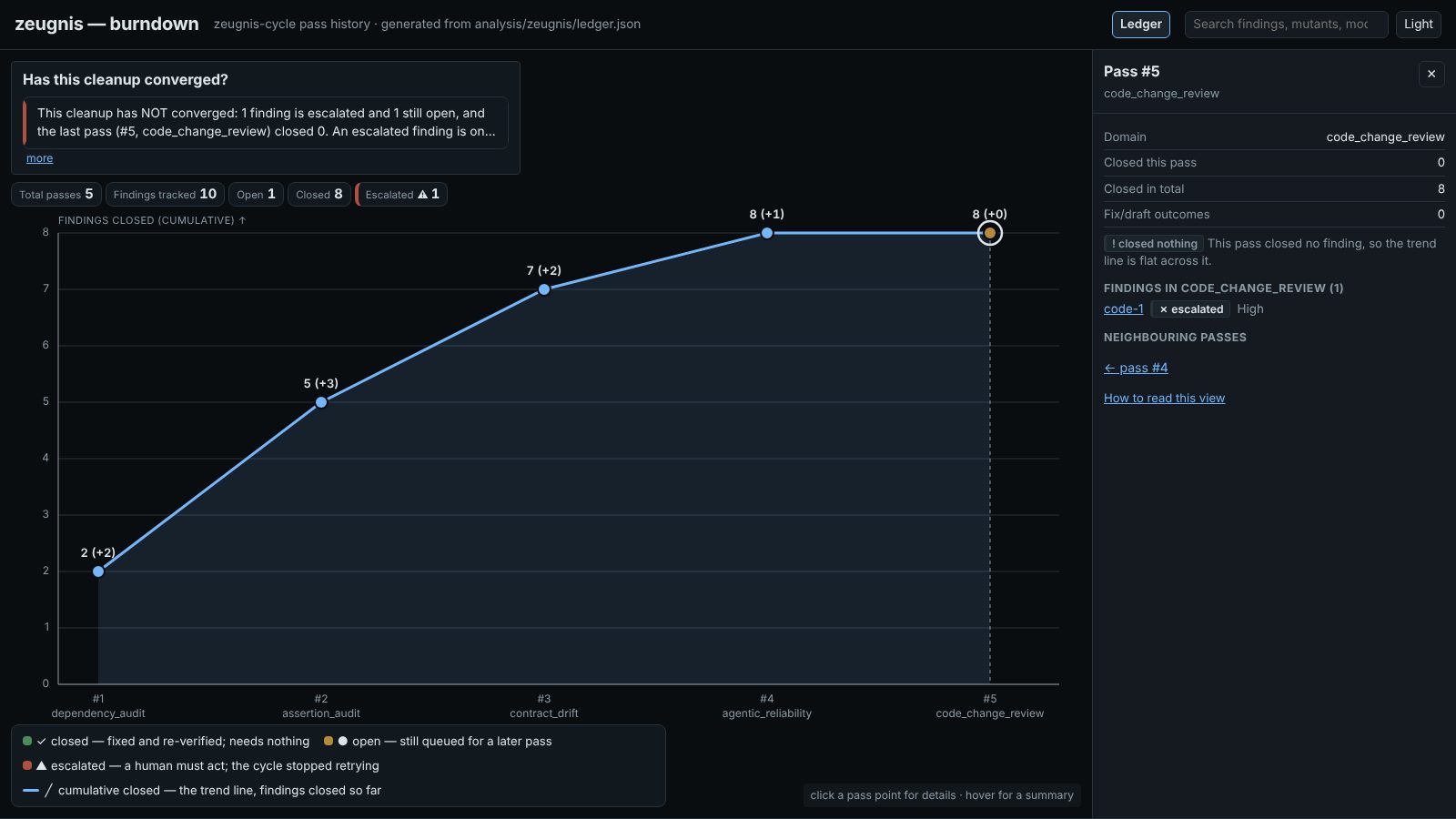
The findings below the figure are drawn from ledger.json's current-snapshot findings map; the search box in the header filters them and each expands to its evidence.
That image is reproducible rather than a one-off capture — the ledger it shows is committed at scripts/fixtures/sample_burndown_ledger.json (5 passes and 10 findings, chosen so the last pass closes nothing and one finding sits escalated with reopenCount: 4 — the thrash-guard outcome this plugin exists to surface, and the one status that never clears itself). To rebuild it:
mkdir -p /tmp/zeugnis-demo/analysis/zeugnis
cp plugins/zeugnis/scripts/fixtures/sample_burndown_ledger.json \
    /tmp/zeugnis-demo/analysis/zeugnis/ledger.json
python3 plugins/zeugnis/scripts/build_burndown_html.py /tmp/zeugnis-demo \
    --template plugins/zeugnis/assets/burndown-viewer.html \
    --d3 plugins/zeugnis/assets/inline-d3.html \
    --tokens plugins/zeugnis/assets/tokens.css
When zeugnis-mutation-harden has written analysis/zeugnis/mutation_harden_summary.json, a second view, Mutation, appears next to Ledger in the header. It answers a different question, "did the new tests kill what survived?", so it hides the ledger's convergence verdict and tiles while open:
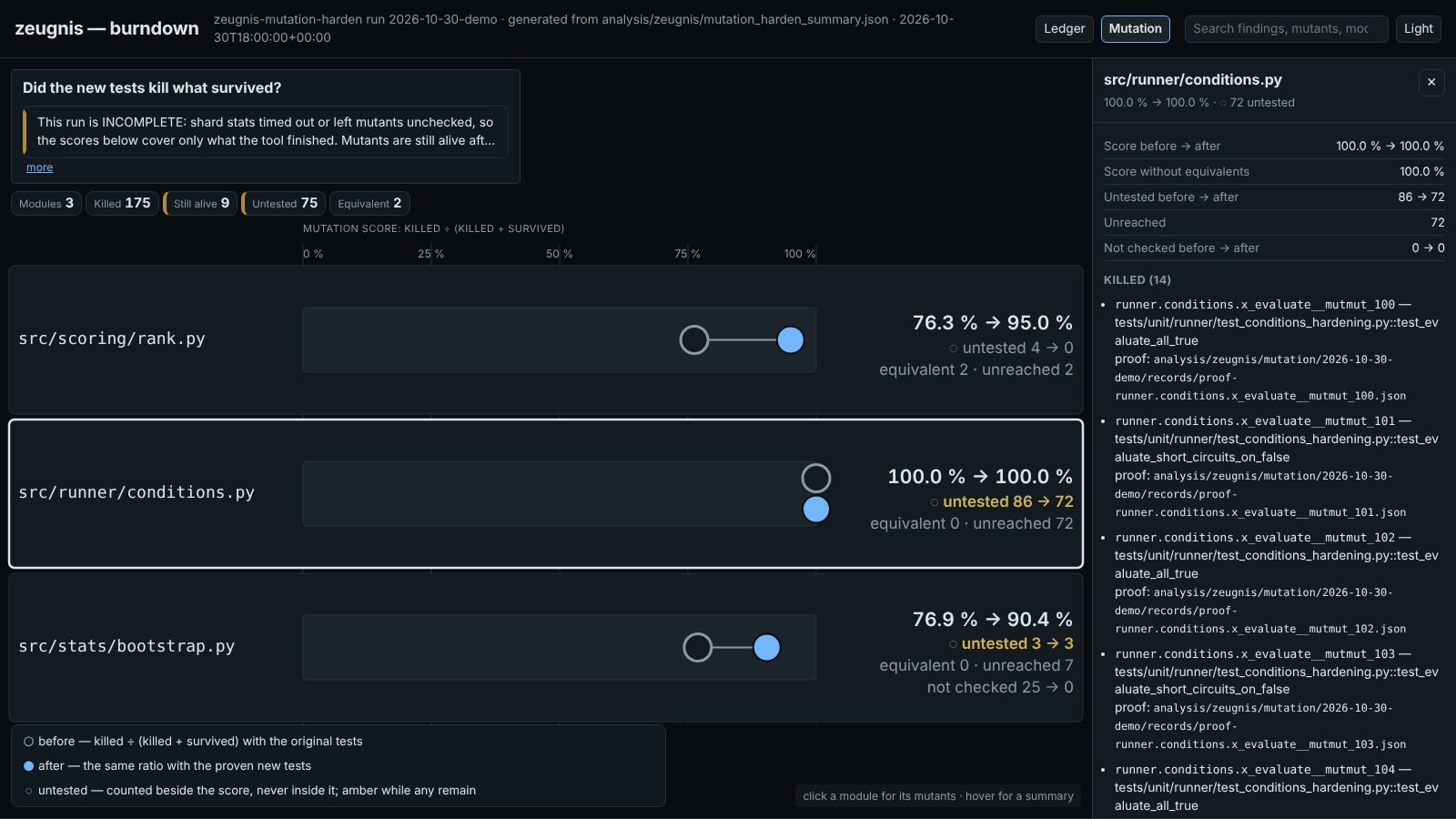
Its demo data is committed at scripts/fixtures/sample_mutation_harden_summary.json. It is chosen so that one module scores 100 % before and after while 72 of its mutants are still untested, the trap the score alone hides. One shard timed out, and one kill claim was contradicted by the re-measure. Its kill and still-alive lists match its counts. To rebuild it, add the fixture to the demo repo above, open the report with ?view=mutation, and select src/runner/conditions.py:
cp plugins/zeugnis/scripts/fixtures/sample_mutation_harden_summary.json \
    /tmp/zeugnis-demo/analysis/zeugnis/mutation_harden_summary.json
python3 plugins/zeugnis/scripts/build_burndown_html.py /tmp/zeugnis-demo \
    --template plugins/zeugnis/assets/burndown-viewer.html \
    --d3 plugins/zeugnis/assets/inline-d3.html \
    --tokens plugins/zeugnis/assets/tokens.css
The view switch and the selected module are part of the capture, not a hand step:
python3 scripts/ci/capture_viewer_screenshot.py /tmp/zeugnis-demo/analysis/zeugnis/reports/BURNDOWN.html \
    plugins/zeugnis/assets/burndown-viewer-mutation-screenshot.jpg \
    --query '?view=mutation#module-src-runner-conditions.py'
Every number has a control behind it, and every control is a real button you can reach with Tab:
- Ledger: hovering or focusing a pass point shows a crosshair and a tooltip of that pass's numbers. Click it, or press Enter or Space, to open that pass in the drawer beside the chart (its domain's findings link to their evidence below); Esc lets go of the point and closes the drawer.
- Search: the header's search box narrows the findings (and, in the Mutation view, the mutants and modules) to the ones that match.
- Mutation: a module's track opens the mutants the proven tests killed, the ones still alive, and the ones judged equivalent in the drawer; the same lists stay expandable in the Modules section below the figure.
A selection is marked by an outline and bold text, never by colour alone. Transitions use the token durations and switch off under prefers-reduced-motion.
The report states its own verdict in words before any chart: whether the cleanup converged, stalled, or is still closing findings, and what an escalated finding means. Every status colour is named in a legend that is visible without clicking anything, because --status-good/--status-bad are not separable under deuteranopia — see the mandate at the top of tools/design-tokens/tokens.css.
Mutation hardening
zeugnis-mutation-harden drives scripts/mutation_harden.py, and every step leaves a file under analysis/zeugnis/mutation/<runId>/:
| subcommand | writes | refuses |
|---|---|---|
prepare | shards/<shard>/, a fresh git archive HEAD copy whose [tool.mutmut] names only that shard | a copy or shard that already exists; uncommitted changes under the sources; an exclusion without a reason |
run-shard | records/<kind>-<shard>.run.json and .log, time-boxed, meant to run in the background | a directory that is not a marker-bearing copy; a copy that already holds mutants/ |
collect | records/<kind>-<shard>.results.json: every mutmut status counted, no tests beside the score and never in it, each mutant's diff, line and heuristic kind | collecting while the run is still running |
prove | records/proof-<mutant>.json | anything but a surviving or untested mutant; a test file outside the shard's test paths; a kill unless the test exits 0 unmutated and 1 with the mutant applied |
report | analysis/zeugnis/mutation_harden_summary.json, reports/MUTATION_HARDEN.md, records/pass.json | a kill whose proof fails or that the re-measure contradicts; an equivalent without a one-line reason |
The issue that asked for this (#142) listed what a 17,000-statement cleanup taught. Each item is a mechanism here, not advice:
- Long runs are scripts.
run-shardis a background script, and agents read its files. - Shard and time-box. One shard per module or package, each with
--time-box. A cut-off shard reportsnotCheckedandcomplete: false. - "No test" is reported apart from the score. It gets its own column.
- Fast tests only.
--testselects the tests per shard, and the skill keeps integration tests out. - Exclusions carry their reason.
--exclude GLOB=reason. - A fresh copy per run. The harness refuses to reuse one.
- The kill phase is budgeted. Lanes carry a budget, and the report counts unreached survivors.
Only mutmut 3 is driven. references/mutation-tools.md records what was checked for cosmic-ray, cargo-mutants and StrykerJS: their in-place modes are guarded, but no adapter drives them. A repository-wide workflow mode, and a CI matrix template for scheduled shard runs, are follow-ups.
Design decisions
(spec was silent here)
The behavioral spec stated obligations, not implementation details. Where it didn't specify something, these are the choices made and why:
- Output location: all zeugnis artifacts live under
analysis/zeugnis/at the repo root (reports/*.mdfor the human-readable outputs,*_summary.jsonsidecars,ledger.json, asymbol_index/snapshot cache, and a transientremediation_scope.jsonlock). The spec named filenames likeDEPENDENCY_AUDIT.mdwithout a directory; putting everything under one declared directory is what makes the write-scope enforcement inlib/paths.pypossible and keeps the repo root clean. - First-pass constraint-domain tiebreak in
zeugnis-cycle: when the ledger has no findings yet (first pass of a fresh cycle), there's no "most open High findings" signal to rank domains by.cycle_engine.pyfalls back to a fixed canonical order:dependency_audit,contract_drift,agentic_reliability,assertion_audit— roughly cheapest/fastest-to-check first. zeugnis-code-change's per-domain checks are single-pass, unverified: the spec's guarantee for this skill is "verdict always advisory," not "verification always runs" — unlike the four full domain-audit skills, a fast pre-commit check trades verification rigor for speed. If a user wants a verified result, the README and the skill's own instructions point them at the corresponding fullzeugnis-*-auditskill instead.- Typosquat heuristic:
dependency_audit.pyships a small seed list of well-known packages per ecosystem and a Levenshtein-distance-1 check. This is a first-pass heuristic, not an oracle — thedependency-auditoragent can supply additional judgment-based candidates (e.g. names engineered to look official) via--agent-findings, which get the same mandatory independent re-check as script-found candidates. - Symbol-index snapshot format: left as an opaque JSON blob the building agent/script controls the shape of;
lib/symbol_index.pyonly enforces the build-once-per-invocation, single-flight-lock behavior, not a specific schema for the index contents, since the spec doesn't define one and the two consumers (contract-auditor,assertion-auditor) have different evidence needs. zeugnis-remediator's dispatch granularity: the spec says "given a batch of findings" for the agent'smust_refuselist but "exactly one scoped fix" for its role — resolved as: the agent is always dispatched once per finding (never handed a batch to iterate itself), andzeugnis-cycleis the one that iterates the batch across separate dispatches. This is what makes thePreToolUsescope hook viable: it only ever has to reason about one active scope at a time.mutation_hardenshares the ledger but not the cycle: its proven kills are recorded throughcycle_engine.py record-pass-result(sozeugnis-statusand the burndown see them), butplan-next-passonly ever picks one of the four cycle domains, becausezeugnis-cyclehas no step that runs a mutation tool.assertion_auditstays draft-only: it judges tests and has no proof step.
Verifying a change to this plugin
python3 plugins/zeugnis/scripts/hooks/test_guard_edit_scope.py   # the edit-scope hook denies AND allows, incl. the mutation_harden test scope
python3 plugins/zeugnis/scripts/hooks/test_guard_bash_scope.py   # the bash-scope hook denies AND allows, incl. mutation tools outside a copy
python3 plugins/zeugnis/scripts/test_mutation_harden.py          # citations, kill proofs, the cycle gate (ZEUGNIS_MUTMUT=<mutmut> adds a real e2e)
python3 plugins/zeugnis/scripts/test_build_burndown_html.py      # burndown HTML renderer, known fixtures
python3 plugins/zeugnis/scripts/test_cycle_engine.py             # pass cap / reopen thrash-guard raise correctly
python3 test/plugins/lint-frontmatter.py plugins/zeugnis         # YAML that would load with EMPTY metadata
python3 test/plugins/verify-hooks-deny.py plugins/zeugnis        # both hooks deny the violation AND stay inert elsewhere
python3 test/plugins/differential-guard-cases.py zeugnis-73-grep-mentions-install zeugnis-73-real-install zeugnis-73-wrapped-install   # #73's fix pair, plus the wrapper anti-loosening case
claude plugin validate plugins/zeugnis --strict                  # manifest + structure
python3 plugins/nacharbeit/scripts/nacharbeit_lint.py plugins/zeugnis --docs-root docs   # mechanical M/H/S/A/P/D rules
guard_bash_scope.py matches mutating commands by tokenising with shlex.split and checking argv[0]/argv[1] of each shell segment (split on &&, ||, ;, |, &), not by searching the raw command string — a read-only command that merely mentions an install phrase (a grep pattern, a filename, quoted text) is no longer refused (issue #73). Before that check, a short named list of wrapper commands (sudo, env, command, nohup, nice, time, xargs, plus bare VAR=VALUE prefixes) is stripped from the front of each segment, so sudo npm install x and env FOO=1 npm install x — ordinary, non-adversarial prefixes, not evasions — are still caught; anchoring argv[0] without that step would have silently regressed coverage the old raw-string search had for free. test_guard_bash_scope.py covers inertness, the read-only-mention regression class, real mutating invocations (including a qualified-path binary, wrapped and stacked-wrapper forms, and a later pipeline segment), the wrapper skip not becoming a bypass itself, unbalanced-quote handling, and the escape hatch.
Mutation tools get a second check. A copy-only verb (mutmut run/apply/ browse, cosmic-ray exec/apply, cargo mutants --in-place, stryker run --inPlace, also behind python -m, uv run, npx and the like) is allowed only where the command's effective cwd is a harness copy. The guard follows cd across &&, ;, newlines and subshells, lexically. After |, ||, &, a heredoc or env -C the cwd is unknown, and an unknown cwd is never a copy.
Behavioural cases
bash test/plugins/verify-clean-box.sh        # ALWAYS first
bash test/plugins/run.sh new-dep-audit       # zeugnis-dependency-audit against a seeded hallucinated package
Escape hatch
Both hooks fail closed and always name their own bypass in the deny message:
guard_edit_scope.py(Edit/Write): "If this edit is unrelated to a zeugnis remediation, setZEUGNIS_DISABLE_GUARD=1for this one call, removeanalysis/zeugnis/remediation_scope.json(or the wholeanalysis/zeugnis/directory) to clear stuck state, or runzeugnis-cyclewithout--fix." Note the env var behaves slightly differently here than for the Bash guard below: this hook is the only writer ofconsumed: true, so a bypassed edit does not spend the finding's one-shot remediation budget. That is deliberate — an edit the guard never judged should not count as a finding's single authorized fix — but it means leaving the variable set through a real remediation pass silently uncaps it.guard_bash_scope.py(Bash): "If this command is genuinely needed and unrelated to a zeugnis audit, setZEUGNIS_DISABLE_GUARD=1for this one call, run it outside a zeugnis-managed session, or removeanalysis/zeugnis/from this repository to disable this guard." SettingZEUGNIS_DISABLE_GUARD=1in the environment for a single Bash call bypasses this hook without touching any repository state.
Both hooks are also inert by construction — see "What is enforced, and what is not" — until the target repository already has an analysis/zeugnis/ directory, so a repo that has never run a zeugnis skill is never touched by either guard.