
arbeitsplan
Turns a described change into a budgeted workflow, builds it several independent ways at once, and lands exactly one result.
The name. An Arbeitsplan is the routing sheet that turns a part drawing into a concrete sequence of operations — which machine, which tooling, how long. That is this plugin's job: problem drawing in, operation sequence out.
- Use when you can state a change and check it with commands, and want N independent attempts at it with one adjudicated winner applied and the rest deleted.
- Not when the problem is a question to reason through rather than a change to make — use
zirkel— or you only need an existing order enforced — usetakt— or you want a named handoff proven — useandon.
Use case
Situation. You need a per-key rate limit on the search endpoint and do not know which design will hold. "Use an agentic workflow" is the advice you have; it carries no agent count, no model tier and no stop rule. Call. /arbeitsplan:arbeitsplan-compile add a per-key rate limit to the search endpoint, covered by tests/test_ratelimit.pyWrites. analysis/arbeitsplan/<runId>/workflow.json; .claude/takt.local.md only after you approve it, because that makes takt live and fail-closed in the repo. Next. Say whether the beats may be written, then arbeitsplan-run fans the candidates out into worktrees, referees them blind and lands one diff.
arbeitsplan compile — run ap-2026-09-12-a3f1
  shape        change
  scope        src/api/search.py, src/api/limits/**, tests/test_ratelimit.py
  acceptance   3 criteria, 3 with runnable checks
  budget       9 dispatches / 25 min
  phases       build (best-of-n, fanOut 3, sonnet, auto, writes worktree)
               -> referee (blind-referee, 3, sonnet, auto, writes none)
               -> land (select-then-synthesize, 1, sonnet, auto, writes shared)

wrote analysis/arbeitsplan/ap-2026-09-12-a3f1/workflow.json
takt beats NOT written — approval required. ...
Excerpt from the "Output format" block of plugins/arbeitsplan/skills/arbeitsplan-compile/SKILL.md (the delegates and backend lines are elided).
Why this exists
Users are told to "use an agentic workflow" and don't. Not because they disagree — because the advice carries no numbers. How many agents? Which model? When does it stop? This plugin takes the transformation as its own job: in, a problem in prose; out, a spec concrete enough that a machine runs it and a hook enforces it.
Two shapes that agentic advice usually takes are, on this repository's own evidence, traps.
Serial validation does not converge. superpowers:subagent-driven-development runs up to five fix rounds per task, each one fix dispatch plus one re-review — up to ten dispatches spent purely on validation — and then concedes the outcome itself: "Past the cap, rounds don't converge — the failure is structural." It knows, and it still runs the loop five times first. So here, convergence comes from widening, never from repeating: new independent candidates under new angles. An identical re-dispatch is denied by a hook, not discouraged by prose.
One-agent-per-worktree buys conflicts. The same skill states "Never dispatch multiple implementation subagents in parallel (conflicts)", which forbids parallelism inside a worktree and forces it up to the worktree level — where the conflicts reappear at integration, and cost more. This plugin uses the same isolation mechanism, inverted:
N worktrees, the SAME scope, one angle each
  c1 ✓ builds, tests pass, diff A
  c2 ✓ builds, tests pass, diff B
  c3 ✗ no toolchain → UNMEASURED, excluded from the denominator

referee (blind: criteria + diff only, never the builder's case)
  → c2 accepted

land c2. Delete c1 and c3, worktrees and branches.
Exactly one diff is ever applied, so there is nothing to merge and a merge conflict cannot occur. Integration cost goes from O(N) conflicts to zero.
Work larger than one change — several rows of different work per wave — is the one place this plugin does merge, and only in the narrowed form described under designs and waves: disjointness proven at compile time, a gate per wave, and the target moved only on green.
What it is not
- Not a reasoning aid. A problem that turns out to be a question rather than a change is refused and routed to
zirkel, with anout-of-scope-reasoningrecord — the boundary is implemented, not asserted. zirkel already does parallel branch generation, self-consistency voting and gated hybrid synthesis well; arbeitsplan does not reimplement any of it. zirkel reasons about a question; this compiles and executes a change. - Not the ordering runtime. Ordering is
takt's charter — the beats span plugins, so no single plugin honestly owns that order.arbeitsplan-compilewrites the beat declaration; takt enforces it. This plugin's own hook covers only per-dispatch attribution, which takt structurally cannot. - Not a proof engine.
andonproves a named wire with evidence. A referee here asks a narrower question: does this diff meet these criteria. - Not a code reviewer.
nacharbeit,lehreandcupertinoeach judge work against a standard. arbeitsplan judges candidates against each other and against the acceptance criteria the run declared.
Install
/plugin marketplace add Anselmoo/werkstoff
/plugin install arbeitsplan@werkstoff
The hook is inert until a run is in flight (analysis/arbeitsplan/run_scope.json), so installing it changes nothing until you compile a workflow.
Example Prompts
Say any of these to Claude Code once the plugin is installed — they're plain-language prompts, not exact phrasing Claude has to match. Claude routes them to the skill below by intent.
Turn a vague piece of work into something runnable
"I know roughly what I want to change but not how to actually run it as an agentic workflow — turn it into one"Triggers
arbeitsplan-compile: scopes the problem, derives acceptance criteria with real commands, picks patterns from the frozen catalog, sets a dispatch budget, and writesworkflow.json. Refuses and points atzirkelif the problem turns out to be a question.
Build several versions and keep the best one
"build three independent versions of this change and land whichever one actually holds up"Triggers
arbeitsplan-run: one worktree per candidate over the same scope, a blind referee per candidate, exactly one diff applied, the losers deleted. Nothing is merged.
Ask what shape the work should take
"how many agents should I actually use for this, and when does it stop?"Triggers
arbeitsplan-patterns: names a pattern, a fan-out width, a model tier, a stop rule and a cost, each tagged with whether the number was measured or reasoned.
Compare with and without a plugin, on fresh processes
"run this same prompt three times with the plugin and three times without, on separate processes"Triggers
arbeitsplan-matrix: compiles acases × models × plugin_states × repeatssweep, proves the environment can authenticate with one cheap call, then runs it — one fresh process per cell, with a real per-cell--model.
Find out where to even start
"which workflow fits fixing this bug, what do I need to install, and should I use plan mode?"Triggers
arbeitsplan-start: matches the task to one of the four approved workflows inreferences/approved-workflows.md, names the plugins still missing with their exact install command, and states the permission mode to run in. Recommend-only — it never installs anything or writesworkflow.jsonitself. "No fit" is a valid answer.
Decide how the work should run
"should this run as a workflow of parallel agents, a matrix of fresh processes, or just in this session?"Triggers
arbeitsplan-backend: walks the decision table inreferences/backend-selection.mdand returns thebackendobjectworkflow.jsonneeds — the kind, the table rows that chose it, and the acknowledged gap when it isworkflow. Refusesworkflowfor any phase that writes the shared tree. Recommend-only.
Find out why something was refused
"the swarm just stopped and said the contract is wrong — what happened?"Triggers
arbeitsplan-status: reads the run'srun.jsonl— phases closed and open, a halt with its reason, refuted candidates, open doubts, budget used, whether a lock is still open — and quotes the single next command.
Design the workflow before running it
"before anything runs, walk me through this workflow step by step — what each step does, where it runs, when, and on which model"Triggers
arbeitsplan-design: builds the design table node by node in plan mode, writes every command in the repository's own toolchain (a gate or a state helper becomes a declared script node, in whatever language the project uses), validates it withcompile_spec.py --design, preflights each toolchain, and asks for approval against the design's sha256. Then prints the handoff — launch in a later turn than the install whenever the design created agent types, or in a fresh session with the exact start prompt it prints.
Run a restructuring in waves
"this refactor is several waves of parallel work, each building on the last — set it up so it can stop and resume"Triggers
arbeitsplan-waves: installs the approved wave design as project-owned files — a pinned interpreter, the plan, a state helper, a guard, one agent file per role — and runs it from the primary checkout. A red gate stops it with the target unmoved; a relaunch skips every finished wave and builder.
Designs and waves (#107, #106)
arbeitsplan-compile picks a pattern per phase. arbeitsplan-design answers what it leaves in prose — per node: what (goal, strict output schema), where (primary checkout, agent worktree, scratch directory), when (dependencies; a human gate only between runs) and how (kind, a recommended per-node model, write scope, and for a script node the exact command and the toolchain that runs it). compile_spec.py --design validates it against references/design-table-schema.md; every rule the issues name has a red fixture.
Script nodes are how a deterministic step stops being an agent told to run a command. A Workflow script cannot exec, so a script node is one dispatch to a runner whose only tool is Bash, whose guard allows exactly the declared command once, and whose {exit, stdout_digest, parsed} is checked in code. The command is in whatever toolchain the project uses — shell, PowerShell, Go, Rust, Haskell, Java, .NET, Node, Python, Julia, R, make, CMake, or one the design declares — and preflight probes each one it names.
Waves are a design whose rows carry wave. arbeitsplan-waves installs it as project-owned files that run without werkstoff, and workflows/waves.js interprets it. What the hand-written prototype got wrong is now a check in code: launching from a linked worktree halts; every row merges --ff-only to its wave base and a wrong baseSha halts; a finished wave is skipped before any builder is dispatched; merges go to an integration branch and the target moves only when every declared gate is green in both the primary checkout and a clean worktree (a failure only the primary shows is labelled primary-only); a swarm row's losers are never merged; prompts carry ids and branch names only. Concurrent rows own disjoint files, proven by a conservative, case-folded overlap check; an integrator row after them owns the module manifest and lockfile most ecosystems edit per new module.
Authored steps. When the deterministic step a design needs does not exist yet, the script node authors it: script.author = {model, purpose, sample}, in bash, pwsh, ruby, node (.mjs — every .js under .claude/workflows/ is a workflow to Claude Code) or python. The runtime is the language and the path is fixed, so neither is a key a design can get wrong. A shell-less author agent writes the file; <name>_state.py verify-step checks its syntax without running it, runs its sample in a throwaway worktree and validates its stdout against the node's strict schema; and the runner guard refuses to run a step whose file or contract changed since. test_authored_steps.py drives all five languages end to end.
Generated agents honour the design. scripts/agent_gen.py writes each <name>-* agent file with the node's effort, tools and skills (which the installer used to validate and then drop), and the validator refuses nodes that share an agent type but disagree on what its one file should say. Next to the interpreter, install_waves.py writes <name>.md — a runbook for the people who own the installed tooling. Claude Code needs no markdown for a workflow and ignores it.
The two inversions
| the usual shape | here | |
|---|---|---|
| converge by | deepening — retry the same scope until a reviewer passes it | widening — new independent candidates under new angles |
| parallelise by | partition — split the work, reconcile at the end | redundancy — same scope N times, keep one, delete the rest |
| unmeasured run | counted as a failure | excluded from the denominator |
That last row is the quiet one, and it is the invariant everything else rests on. A candidate whose worktree would not build was never fairly tried. Counting it as a rejection makes the circuit breaker measure the weather instead of the work — and in any design with a retry, a weather reading is what starts the loop. This repository has derived the same rule three times independently: test/plugins/run.sh's ERROR ("a case whose error count is above zero has no rate, only missing data"), matrize's readable: false, and quo-warranto's INDETERMINATE ("not FAIL, because the case was never fairly measured").
The circuit breaker
Judged per batch, never cumulatively — a cumulative rate lets healthy early batches mask a batch that has started failing, and fires one full expensive batch too late.
| condition | meaning | response |
|---|---|---|
measured == 0 | nothing was built at all | acquisition problem — fix the environment, not the contract |
accepted × 3 < measured × 2 | under two thirds usable | contract problem — the correct response is a better contract, not more agents |
| no candidate accepted | all N failed the same way | halt and surface — never re-dispatch |
The run directory is the plan of record
The plan is a file the compiler writes once; until this release the execution was a chat transcript, so a halted run looked exactly like an abandoned one and no run could be resumed. Now both live on disk, each written by code:
analysis/arbeitsplan/<runId>/
  workflow.json         the plan — immutable after compile         compile_spec.py
  run.jsonl             the execution — append-only, span-shaped   record_event.py, worktree_pool.py
  candidates/<id>.json  one file per candidate, written once       record_event.py
  referee/<id>.json     one file per verdict, written once         record_event.py
  phases/<id>.json      a plan-mode phase's output                 record_event.py
  landed.json           what landed, with divergedFrom if edited   land_candidate.py
dispatch/<sha>.json the re-dispatch ledger arbeitsplan_guard.pyrun.jsonl's events carry OpenTelemetry-GenAI-shaped ids (trace_id, span_id, parent_span_id, span, node_id) with no OTel dependency, and a status from a closed set — proposed | accepted | refuted | doubt plus lifecycle states. A losing candidate stays in the record as refuted; a doubt must carry resolves_if. The writer is tools/run-record/run_record.py, vendored here as scripts/run_record.py.
Three refusals make the record load-bearing rather than a log nobody writes: worktree_pool.py close refuses a phase that recorded no terminal event (--halt "<reason>" records one); a Stop hook refuses one completion while an armed phase is unrecorded; and reconcile.py joins every acceptance id to recorded evidence, running each check itself with --run-checks rather than trusting the referee's transcript.
Measurement gates landing (#76)
reconcile.py --run-checks could always measure, but nothing in the operator's path ran it before a landing — a builder's self-reported checks: [{id, command, exit}] went straight to land_candidate.py --apply on trust. reconcile.py --run <runId> --run-checks --candidate CID --tree DIR, run from the main repository root, closes that gap: it re-runs every checked criterion of the run's acceptance with cwd=DIR — the candidate's own worktree, not the main tree — and appends one execute_tool event per check to the run's run.jsonl, each carrying detail.candidate == CID. Comparing that against candidates/CID.json, by criterion id only — never by the builder's own command spelling — prints CONTRADICTION <id>: ... (exit 1) for any disagreement, in either direction.
land_candidate.py --apply reads exactly those events as its landing gate: it refuses a candidate lacking its own measurement (detail.candidate must equal that candidate — another candidate's measurement never unlocks it) for any checked criterion, or whose latest measurement contradicts its report, naming reconcile.py and --run-checks as the remedy. An honestly-reported failure a referee already accepted is not blocked — the gate is "unmeasured or contradicted", nothing more. Every refusal land_candidate.py makes is recorded in run.jsonl too: an execute_tool land_candidate event, status refuted, node_id the candidate.
A contradiction is a reported exit that disagrees with the measured one, nothing else (land_candidate.contradicts() is the one comparator both this gate and reconcile.py's --candidate mode call, so they cannot diverge). Two things are never a contradiction: the builder's own spelling of a command (grouping is by criterion id, and the measured side always uses the contract's own command), and a criterion the builder never reported at all (an empty report carries no claim — the criterion still needs its own measurement, or it stays unmeasured, never contradicted).
Cleanup preserves dirty losers (#80)
Deleting a losing worktree used to be git worktree remove --force, unconditionally — a rejected candidate's uncommitted state was simply gone, and the throwaway arbeitsplan/<runId>/<cid> branch was never deleted at all. worktree_pool.preserve_then_remove is now the one place under scripts/ that calls git worktree remove (sweep_artifacts.py imports it rather than shelling out a second copy): a DIRTY worktree (tracked changes, or untracked non-ignored files) is committed in full and kept/<runId>-<cid> is pointed at that commit before the worktree or its branch is removed; a clean worktree gets no kept/ branch. FAIL CLOSED — if preservation cannot write (a read-only object store, for instance), that worktree and its branch are left exactly in place and sweep_artifacts.py --apply exits 1. sweep_artifacts.py stays dry-run-by-default (a dry run now also names, per dirty worktree, the kept/ branch it would create and every candidate branch it would delete) and record-gated (a run that has not ended keeps its worktrees and branches and gets no kept/ branch either).
Backends, and the plan-node stop
backend is an object — {kind, why[], acknowledgedGaps[]} — and arbeitsplan-backend picks it from references/backend-selection.md. Under workflow, workflows/run.js executes spec.phases itself, counts the dispatch budget in code (no hook sees a Workflow dispatch), and halts before every mode: "plan" phase with pending_plan_node: with a run-scope lock open, plan mode has no legal write. worktree_pool.py open refuses a plan-mode phase for the same reason. The compiler refuses workflow for any phase that writes the shared tree; candidates return diffs as data and the session lands one with land_candidate.py.
scripts/test_run_workflow.js executes run.js against stub hooks — no tokens — and then sabotages it nine ways; each planted defect must turn the suite red.
Hooks
A PreToolUse hook, type: "command", matching Skill|Task|Agent|Write|Edit|MultiEdit, and a Stop hook (below). Never type: "prompt" — a prompt hook asks a model to decide, and a model asked whether it may retry is the thing being governed.
It denies four things: an identical re-dispatch, a write to the shared tree during a fan-out, a write outside writeScope, and a dispatch past the declared budget.
The re-dispatch ledger is the guard's own. A guard that checks a list some skill was supposed to append to is a guard predicated on its own input existing — it fails open exactly when the skill misbehaves, which is the case it was written for. So the hook records every dispatch itself, one file per signature created with O_CREAT|O_EXCL: a repeat dispatch is that create failing with EEXIST. No read-modify-write, no lock file, race-free across parallel candidates by construction.
It gates on a per-dispatch lock, never on repo-level state. A guard in this repository once gated on repo-level state and swept every edit in the session — from any plugin — into its gate; parallel writers are exactly the case that breaks repo-level gating, and parallel writers are this plugin's premise.
Inert unless analysis/arbeitsplan/run_scope.json exists. Fail-closed past that point. Python ≥ 3.11, checked once a run is in flight: below it the guard denies naming the version it found, instead of failing on the first 3.11-only call with a bare traceback.
The Stop hook refuses one completion while the armed phase has recorded no terminal event in run.jsonl, naming the two legal moves. It never blocks twice — stop_hook_active allows — so it cannot trap a session.
The matrix backend
A second way to run a swarm: one fresh claude -p process per candidate instead of one in-session dispatch. cases × models × plugin_states × repeats at 1 × 1 × 1 × N is the swarm, with isolation in-session dispatch cannot offer — a fresh registry, and a --model that cannot be inherited from the caller.
Isolation is structural rather than enumerated: an empty temp cwd, --setting-sources project, --strict-mcp-config, and --plugin-dir on the enabled arm only. Enumerating everything currently installed goes stale silently; this does not.
Two traps it carries deliberately:
--allowedToolsdoes not restrict the tool surface. It is a permission allowlist.--disallowedToolsrestricts. A matrix that setsallowed_toolsis rejected with that explanation rather than quietly honoured.- Denying is best-effort; the assertion is the gate. The disallow list will go stale, so a cell that reached outside
expected_toolsis scoredUNMEASURED— neverFAIL, because the case was never fairly measured.
Authentication is probed, not assumed. An earlier version refused to run whenever it detected a nested Claude Code session, on the strength of a measurement made in another repository. That does not reproduce here, and the refusal was redundant anyway — a cell that hits an auth banner is already UNMEASURED with the reason. The runner now makes one cheap call first: if it authenticates the sweep runs, and if it does not the runner refuses and prints what the probe actually got, which a blanket refusal never could. --skip-probe bypasses it.
Delegation, and why it does not replace takt
Every plugin declares what it produces and requires in .claude-plugin/beats.json; emit_beats.py --repo-only compiles the union into one .claude/takt.local.md, and takt enforces it. The repo's cross-plugin order becomes one readable artifact instead of prose scattered across seven guards.
Delegation itself — who dispatched whom, how deep — is a different axis, recorded in an append-only delegation.jsonl and bounded by depth 3 plus cycle detection, both in the hook. The two rules catch different things: a cap bounds a runaway chain A→B→C→D, while A→B→A is depth 2 and would sail under any cap. See references/delegation.md.
That is also why takt is not redundant: a delegation ledger cannot express "no *.tsx write until the council has run" — there is no dispatch to record.
Composing with takt
arbeitsplan-compile generates .claude/takt.local.md, and takt enforces it. That is why ordering is absent from this plugin's own hook: two guards answering one question is two answers that will drift.
Beats are namespaced by runId, so a marker from an earlier run cannot satisfy this run's beat — takt gained an optional runId field for exactly this, and a declaration without one behaves as it always did.
Writing that file makes takt live and fail-closed in your repository, so it is written only behind an explicit approval gate. And if a declaration already exists without this plugin's provenance key, emit_beats.py refuses rather than replacing it: takt reads only the first fenced block, so there is no safe merge, and overwriting would silently switch off rules somebody meant.
The run report
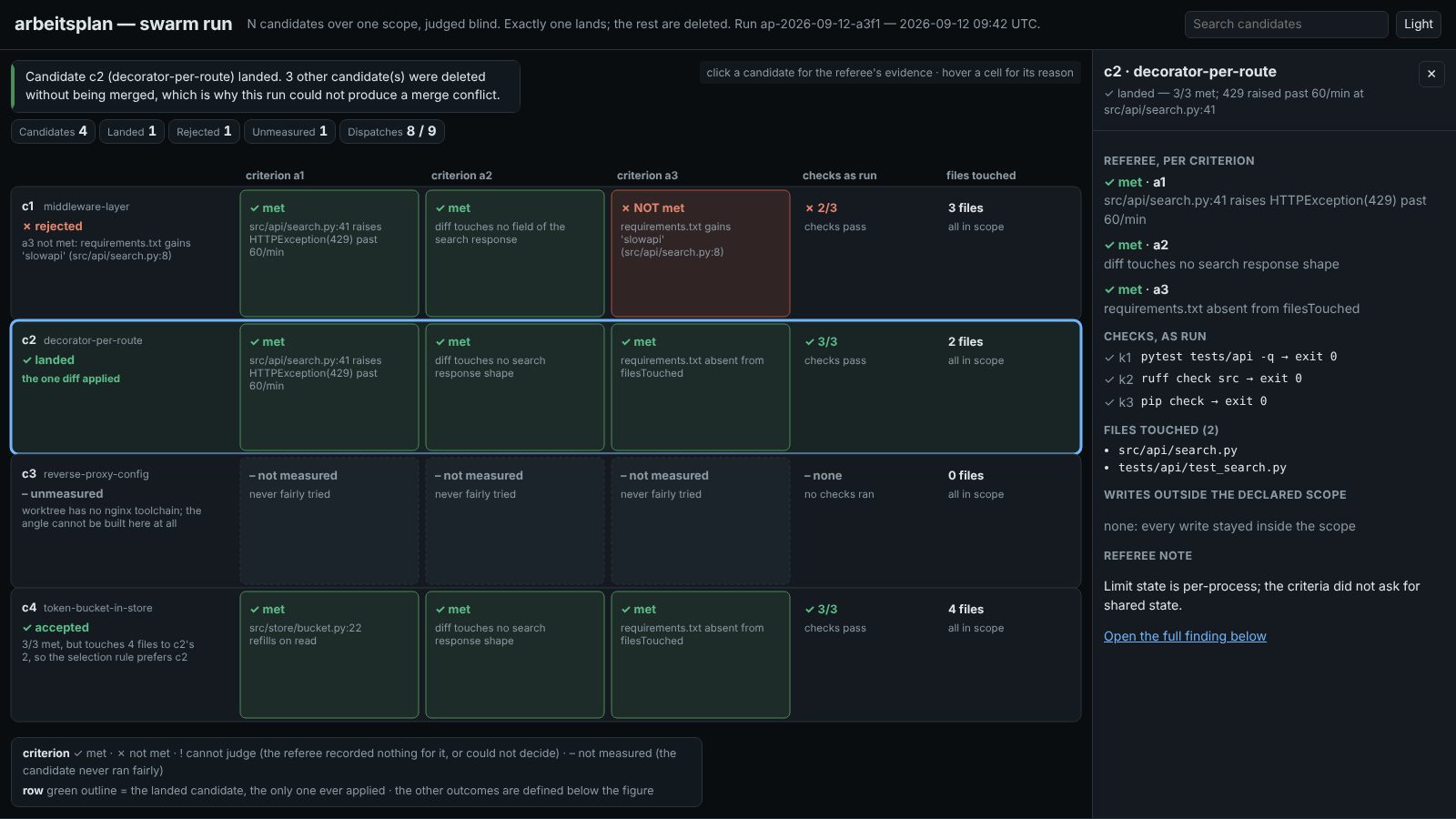
python3 plugins/arbeitsplan/scripts/build_run_html.py --run <runId> --out /tmp/run.htmlRendered from committed demo data at scripts/fixtures/run-demo.json, so the picture is reproducible rather than a snapshot of one machine. That fixture deliberately carries all four outcomes — landed, accepted, rejected and unmeasured — because a demo missing any of them cannot show what that state looks like, and unmeasured is the one a reader most needs to see excluded from the breaker's denominator.
Every outcome is a word plus a glyph; colour is a third channel on top of two that already work without it.
The design report
python3 plugins/arbeitsplan/scripts/build_design_html.py \
  --design analysis/arbeitsplan/<runId>/design.json \
  [--state <`<name>_state.py show` output>] [--preflight <{toolchain: true|false}>] \
  [--workflow analysis/arbeitsplan/<runId>/workflow.json] --out /tmp/design.html
python3 plugins/arbeitsplan/scripts/build_design_html.py \
  --bundle plugins/arbeitsplan/scripts/fixtures/design-demo.json --out /tmp/design.html
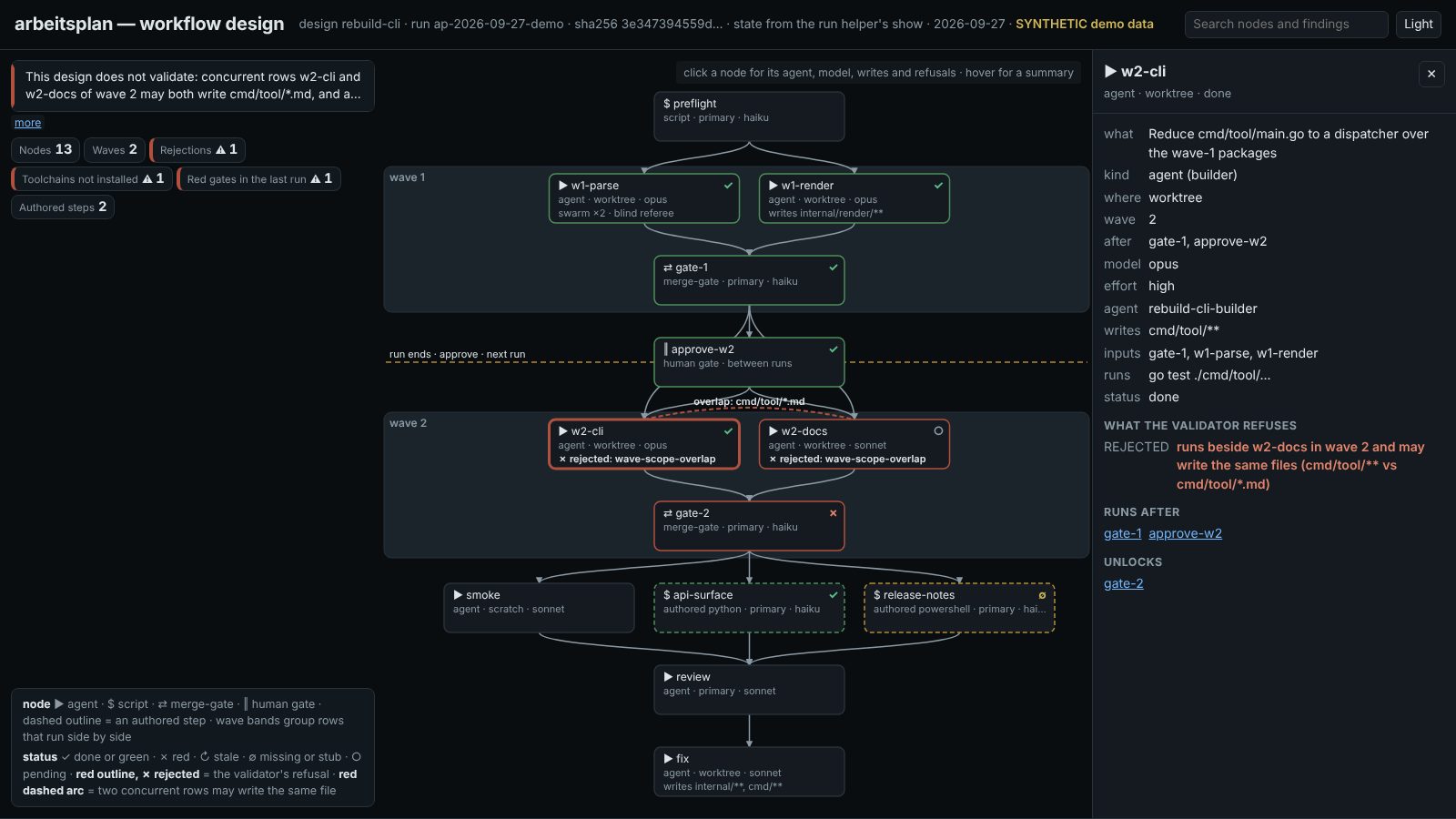
A design table is a list of rows; what a reader needs to see is a graph: which rows run side by side, which two of them may write the same file, where a human gate ends one run and starts the next, where the last run stopped. The page draws the design top to bottom by longest-path layering, with waves as bands, and puts every node's what, where, when and how one click away. Everything on it is computed, not described. Rejections come from design_spec.py, overlaps from land_candidate.py, statuses from the state helper's show, toolchains from preflight results, and the compiled workflow's phases from compile_spec.py. A toolchain nobody probed reads "not probed", never "installed".
The demo, scripts/fixtures/design-demo.json, is SYNTHETIC and carries the failures the page exists for. The last run stopped red at gate-2 on a primary-only finding. The revised draft adds a docs row whose scope overlaps w2-cli, and a PowerShell step on a machine without pwsh.
Verifying a change to this plugin
python3 test/plugins/lint-frontmatter.py plugins/arbeitsplan
claude plugin validate plugins/arbeitsplan --strict
python3 plugins/nacharbeit/scripts/nacharbeit_lint.py plugins/arbeitsplan --docs-root docs
python3 plugins/arbeitsplan/hooks/test_arbeitsplan_guard.py
python3 test/plugins/verify-hooks-deny.py plugins/arbeitsplan
bash plugins/arbeitsplan/scripts/run_matrix.sh --selftest
python3 plugins/arbeitsplan/scripts/compile_spec.py --selftest
python3 plugins/arbeitsplan/scripts/emit_beats.py --selftest
python3 plugins/arbeitsplan/scripts/worktree_pool.py selftest
python3 plugins/arbeitsplan/scripts/land_candidate.py --selftest
python3 plugins/arbeitsplan/scripts/run_record.py selftest
python3 plugins/arbeitsplan/scripts/record_event.py selftest
python3 plugins/arbeitsplan/scripts/reconcile.py --selftest
python3 plugins/arbeitsplan/scripts/sample_rederive.py --selftest
python3 plugins/arbeitsplan/scripts/sweep_artifacts.py --selftest
python3 plugins/arbeitsplan/scripts/check_contract_sync.py --selftest
python3 plugins/arbeitsplan/hooks/test_record_stop_guard.py
node plugins/arbeitsplan/scripts/test_run_workflow.js
python3 plugins/arbeitsplan/scripts/design_spec.py --selftest
python3 plugins/arbeitsplan/scripts/test_red_fixtures.py
node plugins/arbeitsplan/scripts/test_waves_workflow.js
python3 plugins/arbeitsplan/scripts/waves_state.py selftest
python3 plugins/arbeitsplan/scripts/waves_guard.py --selftest
python3 plugins/arbeitsplan/scripts/install_waves.py --selftest
python3 plugins/arbeitsplan/scripts/handoff.py --selftest
python3 plugins/arbeitsplan/scripts/agent_gen.py --selftest
ARBEITSPLAN_REQUIRE_TOOLCHAINS=1 python3 plugins/arbeitsplan/scripts/test_authored_steps.py
python3 plugins/arbeitsplan/scripts/build_design_html.py --selftest
python3 plugins/arbeitsplan/scripts/probe_runtime.py --selftest
python3 plugins/arbeitsplan/scripts/check_contract_sync.py
bash scripts/ci/check-js-syntax.sh
probe_runtime.py --selftest proves the instrument that measured the runtime behaviours arbeitsplan depends on (ADR 0004): plan mode in a worktree, resume across EnterWorktree, prompt-cache reuse, when a new agent type resolves, and where an isolated worktree starts. The measurement itself spends tokens — about 55 haiku runs, capped at $0.50 each — and is run by hand after a CLI upgrade, never in CI:
python3 plugins/arbeitsplan/scripts/probe_runtime.py --probe all --n 3 --out analysis/probes/<stamp>node --check is gone from this list on purpose. Under Node's module auto-detection, export const meta makes it parse a workflow as an ES module, where the top-level return every correct workflow carries is illegal — all fifteen failed under Node 26 without a file changing. check-js-syntax.sh parses the body as the runtime does, as an async function.
test_arbeitsplan_guard.py is sabotage-tested, and the sabotages are worth running rather than trusting — each is named in its docstring. Make dispatch_signature return a constant and the WIDEN cases must go red; drop O_EXCL and REPEAT must; make matches return True and SCOPE must. A guard whose test cannot fail reports success every run and nobody looks again.
run_matrix.sh --selftest runs two end-to-end checks against a stub CLI, and they exist because validation alone would have caught neither of the two bugs that shipped in the argv builder during development: tab used as a field separator (an IFS whitespace character, so the empty plugin_dir of the disabled arm collapsed and swapped the two ablation arms), and printf '%s' without a trailing newline (so read hit EOF and the enabled arm got no --plugin-dir at all). Both produced a full table of PASSes. An ablation whose arms are wrong is worse than no ablation, because it reports a number.
Escape hatch
ARBEITSPLAN_DISABLE_GUARD=1 bypasses the guard, and it is named in every denial message. Closing the run (rm analysis/arbeitsplan/run_scope.json) makes the hook inert again.
A denial from another plugin's guard is that plugin doing its job. Report it; do not reach for its escape hatch.