

The Skill System
Domain Coverage
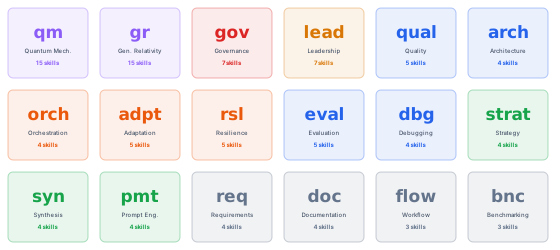
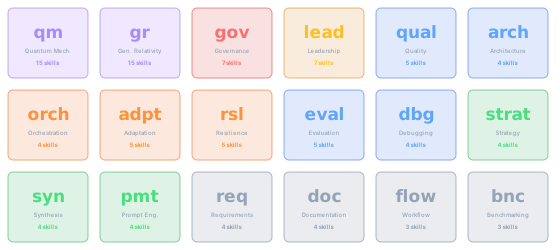
Section titled “Domain Coverage”All 102 skills are organized into 18 domain groups. The domain prefix determines which dispatch tier handles each skill — qm-* and gr-* route through the physics-gated tier; gov-* is always governance-reviewed.
Instruction-First Architecture
Section titled “Instruction-First Architecture”The public MCP surface exposes 20 instruction tools — high-level mission verbs like system-design, feature-implement, issue-debug. These are the only entry points consumers interact with.
Beneath each instruction tool is a skill pipeline: the instruction resolves which skills to invoke based on the request, orchestrates them in the right order (serial, parallel, or cascade), and synthesizes the results into a single coherent output.
flowchart LR
    A([Consumer]) --> B[Instruction Tool\ne.g. system-design, issue-debug]
    B --> C[Skill Pipeline\nskill-1 · skill-2 · skill-3 · ...]
    C --> D([Synthesized Output])
    style A fill:#334155,color:#e2e8f0,stroke:#475569
    style B fill:#7c3aed,color:#fff,stroke:#6d28d9
    style C fill:#1e40af,color:#fff,stroke:#1d4ed8
    style D fill:#15803d,color:#fff,stroke:#166534
Skills are never called directly by consumers. They are internal workflow assets.
What is a Skill?
Section titled “What is a Skill?”A skill is a focused, single-purpose AI workflow step with:
- A canonical ID (
qm-superposition-generator,gov-prompt-injection-hardening, etc.) - A preferred model class (
free,cheap,strong,reviewer) - A domain prefix that determines dispatch tier
- A description of exactly when to invoke it
- A source implementation under
src/skills/<domain>/<skill-id>.ts
18 Skill Domains
Section titled “18 Skill Domains”| Domain | Prefix | Count | Gated? | Purpose |
|---|---|---|---|---|
| Requirements | req- | 4 | No | Scope clarification, acceptance criteria, ambiguity detection |
| Architecture | arch- | 4 | No | Reliability, scalability, security, system design |
| Quality | qual- | 5 | No | Code analysis, performance, security, review, refactoring priority |
| Debugging | debug- | 4 | No | Assistant, postmortem, reproduction, root cause |
| Documentation | doc- | 4 | No | API docs, README, generator, runbook |
| Evaluation | eval- | 5 | No | Design, output grading, prompt, prompt-bench, variance |
| Benchmarking | bench- | 3 | No | Analyzer, blind comparison, eval suite |
| Workflows | flow- | 3 | No | Context handoff, mode switching, orchestrator |
| Governance | gov- | 7 | No | Data guardrails, model compatibility, policy validation, prompt injection hardening, regulated workflow design, workflow compliance |
| Orchestration | orch- | 4 | No | Agent orchestrator, delegation, multi-agent, result synthesis |
| Prompting | prompt- | 4 | No | Chaining, engineering, hierarchy, refinement |
| Research | synth- | 4 | No | Comparative, engine, recommendation, research |
| Strategy | strat- | 4 | No | Advisor, prioritization, roadmap, tradeoff |
| Resilience | resil- | 5 | No | Clone/mutate, homeostatic, membrane, redundant voter, replay |
| Adaptive | adapt- | 5 | Yes (ENABLE_ADAPTIVE_ROUTING) | ACO router, annealing, Hebbian router, Physarum router, quorum |
| Leadership | lead- | 7 | No | Capability mapping, digital architect, exec briefing, L9 engineer, software evangelist, staff mentor, transformation roadmap |
| Quantum Mechanics | qm- | 15 | Yes (ENABLE_PHYSICS_SKILLS) | 15 QM metaphor skills — coupling, coverage, style via quantum analogies |
| General Relativity | gr- | 15 | Yes (ENABLE_PHYSICS_SKILLS) | 15 GR metaphor skills — technical debt, gravitational mass, refactoring paths |
Skill Gating
Section titled “Skill Gating”Three domains are gated behind environment variables:
# Physics skills (qm-* and gr-*, 30 skills total)ENABLE_PHYSICS_SKILLS=true
# Bio-inspired adaptive routing (adapt-*, 5 skills)ENABLE_ADAPTIVE_ROUTING=true
Ungated skills run by default. Gated skills silently fall back to conventional analysis unless the gate is open — they never fail, they degrade gracefully.
Dispatch Tiers
Section titled “Dispatch Tiers”Skill prefix determines which dispatch tier in skill-handler.ts:
| Prefix group | Tier |
|---|---|
qm-, gr- | Physics tier |
gov- | Governance tier |
adapt- | Adaptive tier |
| Everything else | Core tier |
Each tier can add validation, logging, or pre/post hooks specific to that domain.
Skill IDs and Aliases
Section titled “Skill IDs and Aliases”Skills have a canonical ID (e.g., qm-superposition-generator) and may have legacy aliases for backward compatibility. The spec file src/skills/skill-specs.ts bridges legacy IDs to canonical ones. Always use canonical IDs in code; legacy aliases continue to dispatch but are not advertised.
Verifying Coverage
Section titled “Verifying Coverage”The scripts/verify_matrix.py script enforces zero orphan skills — every skill must appear in at least one workflow in src/workflows/workflow-spec.ts. Run it as part of the quality gate:
python3 scripts/verify_matrix.pySee Also
Section titled “See Also”- Skill Domain Reference — all 102 skills organized by domain
- Philosophy — why instruction-first architecture
- Orchestration Patterns — how skills are orchestrated