

Philosophy & Architecture
The “Software Evangelist” Mandate
Section titled “The “Software Evangelist” Mandate”In modern AI agent architecture, humans are the bottleneck and the carriers of emotional legacy debt. The primary tenet of the Guidelines orchestration is Radical Forward Movement.
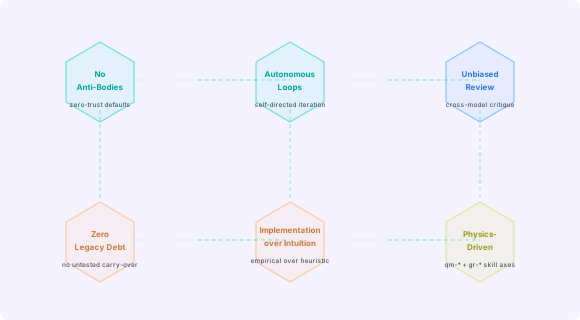
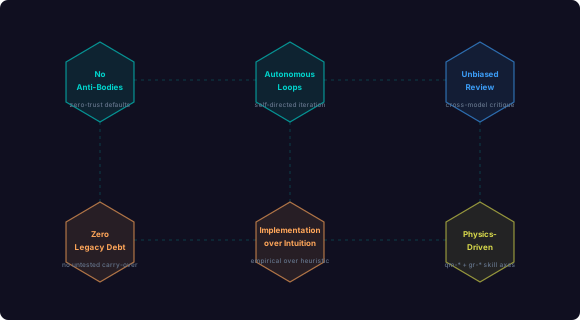
No Anti-Bodies
Section titled “No Anti-Bodies”Every dependency is a first-class citizen. If an integration requires duct tape, it is rejected. This means:
- Dependencies (Zod, AI SDK, xstate) are integrated cleanly or not at all
- No shim layers, no version-pinning workarounds that survive longer than one sprint
- The
qualitypipeline (npm run quality) is mandatory — no merge bypasses
Autonomous Loops
Section titled “Autonomous Loops”The agent ecosystem operates on state machines where failing tests automatically throw back to debug loops. Humans do not babysit test runners.
test-verify (failing) → auto-chain to issue-debug → fix → test-verify (re-run)This pattern is enforced via workflow FSMs in src/workflows/workflow-spec.ts and the task-bootstrap auto-chain mechanism.
Unbiased Architectural Review
Section titled “Unbiased Architectural Review”Physics and metaphor analyses (QM/GR skills) strip subjective arguments out of coupling disputes. When two engineers disagree about whether a module is “too coupled”, the qm-entanglement-mapper gives an objective entanglement coefficient. No more “I feel like this is too coupled.”
Zero Legacy Debt
Section titled “Zero Legacy Debt”Code is continuously evaluated. Any module detected with high spacetime_debt or event-horizon metrics by the QM/GR pipelines is refactored without asking for permission.
This is not aspirational — it is enforced through:
gr-spacetime-debt-metricskill: computes accumulated technical debt as relativistic spacetime curvaturegr-event-horizon-detectorskill: flags modules past the “point of no return” for refactoring
Implementation over Intuition
Section titled “Implementation over Intuition”Code remains the source of truth. This means:
- Documentation follows code, not the other way around.
docs-generateproduces docs from source; source is never written to match wishful docs - Workflow state handling lives in
src/infrastructure/state-machine-orchestration.tswith machine-readable specs insrc/workflows/workflow-spec.ts - Every claim in architecture docs is verifiable by a test or a generated artifact
The current docs contract verifies that:
- Each implemented workflow has Markdown/JSON documentation
- Workflow specs can render Mermaid state diagrams
- The skill coverage graph has zero orphan skills
The Skill Count Discipline
Section titled “The Skill Count Discipline”102 skills are not an accident. The count is precisely tracked because:
- Skill inflation is complexity debt: every skill added must justify its existence in the coverage matrix
- Domain prefix uniqueness prevents collision and enables tier dispatch
scripts/verify_matrix.pyis the automated guardian — it fails CI if any skill is orphaned from a workflow
Why MCP?
Section titled “Why MCP?”The Model Context Protocol was chosen because:
- Transport-agnostic: stdin/stdout today, WebSocket tomorrow — the server code does not change
- Tool discovery:
tools/listgives hosts a clear catalog without documentation parsing - Host ecosystem: Claude Desktop, VS Code Copilot, Cline, and others support it natively
- Composability: multiple MCP servers can coexist — this server can chain to GitHub MCP, Serena, or any other
Advisory-Only by Design
Section titled “Advisory-Only by Design”This server produces advisory outputs — recommendations, analysis, generated artifacts — but makes zero runtime LLM calls itself. The orchestration layer decides which model to assign to each skill, but the actual LLM inference happens in the host’s own model execution environment.
This is a deliberate security and cost boundary: the server cannot exfiltrate data through LLM calls, and model costs are controlled by the host.
See Also
Section titled “See Also”- The Skill System — instruction-first architecture details
- Orchestration Patterns — multi-model pattern reference
- Physics Skills QM — quantum mechanics code metaphors
- Physics Skills GR — general relativity code metaphors