

Model Routing
Core Rule
Section titled “Core Rule”Model IDs are dynamic. Never hardcode display names or model IDs in source code. Use role classes (free, cheap, strong, reviewer) in code; the router resolves the actual model at runtime from orchestration.toml.
// ✅ Correct — use role classconst model = modelRouter.resolveForClass("strong");
// ❌ Wrong — hardcoded model nameconst model = "claude-sonnet-4-6"; // will break when model roster changes
Role Classes
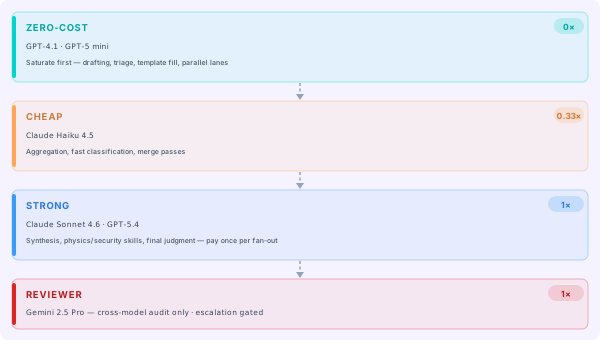
Section titled “Role Classes”| Class | Use case | Cost multiplier |
|---|---|---|
free | Broad drafting, fan-out, template fill, triage | 0× |
cheap | Aggregation, fast classification, merge, routing | ~0.33× |
strong | Synthesis, physics, security, final judgment | 1× |
reviewer | Cross-model audit, independent critique | 1× |
orchestration.toml is the Authority
Section titled “orchestration.toml is the Authority”The orchestration.toml file at .mcp-ai-agent-guidelines/config/orchestration.toml is the single source of truth for:
- Which physical model maps to which role class
- Which capability tags are required/preferred per workload profile
- Fan-out counts per profile
- Human-in-the-loop toggles
The built-in defaults (src/config/orchestration-defaults.ts) are an explicit fallback only — they are not the normal runtime authority. Strict mode fails fast if the primary file cannot be loaded.
ModelRouter Resolution Flow
Section titled “ModelRouter Resolution Flow”flowchart TD
A([Request]) --> B[Workload Profile\nfrom workflow spec]
B --> C[Capability Tags\nrequired / preferred]
C --> D[Model Candidates\nfrom orchestration.toml]
D --> E[Filter by Available Models\nfrom model-discover]
E --> F[Select by Class + Availability]
F --> G([Physical Model ID])
style A fill:#334155,color:#e2e8f0,stroke:#475569
style G fill:#1e40af,color:#fff,stroke:#1d4ed8
Cost Hierarchy
Section titled “Cost Hierarchy”From the project’s model roster (.copilot-models):
| Tier | Role class | Example models | Usage |
|---|---|---|---|
| Zero-Cost | free | GPT-4.1, GPT-5 mini | Saturate first — fan-out, drafting, triage |
| Efficient | cheap | Claude Haiku 4.5, GPT-5.4 mini | Aggregation, merge, fast classification |
| Advanced | strong | Claude Sonnet 4.6, Claude Opus 4.6, GPT-5.4 | Synthesis, physics, security, final judgment |
| Cross-Model | reviewer | Gemini 2.5 Pro, Gemini 3.1 Pro | Cross-model audit only |
Core rule: saturate the free tier first. Pay exactly once for synthesis/review. Never run strong end-to-end on a task where free lanes can draft.
Strong Model Parity
Section titled “Strong Model Parity”Two strong models are kept as peers, not primary/backup:
| Dimension | Strong model A | Strong model B |
|---|---|---|
| Long-context coherence | Excellent | Excellent |
| Independent adversarial critique | May confirm own prior plan | Preferred — lower self-agreement bias |
| Physics / math symbolic reasoning | Preferred for qm-* | Also strong |
| Security threat modeling | Strong | Preferred as first-pass gov-* reviewer |
| Tie-breaking escalation | Final call | First escalation |
The value is in the disagreement surface between the two — whenever model A generates a plan, model B is the critique lane, not optional.
ModelRouter API
Section titled “ModelRouter API”// Resolve model for a role classconst model = await modelRouter.profileForClass("strong");
// Discover available modelsconst models = await modelRouter.discoverAvailableModels();
// Check if a capability tag is availableconst canDoPhysics = modelRouter.supportsCapability("math_physics");Extending the Roster
Section titled “Extending the Roster”To add a new model:
- Add it to the model registry in
orchestration.tomlunder the appropriate class - Call
model-discoverto verify it is advertised by the host - The
ModelRouterpicks it up automatically on next initialization — no code changes needed
See Also
Section titled “See Also”- Orchestration Patterns — the five patterns and when to use each
- MCP Configuration — orchestration.toml reference