

Instruction-First Architecture
19 public tools act as mission verbs. Each instruction orchestrates multiple internal skills — consumers never call skills directly. Learn more →
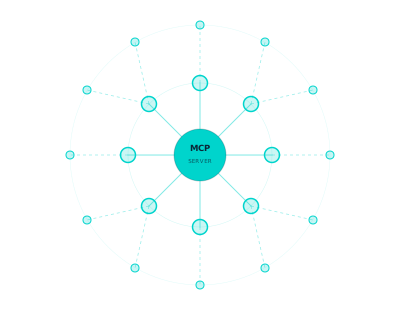
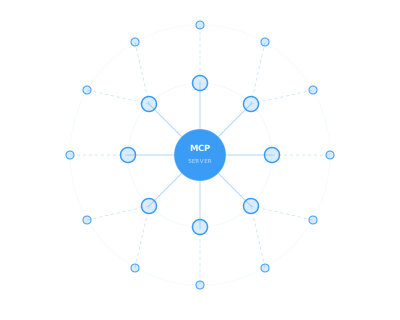
MCP AI Agent Guidelines is a Model Context Protocol server whose public surface is built from 20 instruction tools — high-level mission verbs (design, implement, review, debug, govern…) — each backed by richly orchestrated skill pipelines underneath. You invoke one tool; the server orchestrates dozens of skills internally.
// Claude Desktop / VS Code — add to your MCP config{ "mcp": { "servers": { "ai-agent-guidelines": { "command": "npx", "args": ["-y", "mcp-ai-agent-guidelines@latest"] } } }}Instruction-First Architecture
19 public tools act as mission verbs. Each instruction orchestrates multiple internal skills — consumers never call skills directly. Learn more →
Bio-Inspired Routing
5 adapt-* skills — Ant Colony Optimization, Hebbian reinforcement,
Physarum network pruning, quorum sensing, simulated annealing — make
multi-agent workflows self-optimizing over time.
Learn more →
Governance-First
7 gov-* skills, criticalSkillGuard env-var gating, HMAC session
integrity, and prompt-injection hardening are built-in — not optional add-ons.
Learn more →
Model-Agnostic Orchestration
Role-class routing resolved from orchestration.toml at runtime.
Physical model IDs are never hardcoded. 5 orchestration patterns documented.
Learn more →
Zero Runtime LLM Calls
Advisory outputs only — this is a routing and orchestration layer, not an LLM executor. Works with any MCP-compatible host. Architecture →
freecheapstrongreviewerAdvanced model generates plan → independent critic reviews → model reconciles. Used for architecture decisions and high-risk design.
Read more →Zero-cost model drafts → advanced model reviews → zero-cost model applies notes. Cuts advanced-model token cost ~60%.
3 zero-cost/efficient lanes vote → tiebreak escalation → final arbitration. Used for evaluation and classification tasks.
Try efficient → fallback to advanced → emergency escalation. Implements homeostatic PID setpoint concept.
3 zero-cost lanes run concurrently → single advanced synthesis pass. ~80% cheaper than running advanced end-to-end.