

Orchestration Patterns
Tool Tier Classification
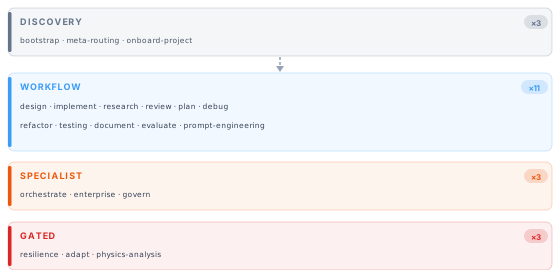
Section titled “Tool Tier Classification”The 20 instruction tools are classified into four routing tiers. bootstrap, meta-routing, and onboard-project act as discovery entrypoints that route consumers to the right tier for their request.
Capability/Profile-Based Resolution
Section titled “Capability/Profile-Based Resolution”The runtime does not bind workflows to hard-coded provider model names. Model selection is resolved through capability tags and workload profiles declared in orchestration.toml, then mapped to physical model IDs by src/models/model-router.ts.
xstate manages workflow state — it is not the model resolver.
Capability Tags
Section titled “Capability Tags”Implemented capability tags:
| Tag | Meaning |
|---|---|
fast_draft | Speed-optimized generation |
deep_reasoning | Multi-step causal chain reasoning |
large_context | Long-context coherence |
adversarial | Independent critique, low self-agreement bias |
classification | Fast label/route assignment |
cost_sensitive | Minimize token cost |
structured_output | Schema-bound JSON/code output |
code_analysis | Code understanding and review |
security_audit | Security threat modeling |
synthesis | Multi-source reconciliation |
math_physics | Symbolic math and physics reasoning |
low_latency | Sub-500ms response priority |
Workload Profiles
Section titled “Workload Profiles”22 named workload profiles in orchestration.toml:
| Profile | Required Tags | Fan-Out | Notes |
|---|---|---|---|
meta_routing | classification | 1 | low_latency preferred |
implement | code_analysis, structured_output | 2 | cost_sensitive preferred |
research | synthesis | 3 | cost_sensitive preferred |
evaluation | structured_output | 3 | cost_sensitive preferred |
governance | security_audit, adversarial | 1 | Human-in-the-loop required |
physics_analysis | math_physics, deep_reasoning | 1 | No fallback configured |
documentation | structured_output | 3 | cost_sensitive preferred |
benchmarking | structured_output | 3 | — |
prompt_engineering | structured_output | 2 | — |
The Five Orchestration Patterns
Section titled “The Five Orchestration Patterns”Pattern 1: Parallel Critique → Synthesis
Section titled “Pattern 1: Parallel Critique → Synthesis”Use for: architecture decisions, wave gating, high-risk design.
flowchart LR
    A([Request]) --> B[Advanced Model\nGenerate plan]
    A --> C[Advanced Model\nIndependent critique\n— no prior context]
    B --> D{Disagreement\ndelta}
    C --> D
    D --> E[Advanced Model\nReconcile + synthesize]
    E --> F([Final output])
    style C fill:#f97316,color:#fff,stroke:#ea580c
    style D fill:#334155,color:#e2e8f0,stroke:#475569
The disagreement delta between steps 1 and 2 is itself signal — review it before step 3.
Pattern 2: Draft → Review Chain
Section titled “Pattern 2: Draft → Review Chain”Use for: code generation, mechanical implementation. Cuts advanced-model token cost ~60%.
flowchart LR
    A([Request]) --> B[Zero-Cost\nFirst draft]
    B --> C[Advanced\nReview + security check]
    C --> D[Zero-Cost\nApply review notes]
    D --> E([Final output])
    style B fill:#16a34a,color:#fff,stroke:#15803d
    style C fill:#dc2626,color:#fff,stroke:#b91c1c
    style D fill:#16a34a,color:#fff,stroke:#15803d
Refactoring variant: Single-file → Zero-Cost only. Cross-module → add Advanced boundary review. Parallel batch → 3× Zero-Cost lanes in parallel → single Advanced diff-review.
Pattern 3: Majority Vote for Classification
Section titled “Pattern 3: Majority Vote for Classification”Use for: eval-*, bench-* skills.
flowchart TD
    A([Request]) --> B[Efficient\nBaseline vote]
    A --> C[Zero-Cost\nSecond vote]
    A --> D[Zero-Cost\nThird vote]
    B --> E{Consensus?}
    C --> E
    D --> E
    E -- Yes --> G([Output])
    E -- Split --> F[Advanced\nTiebreak]
    F --> H{Resolved?}
    H -- Yes --> G
    H -- Split --> I[Advanced\nFinal arbitration]
    I --> G
    style B fill:#d97706,color:#fff,stroke:#b45309
    style C fill:#16a34a,color:#fff,stroke:#15803d
    style D fill:#16a34a,color:#fff,stroke:#15803d
    style F fill:#dc2626,color:#fff,stroke:#b91c1c
    style I fill:#dc2626,color:#fff,stroke:#b91c1c
Pattern 4: Cascade with Fallback
Section titled “Pattern 4: Cascade with Fallback”Use for: resilience-oriented dispatch. Implements resil_homeostatic_module’s PID setpoint concept.
flowchart LR
    A([Request]) --> B{Try Efficient}
    B -- pass --> OUT([Output])
    B -- fail --> C{Try Advanced}
    C -- pass --> OUT
    C -- fail --> D[Emergency fallback]
    D --> OUT
    style B fill:#d97706,color:#fff,stroke:#b45309
    style C fill:#dc2626,color:#fff,stroke:#b91c1c
    style D fill:#7c3aed,color:#fff,stroke:#6d28d9
| Condition | First try | Fallback | Emergency |
|---|---|---|---|
| Simple skill dispatch | Cheap | Free | Free |
| Complex skill dispatch | Free | Strong | — |
Physics skills (qm-*, gr-*) | Strong | Strong (back-translation) | — |
Governance (gov-*) | Strong (first-pass) | Strong (final judgment) | — |
Pattern 5: Free Triple Parallel + Single Strong Synthesis
Section titled “Pattern 5: Free Triple Parallel + Single Strong Synthesis”Use for: research, synthesis, roadmap generation (zero marginal cost for 3× Zero-Cost lanes).
flowchart LR
    A([Request]) --> B[Zero-Cost\nPerspective A\nspeed-optimized]
    A --> C[Zero-Cost\nPerspective B\nanalysis-optimized]
    A --> D[Zero-Cost\nPerspective C\nalternative framing]
    B --> E[Advanced\nSynthesis]
    C --> E
    D --> E
    E --> F([Final output])
    style B fill:#16a34a,color:#fff,stroke:#15803d
    style C fill:#16a34a,color:#fff,stroke:#15803d
    style D fill:#16a34a,color:#fff,stroke:#15803d
    style E fill:#dc2626,color:#fff,stroke:#b91c1c
Cost model: 3 zero-cost calls + 1 Advanced synthesis pass on 300–500 tokens ≈ 80% cheaper than running Advanced end-to-end.
Dynamic Parallelism
Section titled “Dynamic Parallelism”Parallelism is driven by profile fan_out and pattern — not legacy tier names. The server uses p-queue with concurrency: 3 for fan-out workflows. Strong model stays in synthesis/review lane only.
Never free-parallel (strong required):
qm-*, gr-*, gov-*, adapt-*, resil-*, orch-agent-orchestrator
ModelRouter
Section titled “ModelRouter”src/models/model-router.ts resolves model role classes to physical model IDs at runtime. Physical model names are never hardcoded in source. Use role classes in code:
| Role class | Purpose |
|---|---|
free | Broad drafting, fan-out lanes, template fill |
cheap | Fast aggregation, classification, merge |
strong | Synthesis, physics, security, final judgment |
reviewer | Cross-model audit, independent critique |
Always call mcp_ai-agent-guid_model-discover to get current model IDs — the roster changes.
Debugging Orchestration
Section titled “Debugging Orchestration”Use the MCP Inspector CLI to verify the real routing path:
npm run buildnpx -y @modelcontextprotocol/inspector --cli node dist/index.js \ --method tools/call \ --tool-name system-design \ --tool-arg 'request="Design a session token store"'See MCP Debugging Reference for full debugging workflow.