Bowl Shaped Functions
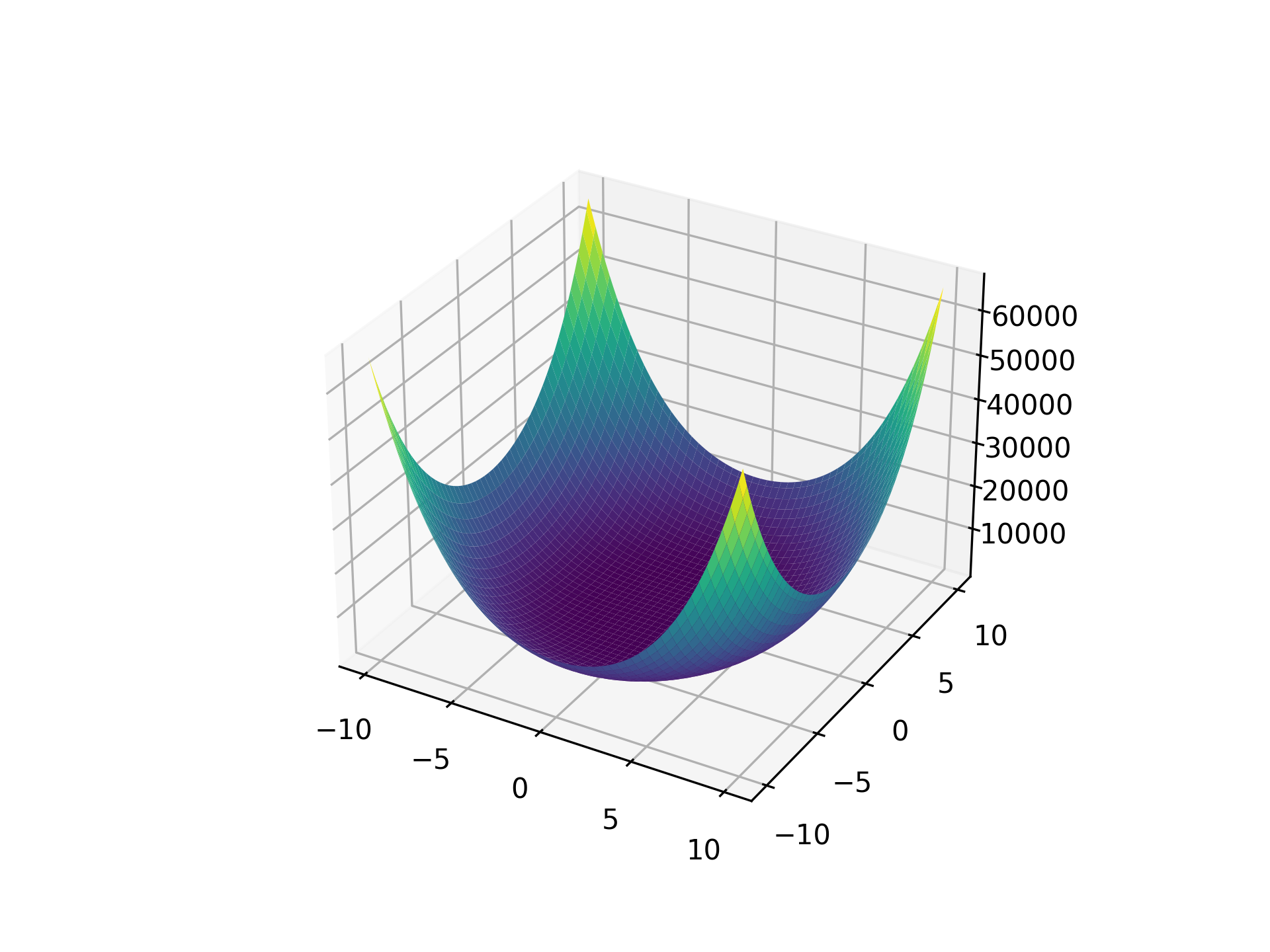
Perm Beta D function
Perm Beta D function.
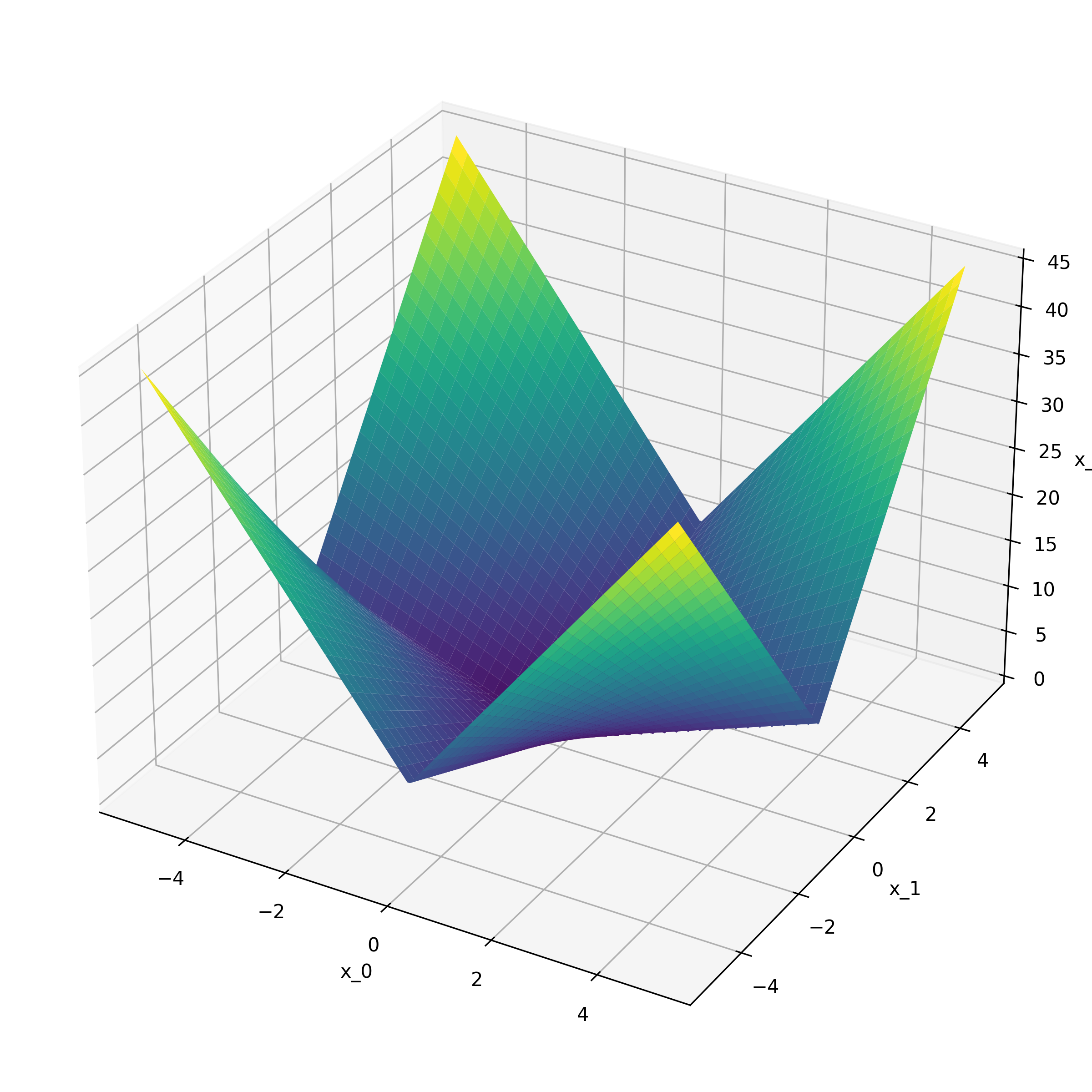
The Perm Beta D function is a D-dimensional function with multimodal structure and sharp peaks.
Examples:
>>> import matplotlib.pyplot as plt
>>> import numpy as np
>>> from umf.functions.optimization.bowl_shaped import PermBetaDFunction
>>> x = np.linspace(-10, 10, 100)
>>> y = np.linspace(-10, 10, 100)
>>> X, Y = np.meshgrid(x, y)
>>> Z = PermBetaDFunction(X, Y).__eval__
>>> fig = plt.figure()
>>> ax = fig.add_subplot(111, projection="3d")
>>> _ = ax.plot_surface(X, Y, Z, cmap="viridis")
>>> plt.savefig("PermBetaDFunction.png", dpi=300, transparent=True)
Notes
The Perm Beta D function is defined as:
with constant \(\beta = 0.5\) and \(D\) the dimension of the input. The hypercube of the function is defined as \(x_i \in [-d, d]\) for all \(i\).
Reference: Original implementation can be found here.
Parameters:
| Name | Type | Description | Default |
|---|---|---|---|
*x | UniversalArray | Input data, which has to be two dimensional. | () |
Source code in src/umf/functions/optimization/bowl_shaped.py
class PermBetaDFunction(OptFunction):
    r"""Perm Beta D function.

    The Perm Beta D function is a D-dimensional function with multimodal structure
    and sharp peaks.

    Examples:
        >>> import matplotlib.pyplot as plt
        >>> import numpy as np
        >>> from umf.functions.optimization.bowl_shaped import PermBetaDFunction
        >>> x = np.linspace(-10, 10, 100)
        >>> y = np.linspace(-10, 10, 100)
        >>> X, Y = np.meshgrid(x, y)
        >>> Z = PermBetaDFunction(X, Y).__eval__
        >>> fig = plt.figure()
        >>> ax = fig.add_subplot(111, projection="3d")
        >>> _ = ax.plot_surface(X, Y, Z, cmap="viridis")
        >>> plt.savefig("PermBetaDFunction.png", dpi=300, transparent=True)

    Notes:
        The Perm Beta D function is defined as:

        $$
            f(x) =  \sum_{i=1}^D \left( \sum_{j=1}^D \frac{1}{j +
            \beta} \left( \frac{x_j}{j} \right)^i  -1 \right)^2
        $$

        with constant $\beta = 0.5$ and $D$ the dimension of the input. The hypercube
        of the function is defined as $x_i \in [-d, d]$ for all $i$.

        > Reference: Original implementation can be found
        > [here](http://www.sfu.ca/~ssurjano/sumpow.html).

    Args:
        *x (UniversalArray): Input data, which has to be two dimensional.
    """

    @property
    def __eval__(self) -> UniversalArray:
        """Evaluate Perm Beta D function at x.

        Returns:
            UniversalArray: Evaluated function value.
        """
        beta = 0.5

        outer_sum = np.zeros(self._x[0].shape)

        for i in range(1, self.dimension + 1):
            inner_sum = sum(
                (j**i + beta) * ((self._x[j - 1] / j) ** i - 1)
                for j in range(1, self.dimension + 1)
            )
            outer_sum += inner_sum**2
        return outer_sum

    @property
    def __minima__(self) -> MinimaAPI:
        """Return the minima of the Perm Beta D function.

        Returns:
            MinimaAPI: Minima of the Perm Beta D function.
        """
        return MinimaAPI(f_x=0, x=tuple(np.arange(1, self.dimension + 1)))
 |
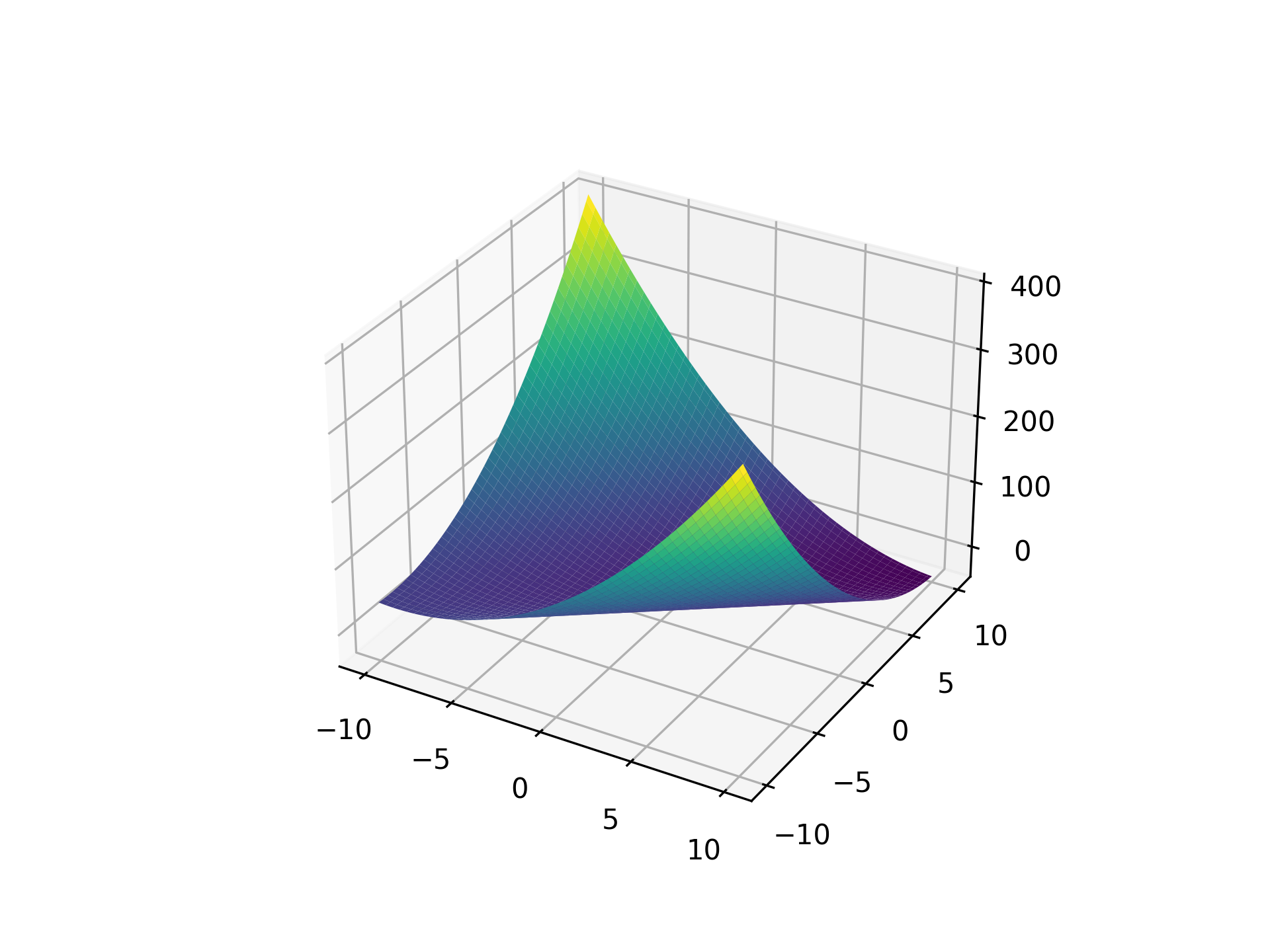
Trid Function
Trid function.
The Trid function is a D-dimensional function with multimodal structure and sharp peaks.
Examples:
>>> import matplotlib.pyplot as plt
>>> import numpy as np
>>> from umf.functions.optimization.bowl_shaped import TridFunction
>>> x = np.linspace(-10, 10, 100)
>>> y = np.linspace(-10, 10, 100)
>>> X, Y = np.meshgrid(x, y)
>>> Z = TridFunction(X, Y).__eval__
>>> fig = plt.figure()
>>> ax = fig.add_subplot(111, projection="3d")
>>> _ = ax.plot_surface(X, Y, Z, cmap="viridis")
>>> plt.savefig("TridFunction.png", dpi=300, transparent=True)
Notes
The Trid function is defined as:
with \(D\) the dimension of the input. The hypercube of the function is defined as \(x_i \in [-d, d]\) for all \(i\).
Reference: Original implementation can be found here
Parameters:
| Name | Type | Description | Default |
|---|---|---|---|
*x | UniversalArray | Input data, which has to be two dimensional. | () |
Source code in src/umf/functions/optimization/bowl_shaped.py
class TridFunction(OptFunction):
    r"""Trid function.

    The Trid function is a D-dimensional function with multimodal structure and sharp
    peaks.

    Examples:
        >>> import matplotlib.pyplot as plt
        >>> import numpy as np
        >>> from umf.functions.optimization.bowl_shaped import TridFunction
        >>> x = np.linspace(-10, 10, 100)
        >>> y = np.linspace(-10, 10, 100)
        >>> X, Y = np.meshgrid(x, y)
        >>> Z = TridFunction(X, Y).__eval__
        >>> fig = plt.figure()
        >>> ax = fig.add_subplot(111, projection="3d")
        >>> _ = ax.plot_surface(X, Y, Z, cmap="viridis")
        >>> plt.savefig("TridFunction.png", dpi=300, transparent=True)

    Notes:
        The Trid function is defined as:

        $$
            f(x) = \sum_{i=1}^D \left( x_i - 1 \right)^2 - \sum_{i=2}^D x_i x_{i-1}
        $$

        with $D$ the dimension of the input. The hypercube of the function is defined
        as $x_i \in [-d, d]$ for all $i$.

        > Reference: Original implementation can be found
        > [here](http://www.sfu.ca/~ssurjano/trid.html)

    Args:
        *x (UniversalArray): Input data, which has to be two dimensional.
    """

    @property
    def __eval__(self) -> UniversalArray:
        """Evaluate Trid function at x.

        Returns:
            UniversalArray: Evaluated function value.
        """
        outer_sum = np.zeros(self._x[0].shape)

        for i in range(1, self.dimension + 1):
            inner_sum = (self._x[i - 1] - 1) ** 2 - self._x[i - 1] * self._x[i - 2]
            outer_sum += inner_sum
        return outer_sum

    @property
    def __minima__(self) -> MinimaAPI:
        """Return the minima of the Trid function.

        Returns:
            MinimaAPI: Minima of the Trid function.
        """
        return MinimaAPI(
            f_x=-self.dimension * (self.dimension + 4) * (self.dimension - 1) / 6,
            x=tuple(i * (self.dimension + 1 - i) for i in range(1, self.dimension + 1)),
        )
 |
Sum Squares Function
Sum squares function.
The Sum squares function is a D-dimensional function with multimodal structure and sharp peaks.
Examples:
>>> import matplotlib.pyplot as plt
>>> import numpy as np
>>> from umf.functions.optimization.bowl_shaped import SumSquaresFunction
>>> x = np.linspace(-10, 10, 100)
>>> y = np.linspace(-10, 10, 100)
>>> X, Y = np.meshgrid(x, y)
>>> Z = SumSquaresFunction(X, Y).__eval__
>>> fig = plt.figure()
>>> ax = fig.add_subplot(111, projection="3d")
>>> _ = ax.plot_surface(X, Y, Z, cmap="viridis")
>>> plt.savefig("SumSquaresFunction.png", dpi=300, transparent=True)
Notes
The Sum squares function is defined as:
with \(D\) the dimension of the input. The hypercube of the function is defined as \(x_i \in [-d, d]\) for all \(i\).
Reference: Original implementation can be found here.
Parameters:
| Name | Type | Description | Default |
|---|---|---|---|
*x | UniversalArray | Input data, which has to be two dimensional. | () |
Source code in src/umf/functions/optimization/bowl_shaped.py
class SumSquaresFunction(OptFunction):
    r"""Sum squares function.

    The Sum squares function is a D-dimensional function with multimodal structure and
    sharp peaks.

    Examples:
        >>> import matplotlib.pyplot as plt
        >>> import numpy as np
        >>> from umf.functions.optimization.bowl_shaped import SumSquaresFunction
        >>> x = np.linspace(-10, 10, 100)
        >>> y = np.linspace(-10, 10, 100)
        >>> X, Y = np.meshgrid(x, y)
        >>> Z = SumSquaresFunction(X, Y).__eval__
        >>> fig = plt.figure()
        >>> ax = fig.add_subplot(111, projection="3d")
        >>> _ = ax.plot_surface(X, Y, Z, cmap="viridis")
        >>> plt.savefig("SumSquaresFunction.png", dpi=300, transparent=True)

    Notes:
        The Sum squares function is defined as:

        $$
            f(x) = \sum_{i=1}^D i x_i^2
        $$

        with $D$ the dimension of the input. The hypercube of the function is defined as
        $x_i \in [-d, d]$ for all $i$.

        > Reference: Original implementation can be found
        > [here](http://www.sfu.ca/~ssurjano/sumsqu.html).

    Args:
        *x (UniversalArray): Input data, which has to be two dimensional.
    """

    def __init__(self, *x: UniversalArray) -> None:
        """Initialize the function."""
        super().__init__(*x)

    @property
    def __eval__(self) -> UniversalArray:
        """Evaluate Sum squares function at x.

        Returns:
            UniversalArray: Evaluated function value.
        """
        outer_sum = np.zeros(self._x[0].shape)

        for i in range(1, self.dimension + 1):
            inner_sum = i * self._x[i - 1] ** 2
            outer_sum += inner_sum
        return outer_sum

    @property
    def __minima__(self) -> MinimaAPI:
        """Return the minima of the Sum squares function.

        Returns:
            MinimaAPI: Minima of the Sum squares function.
        """
        return MinimaAPI(f_x=0, x=tuple(np.zeros(self.dimension)))
__eval__ property ¶Evaluate Sum squares function at x.
Returns:
| Name | Type | Description |
|---|---|---|
UniversalArray | UniversalArray | Evaluated function value. |
__minima__ property ¶Return the minima of the Sum squares function.
Returns:
| Name | Type | Description |
|---|---|---|
MinimaAPI | MinimaAPI | Minima of the Sum squares function. |
__init__(*x) ¶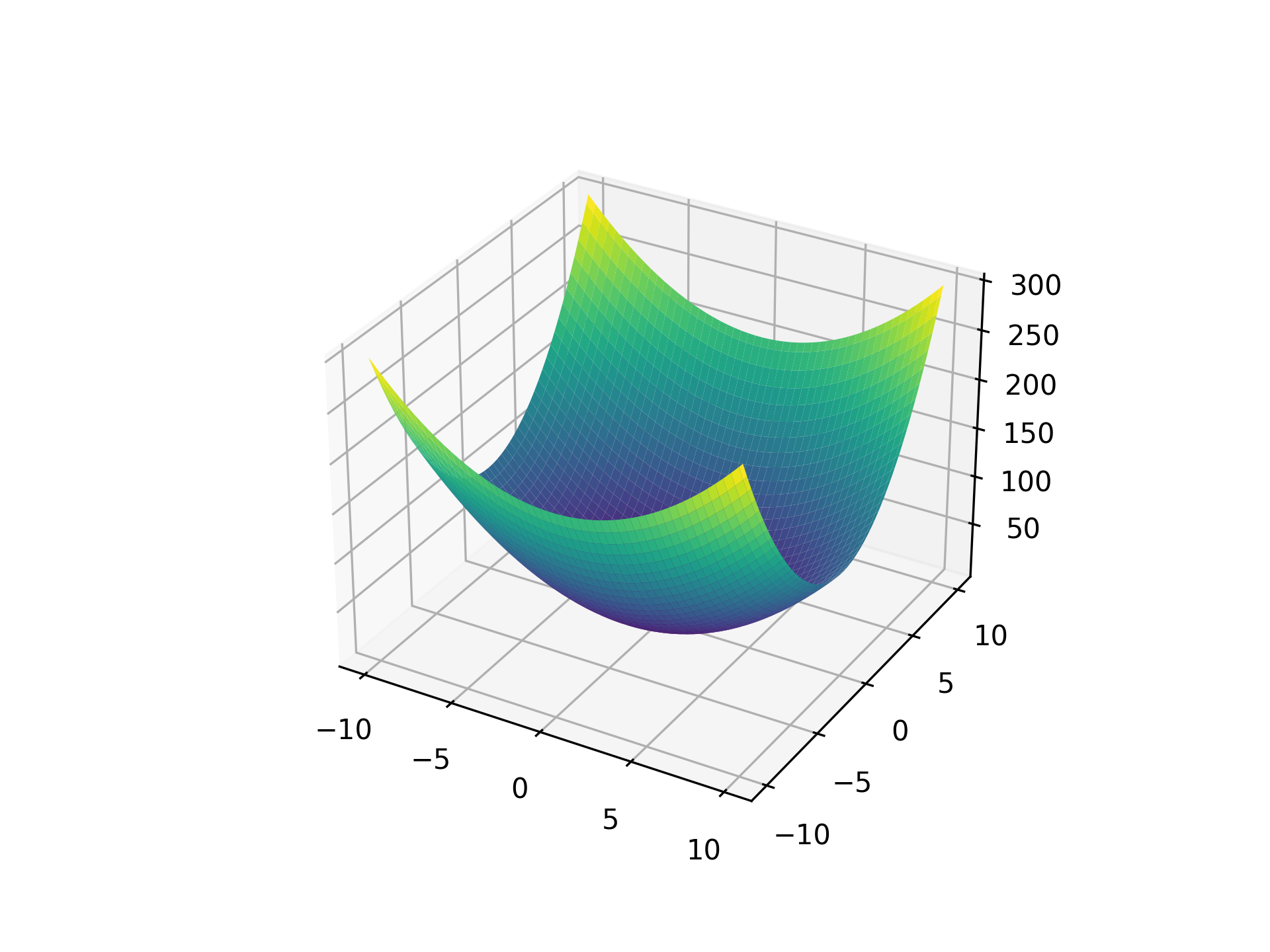 |
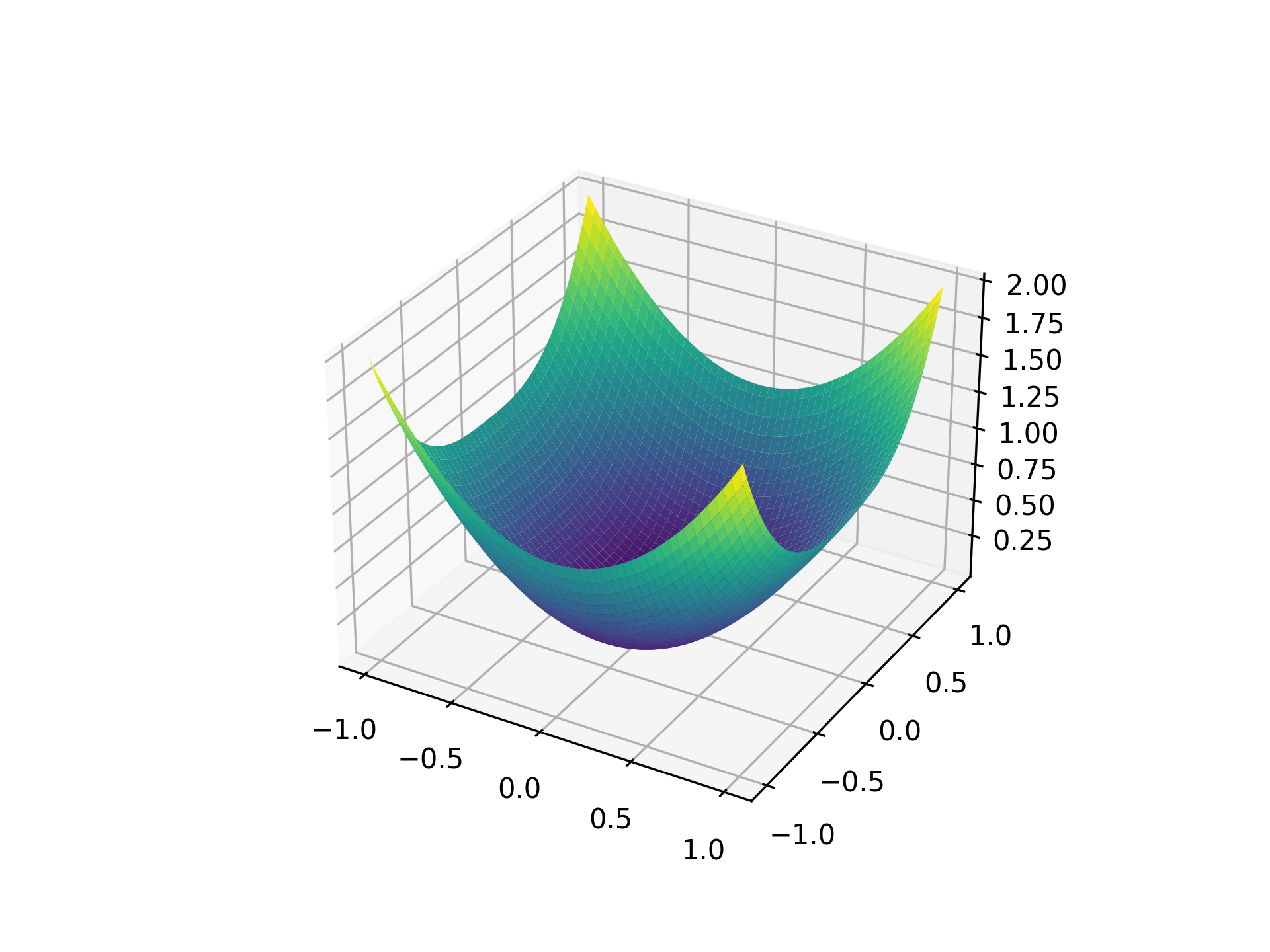
Sum of Different Power Function
Sum of different powers function.
The Sum of different powers function is a D-dimensional function with multimodal structure and sharp peaks.
Examples:
>>> import matplotlib.pyplot as plt
>>> import numpy as np
>>> from umf.functions.optimization.bowl_shaped import (
... SumOfDifferentPowersFunction
... )
>>> x = np.linspace(-1, 1, 100)
>>> y = np.linspace(-1, 1, 100)
>>> X, Y = np.meshgrid(x, y)
>>> Z = SumOfDifferentPowersFunction(X, Y).__eval__
>>> fig = plt.figure()
>>> ax = fig.add_subplot(111, projection="3d")
>>> _ = ax.plot_surface(X, Y, Z, cmap="viridis")
>>> plt.savefig("SumOfDifferentPowersFunction.png", dpi=300, transparent=True)
Notes
The Sum of different powers function is defined as:
with \(D\) the dimension of the input. The hypercube of the function is defined as \(x_i \in [-d, d]\) for all \(i\).
_Reference: Original implementation can be found here.
Parameters:
| Name | Type | Description | Default |
|---|---|---|---|
*x | UniversalArray | Input data, which has to be two dimensional. | () |
Source code in src/umf/functions/optimization/bowl_shaped.py
class SumOfDifferentPowersFunction(OptFunction):
    r"""Sum of different powers function.

    The Sum of different powers function is a D-dimensional function with multimodal
    structure and sharp peaks.

    Examples:
        >>> import matplotlib.pyplot as plt
        >>> import numpy as np
        >>> from umf.functions.optimization.bowl_shaped import (
        ... SumOfDifferentPowersFunction
        ... )
        >>> x = np.linspace(-1, 1, 100)
        >>> y = np.linspace(-1, 1, 100)
        >>> X, Y = np.meshgrid(x, y)
        >>> Z = SumOfDifferentPowersFunction(X, Y).__eval__
        >>> fig = plt.figure()
        >>> ax = fig.add_subplot(111, projection="3d")
        >>> _ = ax.plot_surface(X, Y, Z, cmap="viridis")
        >>> plt.savefig("SumOfDifferentPowersFunction.png", dpi=300, transparent=True)

    Notes:
        The Sum of different powers function is defined as:

        $$
            f(x) = \sum_{i=1}^D \left| x_i \right|^{i+1}
        $$

        with $D$ the dimension of the input. The hypercube of the function is defined as
        $x_i \in [-d, d]$ for all $i$.

        _Reference: Original implementation can be found
        [here](http://www.sfu.ca/~ssurjano/sumpow.html).

    Args:
        *x (UniversalArray): Input data, which has to be two dimensional.
    """

    @property
    def __eval__(self) -> UniversalArray:
        """Evaluate Sum of different powers function at x.

        Returns:
            UniversalArray: Evaluated function value.
        """
        outer_sum = np.zeros(self._x[0].shape)

        for i in range(1, self.dimension + 1):
            inner_sum = abs(self._x[i - 1]) ** (i + 1)
            outer_sum += inner_sum
        return outer_sum

    @property
    def __minima__(self) -> MinimaAPI:
        """Return the minima of the Sum of different powers function.

        Returns:
            MinimaAPI: Minima of the Sum of different powers function.
        """
        return MinimaAPI(f_x=0, x=tuple(np.zeros(self.dimension)))
__eval__ property ¶Evaluate Sum of different powers function at x.
Returns:
| Name | Type | Description |
|---|---|---|
UniversalArray | UniversalArray | Evaluated function value. |
 |
Zirilli Function
Zirilli function.
The Zirilli function is a 2D-dimensional function with multimodal structure and sharp peaks.
Examples:
>>> import matplotlib.pyplot as plt
>>> import numpy as np
>>> from umf.functions.optimization.bowl_shaped import ZirilliFunction
>>> x = np.linspace(-1, 1, 100)
>>> y = np.linspace(-1, 1, 100)
>>> X, Y = np.meshgrid(x, y)
>>> Z = ZirilliFunction(X, Y).__eval__
>>> fig = plt.figure()
>>> ax = fig.add_subplot(111, projection="3d")
>>> _ = ax.plot_surface(X, Y, Z, cmap="viridis")
>>> plt.savefig("ZirilliFunction.png", dpi=300, transparent=True)
Notes
The Zirilli function is defined as:
Parameters:
| Name | Type | Description | Default |
|---|---|---|---|
*x | UniversalArray | Input data, which has to be two dimensional. | () |
Raises:
| Type | Description |
|---|---|
OutOfDimensionError | If the dimension of the input data is not 2. |
Source code in src/umf/functions/optimization/bowl_shaped.py
class ZirilliFunction(OptFunction):
    r"""Zirilli function.

    The Zirilli function is a 2D-dimensional function with multimodal structure and
    sharp peaks.

    Examples:
        >>> import matplotlib.pyplot as plt
        >>> import numpy as np
        >>> from umf.functions.optimization.bowl_shaped import ZirilliFunction
        >>> x = np.linspace(-1, 1, 100)
        >>> y = np.linspace(-1, 1, 100)
        >>> X, Y = np.meshgrid(x, y)
        >>> Z = ZirilliFunction(X, Y).__eval__
        >>> fig = plt.figure()
        >>> ax = fig.add_subplot(111, projection="3d")
        >>> _ = ax.plot_surface(X, Y, Z, cmap="viridis")
        >>> plt.savefig("ZirilliFunction.png", dpi=300, transparent=True)

    Notes:
        The Zirilli function is defined as:

        $$
            f(x) = 0.25 x_1^4 - 0.5 x_1^2 + 0.1 x_1 + 0.5 x_2^2
        $$


    Args:
        *x (UniversalArray): Input data, which has to be two dimensional.

    Raises:
        OutOfDimensionError: If the dimension of the input data is not 2.
    """

    def __init__(self, *x: UniversalArray) -> None:
        """Initialize the function."""
        if len(x) != __2d__:
            raise OutOfDimensionError(
                function_name="Zirilli",
                dimension=__2d__,
            )
        super().__init__(*x)

    @property
    def __eval__(self) -> UniversalArray:
        """Evaluate Zirilli function at x.

        Returns:
            UniversalArray: Evaluated function value.
        """
        x_1 = self._x[0]
        x_2 = self._x[1]
        return 0.25 * x_1**4 - 0.5 * x_1**2 + 0.1 * x_1 + 0.5 * x_2**2

    @property
    def __minima__(self) -> MinimaAPI:
        """Return the minima of the Zirilli function.

        Returns:
            MinimaAPI: Minima of the Zirilli function.
        """
        return MinimaAPI(
            f_x=-0.352386073800034,
            x=(-1.046680576580755, 0),
        )
__eval__ property ¶Evaluate Zirilli function at x.
Returns:
| Name | Type | Description |
|---|---|---|
UniversalArray | UniversalArray | Evaluated function value. |
__minima__ property ¶Return the minima of the Zirilli function.
Returns:
| Name | Type | Description |
|---|---|---|
MinimaAPI | MinimaAPI | Minima of the Zirilli function. |
__init__(*x) ¶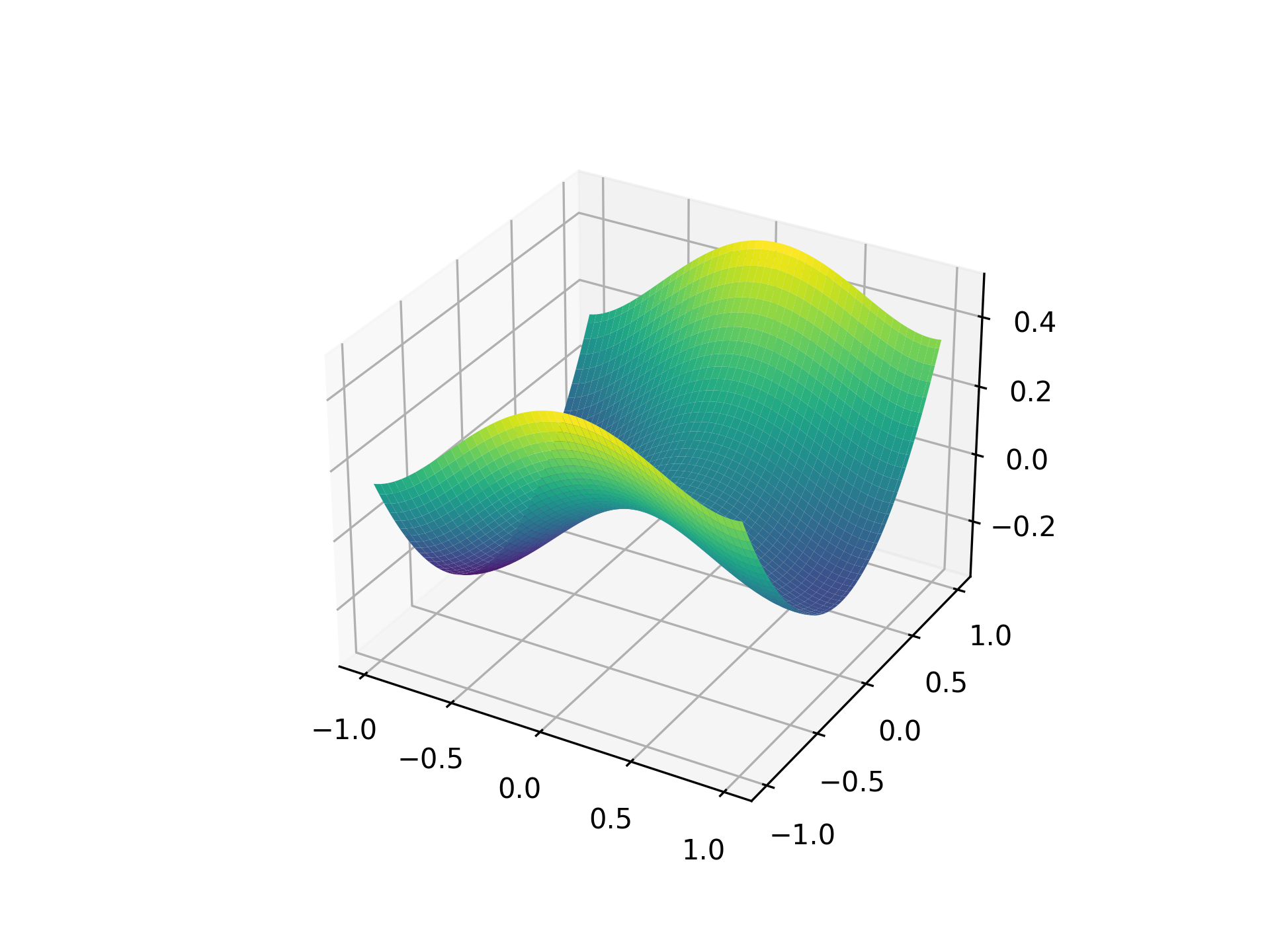 |
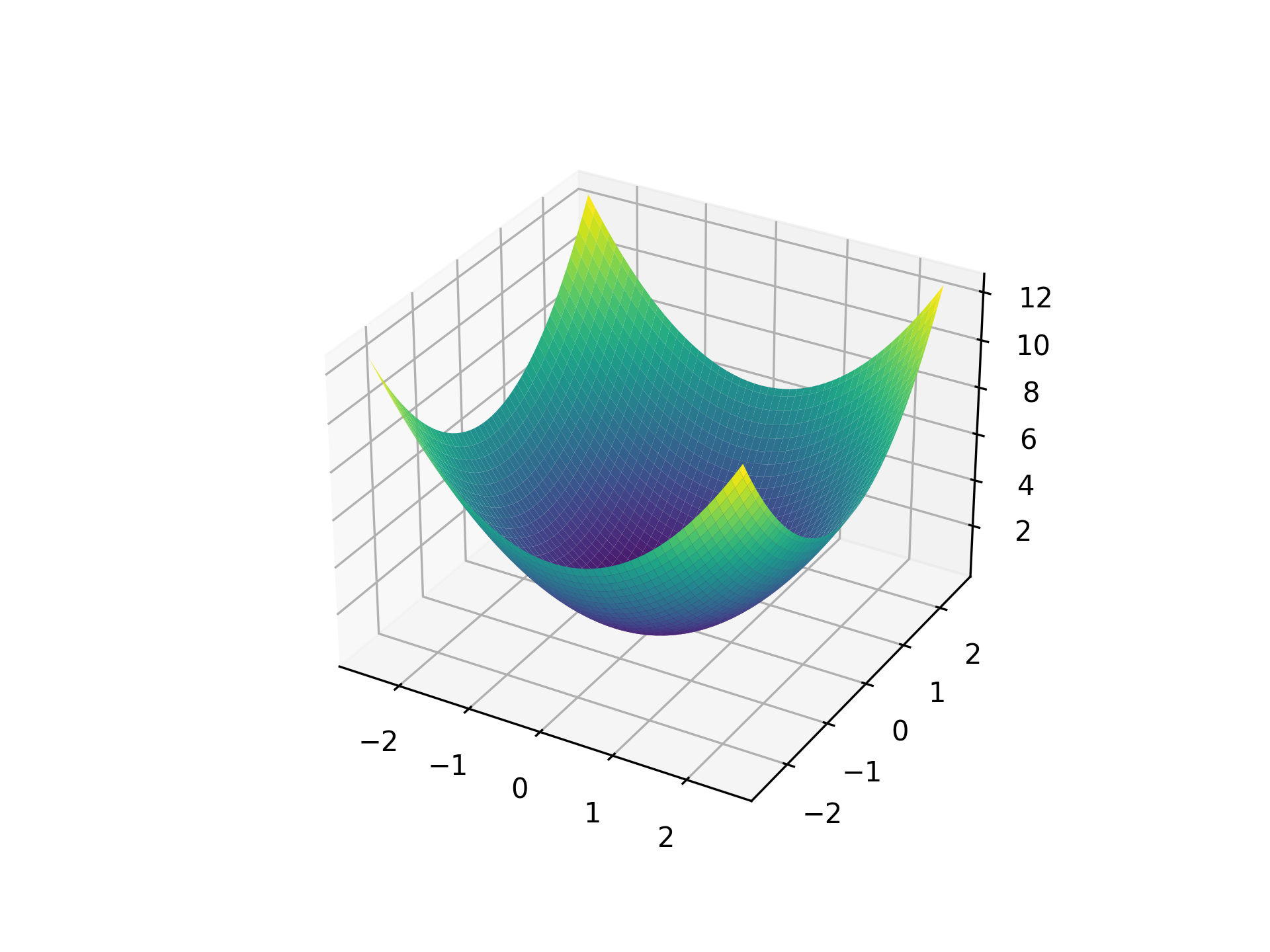
Sphere Function
Sphere function.
The Sphere function is a D-dimensional function with multimodal structure and sharp peaks.
Examples:
>>> import matplotlib.pyplot as plt
>>> import numpy as np
>>> from umf.functions.optimization.bowl_shaped import SphereFunction
>>> x = np.linspace(-2.5, 2.5, 100)
>>> y = np.linspace(-2.5, 2.5, 100)
>>> X, Y = np.meshgrid(x, y)
>>> Z = SphereFunction(X, Y).__eval__
>>> fig = plt.figure()
>>> ax = fig.add_subplot(111, projection="3d")
>>> _ = ax.plot_surface(X, Y, Z, cmap="viridis")
>>> plt.savefig("SphereFunction.png", dpi=300, transparent=True)
Notes
The Sphere function is defined as:
with \(D\) the dimension of the input. The hypercube of the function is defined as \(x_i \in [-d, d]\) for all \(i\).
Reference: Original implementation can be found here.
Parameters:
| Name | Type | Description | Default |
|---|---|---|---|
*x | UniversalArray | Input data, which has to be two dimensional. | () |
Source code in src/umf/functions/optimization/bowl_shaped.py
class SphereFunction(OptFunction):
    r"""Sphere function.

    The Sphere function is a D-dimensional function with multimodal structure and
    sharp peaks.

    Examples:
        >>> import matplotlib.pyplot as plt
        >>> import numpy as np
        >>> from umf.functions.optimization.bowl_shaped import SphereFunction
        >>> x = np.linspace(-2.5, 2.5, 100)
        >>> y = np.linspace(-2.5, 2.5, 100)
        >>> X, Y = np.meshgrid(x, y)
        >>> Z = SphereFunction(X, Y).__eval__
        >>> fig = plt.figure()
        >>> ax = fig.add_subplot(111, projection="3d")
        >>> _ = ax.plot_surface(X, Y, Z, cmap="viridis")
        >>> plt.savefig("SphereFunction.png", dpi=300, transparent=True)

    Notes:
        The Sphere function is defined as:

        $$
            f(x) = \sum_{i=1}^D x_i^2
        $$

        with $D$ the dimension of the input. The hypercube of the function is defined as
        $x_i \in [-d, d]$ for all $i$.

        Reference: Original implementation can be found
        [here](http://www.sfu.ca/~ssurjano/spheref.html).

    Args:
        *x (UniversalArray): Input data, which has to be two dimensional.
    """

    @property
    def __eval__(self) -> UniversalArray:
        """Evaluate Sphere function at x.

        Returns:
            UniversalArray: Evaluated function value.
        """
        return np.sum(np.power(self._x, 2), axis=0)

    @property
    def __minima__(self) -> MinimaAPI:
        """Return the minima of the Sphere function.

        Returns:
            MinimaAPI: Minima of the Sphere function.
        """
        return MinimaAPI(f_x=0, x=tuple(np.zeros(self.dimension)))
 |
Rotated Hyper-Ellipsoid Function
Rotated hyper-ellipse function.
The Rotated hyper-ellipse function is a D-dimensional function with multimodal structure and sharp peaks.
Examples:
>>> import matplotlib.pyplot as plt
>>> import numpy as np
>>> from umf.functions.optimization.bowl_shaped import (
... RotatedHyperEllipseFunction
... )
>>> x = np.linspace(-1, 1, 100)
>>> y = np.linspace(-1, 1, 100)
>>> X, Y = np.meshgrid(x, y)
>>> Z = RotatedHyperEllipseFunction(X, Y).__eval__
>>> fig = plt.figure()
>>> ax = fig.add_subplot(111, projection="3d")
>>> _ = ax.plot_surface(X, Y, Z, cmap="viridis")
>>> plt.savefig("RotatedHyperEllipseFunction.png", dpi=300, transparent=True)
Notes
The Rotated hyper-ellipse function is defined as:
with \(D\) the dimension of the input and \(a_{ij}\) the rotation matrix. The hypercube of the function is defined as \(x_i \in [-d, d]\) for all \(i\).
Reference: Original implementation can be found here
Parameters:
| Name | Type | Description | Default |
|---|---|---|---|
*x | UniversalArray | Input data, which has to be two dimensional. | () |
Raises:
| Type | Description |
|---|---|
OutOfDimensionError | If the dimension of the input data is not 2. |
Source code in src/umf/functions/optimization/bowl_shaped.py
class RotatedHyperEllipseFunction(OptFunction):
    r"""Rotated hyper-ellipse function.

    The Rotated hyper-ellipse function is a D-dimensional function with multimodal
    structure and sharp peaks.

    Examples:
        >>> import matplotlib.pyplot as plt
        >>> import numpy as np
        >>> from umf.functions.optimization.bowl_shaped import (
        ... RotatedHyperEllipseFunction
        ... )
        >>> x = np.linspace(-1, 1, 100)
        >>> y = np.linspace(-1, 1, 100)
        >>> X, Y = np.meshgrid(x, y)
        >>> Z = RotatedHyperEllipseFunction(X, Y).__eval__
        >>> fig = plt.figure()
        >>> ax = fig.add_subplot(111, projection="3d")
        >>> _ = ax.plot_surface(X, Y, Z, cmap="viridis")
        >>> plt.savefig("RotatedHyperEllipseFunction.png", dpi=300, transparent=True)

    Notes:
        The Rotated hyper-ellipse function is defined as:

        $$
            f(x) = \sum_{i=1}^D \left( \sum_{j=1}^D a_{ij} x_j^2 \right)^2
        $$

        with $D$ the dimension of the input and $a_{ij}$ the rotation matrix. The
        hypercube of the function is defined as $x_i \in [-d, d]$ for all $i$.

        > Reference: Original implementation can be found
        > [here](http://www.sfu.ca/~ssurjano/rothyp.html)

    Args:
        *x (UniversalArray): Input data, which has to be two dimensional.

    Raises:
        OutOfDimensionError: If the dimension of the input data is not 2.
    """

    def __init__(self, *x: UniversalArray) -> None:
        """Initialize the function."""
        if len(x) != __2d__:
            raise OutOfDimensionError(
                function_name="RotatedHyperEllipse",
                dimension=__2d__,
            )
        super().__init__(*x)

    @property
    def __eval__(self) -> UniversalArray:
        """Evaluate Rotated hyper-ellipse function at x.

        Returns:
            UniversalArray: Evaluated function value.
        """
        outer_sum = np.zeros(self._x[0].shape)
        for i in range(self.dimension):
            inner_sum = np.zeros(self._x[0].shape)
            for j in range(i + 1):
                inner_sum += self._x[j] ** 2
            outer_sum = outer_sum + inner_sum
        return outer_sum

    @property
    def __minima__(self) -> MinimaAPI:
        """Return the minima of the Rotated hyper-ellipse function.

        Returns:
            MinimaAPI: Minima of the Rotated hyper-ellipse function.
        """
        return MinimaAPI(f_x=0, x=tuple(np.zeros(self.dimension)))
__eval__ property ¶Evaluate Rotated hyper-ellipse function at x.
Returns:
| Name | Type | Description |
|---|---|---|
UniversalArray | UniversalArray | Evaluated function value. |
__minima__ property ¶Return the minima of the Rotated hyper-ellipse function.
Returns:
| Name | Type | Description |
|---|---|---|
MinimaAPI | MinimaAPI | Minima of the Rotated hyper-ellipse function. |
__init__(*x) ¶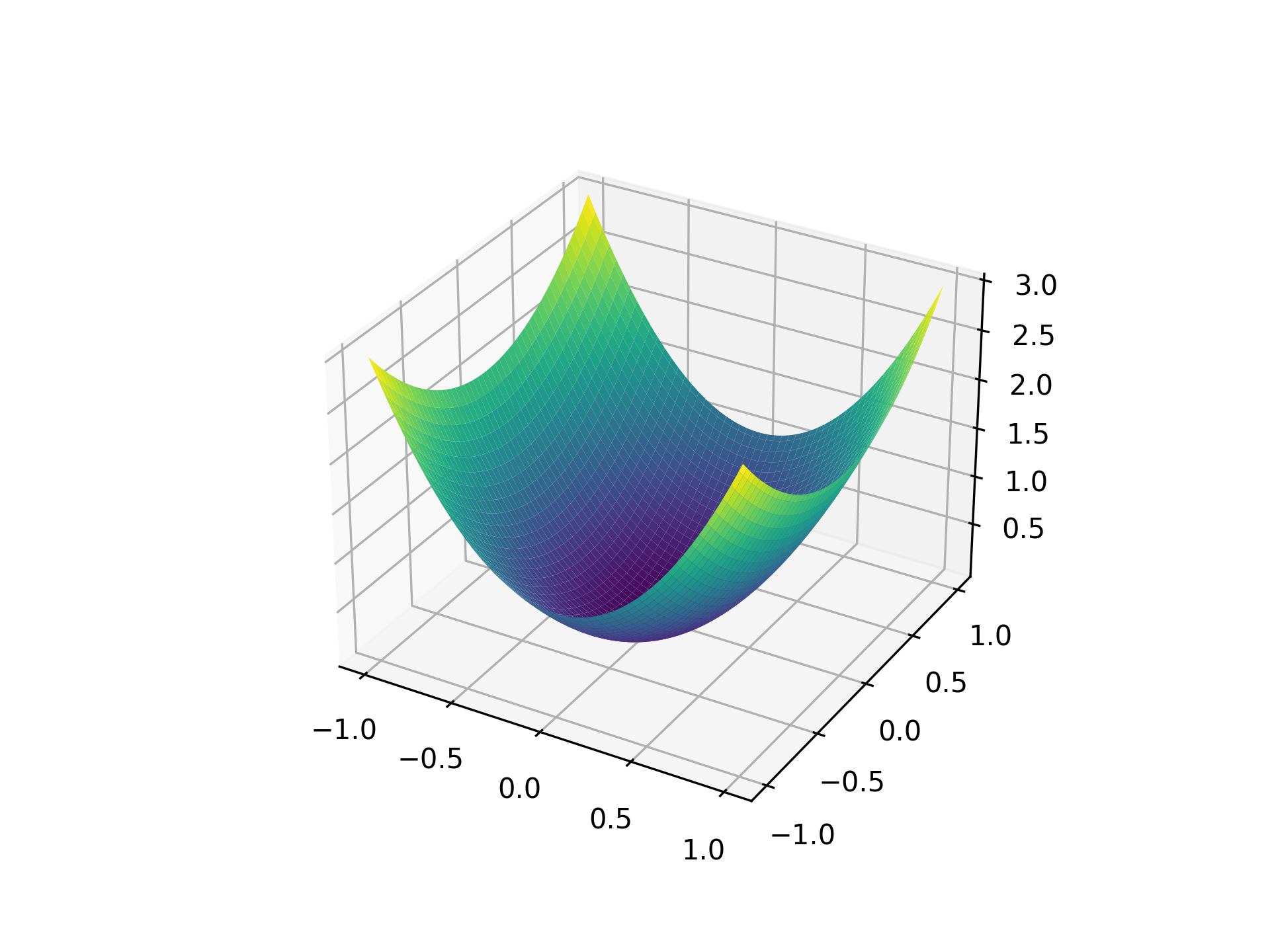 |
Reference: Original implementation can be found here
Bohachevsky Function Type 1
Bohachevsky function type 1.
The Bohachevsky function type 1 is a 2D-dimensional function with multimodal structure and sharp peaks.
Examples:
>>> import matplotlib.pyplot as plt
>>> import numpy as np
>>> from umf.functions.optimization.bowl_shaped import BohachevskyFunctionType1
>>> x = np.linspace(-10, 10, 100)
>>> y = np.linspace(-10, 10, 100)
>>> X, Y = np.meshgrid(x, y)
>>> Z = BohachevskyFunctionType1(X, Y).__eval__
>>> fig = plt.figure()
>>> ax = fig.add_subplot(111, projection="3d")
>>> _ = ax.plot_surface(X, Y, Z, cmap="viridis")
>>> plt.savefig("BohachevskyFunctionType1.png", dpi=300, transparent=True)
Notes
The Bohachevsky function type 1 is defined as:
Reference: Original implementation can be found here
Parameters:
| Name | Type | Description | Default |
|---|---|---|---|
*x | UniversalArray | Input data, which has to be two dimensional. | () |
Source code in src/umf/functions/optimization/bowl_shaped.py
class BohachevskyFunctionType1(OptFunction):
    r"""Bohachevsky function type 1.

    The Bohachevsky function type 1 is a 2D-dimensional function with multimodal
    structure and sharp peaks.

    Examples:
        >>> import matplotlib.pyplot as plt
        >>> import numpy as np
        >>> from umf.functions.optimization.bowl_shaped import BohachevskyFunctionType1
        >>> x = np.linspace(-10, 10, 100)
        >>> y = np.linspace(-10, 10, 100)
        >>> X, Y = np.meshgrid(x, y)
        >>> Z = BohachevskyFunctionType1(X, Y).__eval__
        >>> fig = plt.figure()
        >>> ax = fig.add_subplot(111, projection="3d")
        >>> _ = ax.plot_surface(X, Y, Z, cmap="viridis")
        >>> plt.savefig("BohachevskyFunctionType1.png", dpi=300, transparent=True)

    Notes:
        The Bohachevsky function type 1 is defined as:

        $$
            f(x) = x_1^2 + 2 x_2^2 - 0.3 \cos(3 \pi x_1) - 0.4 \cos(4 \pi x_2) + 0.7
        $$

        > Reference: Original implementation can be found
        > [here](http://www.sfu.ca/~ssurjano/boha.html)

    Args:
        *x (UniversalArray): Input data, which has to be two dimensional.
    """

    def __init__(self, *x: UniversalArray) -> None:
        """Initialize the function."""
        if len(x) != __2d__:
            raise OutOfDimensionError(
                function_name="BohachevskyType1",
                dimension=__2d__,
            )
        super().__init__(*x)

    @property
    def __eval__(self) -> UniversalArray:
        """Evaluate Bohachevsky function type 1 at x.

        Returns:
            UniversalArray: Evaluated function value.
        """
        x_1 = self._x[0]
        x_2 = self._x[1]
        return (
            x_1**2
            + 2 * x_2**2
            - 0.3 * np.cos(3 * np.pi * x_1)
            - 0.4 * np.cos(4 * np.pi * x_2)
            + 0.7
        )

    @property
    def __minima__(self) -> MinimaAPI:
        """Return the minima of the Bohachevsky function type 1.

        Returns:
            MinimaAPI: Minima of the Bohachevsky function type 1.
        """
        return MinimaAPI(f_x=0, x=(0, 0))
__eval__ property ¶Evaluate Bohachevsky function type 1 at x.
Returns:
| Name | Type | Description |
|---|---|---|
UniversalArray | UniversalArray | Evaluated function value. |
__minima__ property ¶Return the minima of the Bohachevsky function type 1.
Returns:
| Name | Type | Description |
|---|---|---|
MinimaAPI | MinimaAPI | Minima of the Bohachevsky function type 1. |
__init__(*x) ¶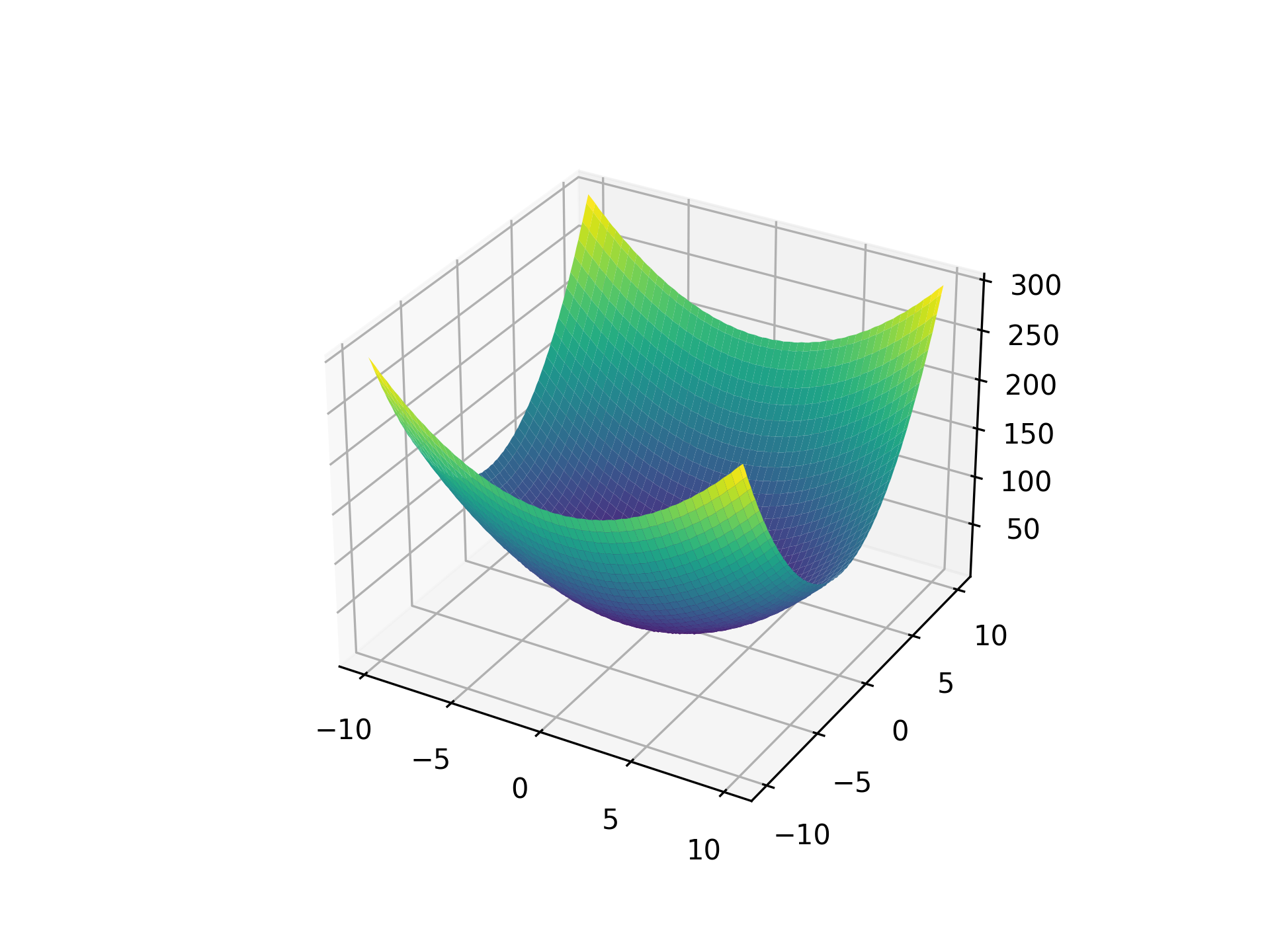 |
Bohachevsky Function Type 2
Bohachevsky function tye 2.
The Bohachevsky function type 2 is a 2D-dimensional function with multimodal structure and sharp peaks.
Examples:
>>> import matplotlib.pyplot as plt
>>> import numpy as np
>>> from umf.functions.optimization.bowl_shaped import BohachevskyFunctionType2
>>> x = np.linspace(-10, 10, 100)
>>> y = np.linspace(-10, 10, 100)
>>> X, Y = np.meshgrid(x, y)
>>> Z = BohachevskyFunctionType2(X, Y).__eval__
>>> fig = plt.figure()
>>> ax = fig.add_subplot(111, projection="3d")
>>> _ = ax.plot_surface(X, Y, Z, cmap="viridis")
>>> plt.savefig("BohachevskyFunctionType2.png", dpi=300, transparent=True)
Notes
The Bohachevsky function type 2 is defined as:
Reference: Original implementation can be found here
Parameters:
| Name | Type | Description | Default |
|---|---|---|---|
*x | UniversalArray | Input data, which has to be two dimensional. | () |
Source code in src/umf/functions/optimization/bowl_shaped.py
class BohachevskyFunctionType2(OptFunction):
    r"""Bohachevsky function tye 2.

    The Bohachevsky function type 2 is a 2D-dimensional function with multimodal
    structure and sharp peaks.

    Examples:
        >>> import matplotlib.pyplot as plt
        >>> import numpy as np
        >>> from umf.functions.optimization.bowl_shaped import BohachevskyFunctionType2
        >>> x = np.linspace(-10, 10, 100)
        >>> y = np.linspace(-10, 10, 100)
        >>> X, Y = np.meshgrid(x, y)
        >>> Z = BohachevskyFunctionType2(X, Y).__eval__
        >>> fig = plt.figure()
        >>> ax = fig.add_subplot(111, projection="3d")
        >>> _ = ax.plot_surface(X, Y, Z, cmap="viridis")
        >>> plt.savefig("BohachevskyFunctionType2.png", dpi=300, transparent=True)

    Notes:
        The Bohachevsky function type 2 is defined as:

        $$
            f(x) = x_1^2 + 2 x_2^2 - 0.3 \cos(3 \pi x_1) \cos(4 \pi x_2) + 0.3
        $$

        > Reference: Original implementation can be found
        > [here](http://www.sfu.ca/~ssurjano/boha.html)

    Args:
        *x (UniversalArray): Input data, which has to be two dimensional.
    """

    def __init__(self, *x: UniversalArray) -> None:
        """Initialize the function."""
        if len(x) != __2d__:
            raise OutOfDimensionError(
                function_name="BohachevskyType2",
                dimension=__2d__,
            )
        super().__init__(*x)

    @property
    def __eval__(self) -> UniversalArray:
        """Evaluate Bohachevsky function type 2 at x.

        Returns:
            UniversalArray: Evaluated function value.
        """
        x_1 = self._x[0]
        x_2 = self._x[1]
        return (
            x_1**2
            + 2 * x_2**2
            - 0.3 * np.cos(3 * np.pi * x_1) * np.cos(4 * np.pi * x_2)
            + 0.3
        )

    @property
    def __minima__(self) -> MinimaAPI:
        """Return the minima of the Bohachevsky function type 2.

        Returns:
            MinimaAPI: Minima of the Bohachevsky function type 2.
        """
        return MinimaAPI(f_x=0, x=(0, 0))
__eval__ property ¶Evaluate Bohachevsky function type 2 at x.
Returns:
| Name | Type | Description |
|---|---|---|
UniversalArray | UniversalArray | Evaluated function value. |
__minima__ property ¶Return the minima of the Bohachevsky function type 2.
Returns:
| Name | Type | Description |
|---|---|---|
MinimaAPI | MinimaAPI | Minima of the Bohachevsky function type 2. |
__init__(*x) ¶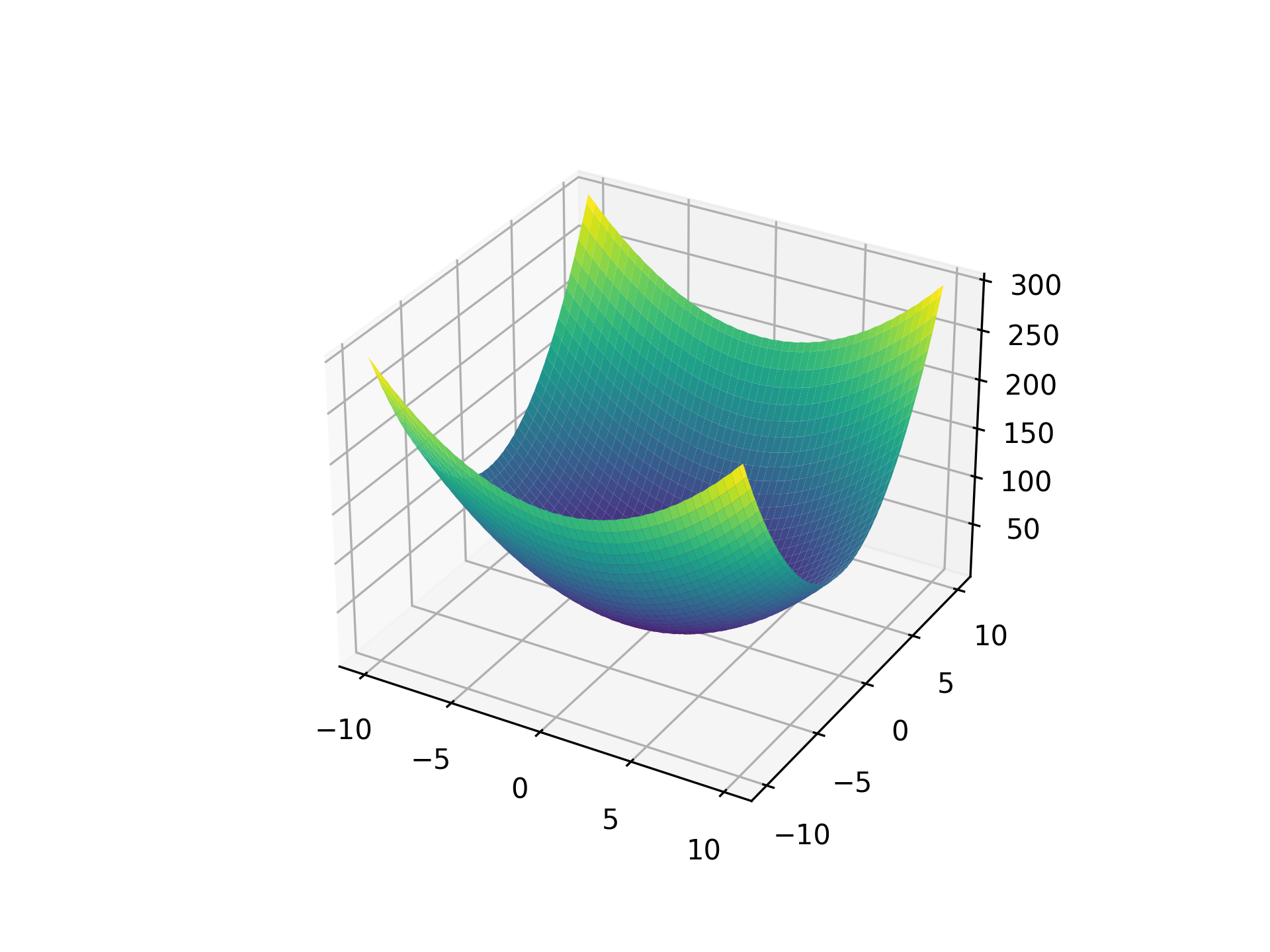 |
Bochachevsky Function Type 3
Bohachevsky function type 3.
The Bohachevsky function type 3 is a 2D-dimensional function with multimodal structure and sharp peaks.
Examples:
>>> import matplotlib.pyplot as plt
>>> import numpy as np
>>> from umf.functions.optimization.bowl_shaped import BohachevskyFunctionType3
>>> x = np.linspace(-10, 10, 100)
>>> y = np.linspace(-10, 10, 100)
>>> X, Y = np.meshgrid(x, y)
>>> Z = BohachevskyFunctionType3(X, Y).__eval__
>>> fig = plt.figure()
>>> ax = fig.add_subplot(111, projection="3d")
>>> _ = ax.plot_surface(X, Y, Z, cmap="viridis")
>>> plt.savefig("BohachevskyFunctionType3.png", dpi=300, transparent=True)
Notes
The Bohachevsky function type 3 is defined as:
Reference: Original implementation can be found here
Parameters:
| Name | Type | Description | Default |
|---|---|---|---|
*x | UniversalArray | Input data, which has to be two dimensional. | () |
Source code in src/umf/functions/optimization/bowl_shaped.py
class BohachevskyFunctionType3(OptFunction):
    r"""Bohachevsky function type 3.

    The Bohachevsky function type 3 is a 2D-dimensional function with multimodal
    structure and sharp peaks.

    Examples:
        >>> import matplotlib.pyplot as plt
        >>> import numpy as np
        >>> from umf.functions.optimization.bowl_shaped import BohachevskyFunctionType3
        >>> x = np.linspace(-10, 10, 100)
        >>> y = np.linspace(-10, 10, 100)
        >>> X, Y = np.meshgrid(x, y)
        >>> Z = BohachevskyFunctionType3(X, Y).__eval__
        >>> fig = plt.figure()
        >>> ax = fig.add_subplot(111, projection="3d")
        >>> _ = ax.plot_surface(X, Y, Z, cmap="viridis")
        >>> plt.savefig("BohachevskyFunctionType3.png", dpi=300, transparent=True)

    Notes:
        The Bohachevsky function type 3 is defined as:

        $$
            f(x) = x_1^2 + 2 x_2^2 - 0.3 \cos(3 \pi x_1 + 4 \pi x_2) + 0.3
        $$

        > Reference: Original implementation can be found
        > [here](http://www.sfu.ca/~ssurjano/boha.html)

    Args:
        *x (UniversalArray): Input data, which has to be two dimensional.
    """

    def __init__(self, *x: UniversalArray) -> None:
        """Initialize the function."""
        if len(x) != __2d__:
            raise OutOfDimensionError(
                function_name="BohachevskyType3",
                dimension=__2d__,
            )
        super().__init__(*x)

    @property
    def __eval__(self) -> UniversalArray:
        """Evaluate Bohachevsky function type 3 at x.

        Returns:
            UniversalArray: Evaluated function value.
        """
        x_1 = self._x[0]
        x_2 = self._x[1]
        return (
            x_1**2 + 2 * x_2**2 - 0.3 * np.cos(3 * np.pi * x_1 + 4 * np.pi * x_2) + 0.3
        )

    @property
    def __minima__(self) -> MinimaAPI:
        """Return the minima of the Bohachevsky function type 3.

        Returns:
            MinimaAPI: Minima of the Bohachevsky function type 3.
        """
        return MinimaAPI(f_x=0, x=(0, 0))
__eval__ property ¶Evaluate Bohachevsky function type 3 at x.
Returns:
| Name | Type | Description |
|---|---|---|
UniversalArray | UniversalArray | Evaluated function value. |
__minima__ property ¶Return the minima of the Bohachevsky function type 3.
Returns:
| Name | Type | Description |
|---|---|---|
MinimaAPI | MinimaAPI | Minima of the Bohachevsky function type 3. |
__init__(*x) ¶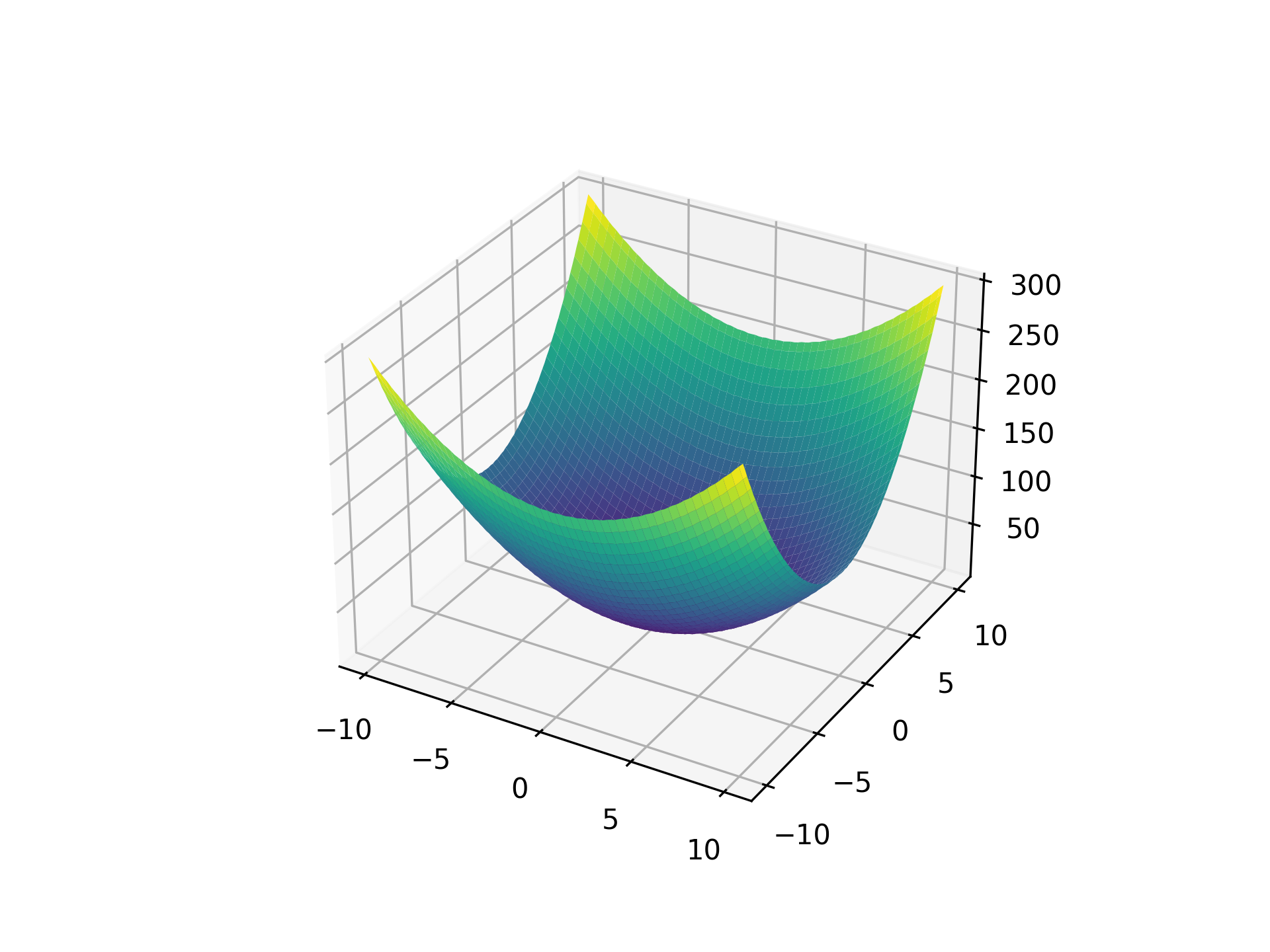 |
Elliptic Paraboloid Function
Elliptic paraboloid function.
Source code in src/umf/functions/optimization/bowl_shaped.py
class EllipticParaboloidFunction(OptFunction):
    r"""Elliptic paraboloid function."""

    def __init__(self, *x: UniversalArray) -> None:
        """Initialize the elliptic paraboloid function."""
        _validate_two_dimensional(*x, function_name="EllipticParaboloid")
        super().__init__(*x)

    @property
    def __eval__(self) -> UniversalArray:
        """Evaluate the elliptic paraboloid function at x."""
        x_1, x_2 = self._x
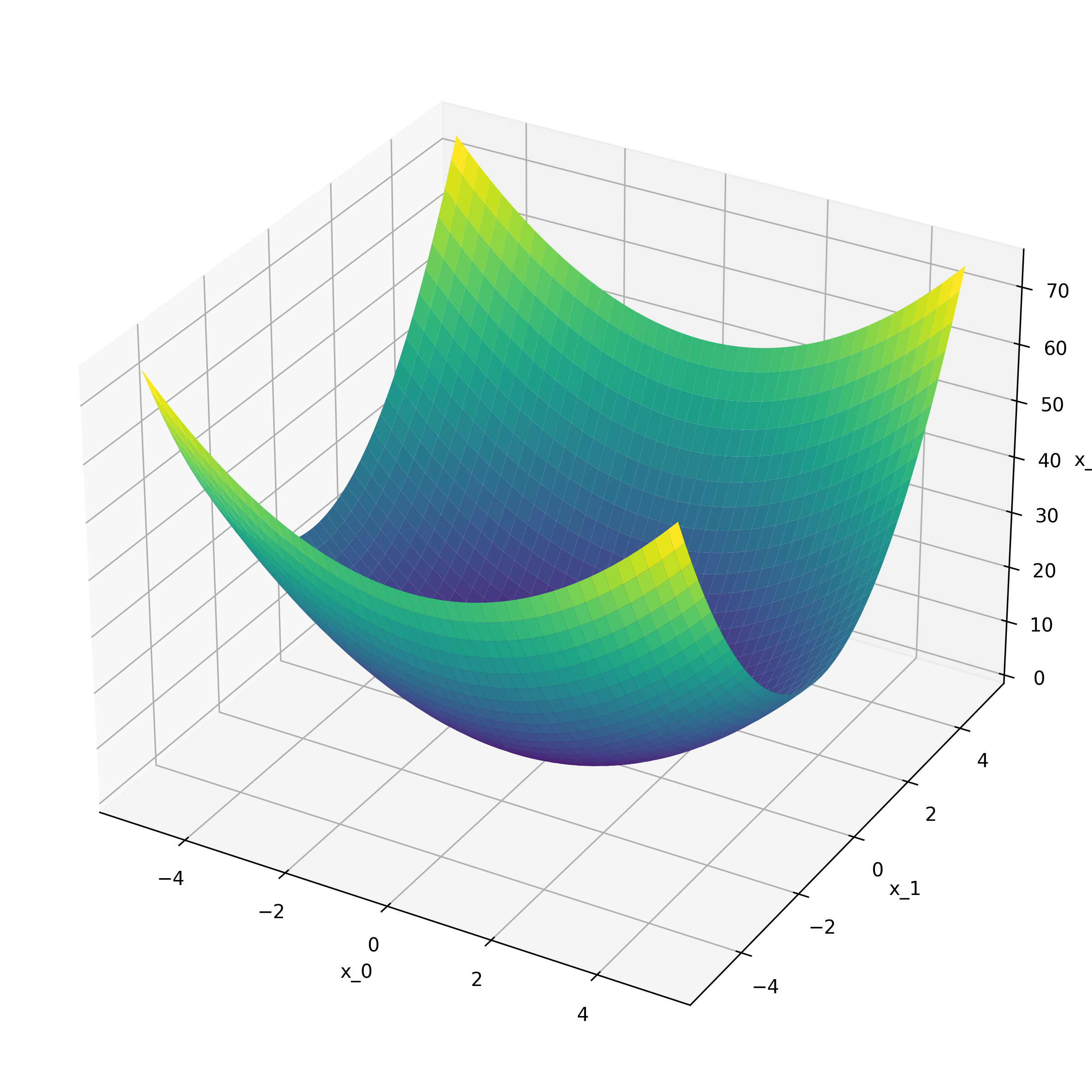
        return x_1**2 + 2 * x_2**2

    @property
    def __minima__(self) -> MinimaAPI:
        """Return the minima of the elliptic paraboloid function."""
        return MinimaAPI(f_x=0.0, x=(0.0, 0.0))
 |
Rotated Quadratic Function
Rotated quadratic function.
Source code in src/umf/functions/optimization/bowl_shaped.py
class RotatedQuadraticFunction(OptFunction):
    r"""Rotated quadratic function."""

    def __init__(self, *x: UniversalArray) -> None:
        """Initialize the rotated quadratic function."""
        _validate_two_dimensional(*x, function_name="RotatedQuadratic")
        super().__init__(*x)

    @property
    def __eval__(self) -> UniversalArray:
        """Evaluate the rotated quadratic function at x."""
        x_1, x_2 = self._x
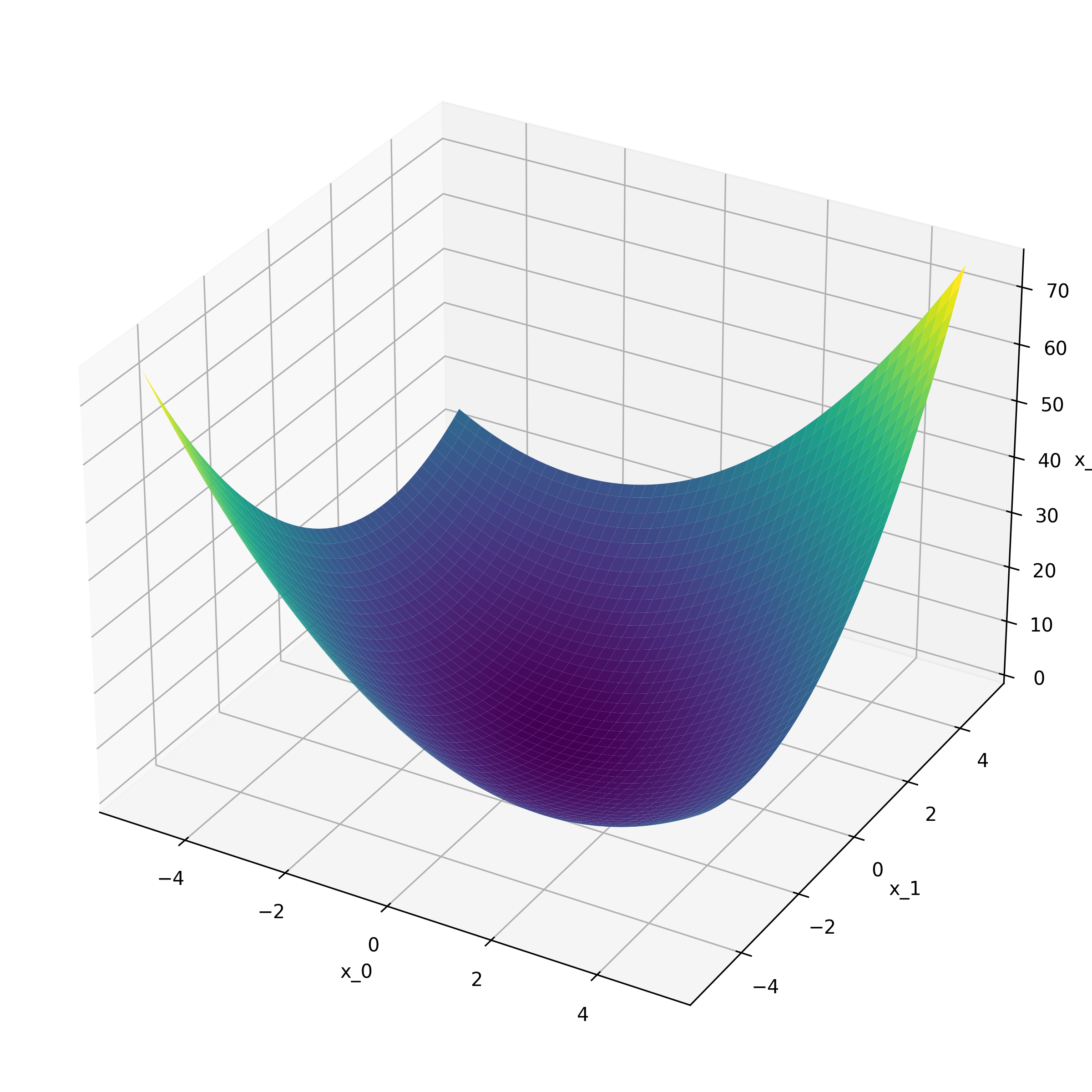
        return x_1**2 + x_1 * x_2 + x_2**2

    @property
    def __minima__(self) -> MinimaAPI:
        """Return the minima of the rotated quadratic function."""
        return MinimaAPI(f_x=0.0, x=(0.0, 0.0))
 |
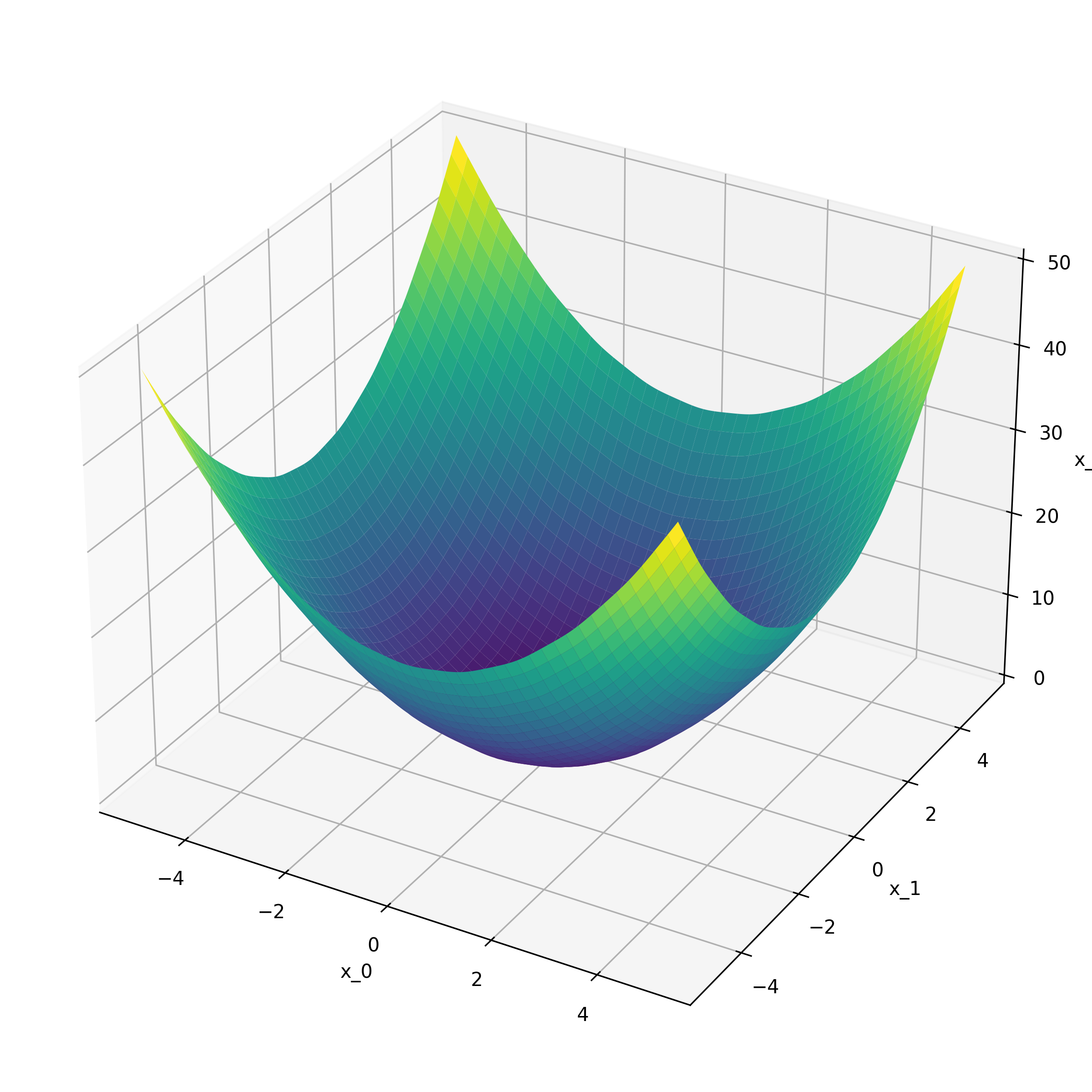
Ripple Bowl Function
Ripple bowl function.
Source code in src/umf/functions/optimization/bowl_shaped.py
class RippleBowlFunction(OptFunction):
    r"""Ripple bowl function."""

    def __init__(self, *x: UniversalArray) -> None:
        """Initialize the ripple bowl function."""
        _validate_two_dimensional(*x, function_name="RippleBowl")
        super().__init__(*x)

    @property
    def __eval__(self) -> UniversalArray:
        """Evaluate the ripple bowl function at x."""
        x_1, x_2 = self._x
        return x_1**2 + x_2**2 + 0.1 * np.sin(3 * x_1) ** 2 + 0.1 * np.sin(3 * x_2) ** 2

    @property
    def __minima__(self) -> MinimaAPI:
        """Return the minima of the ripple bowl function."""
        return MinimaAPI(f_x=0.0, x=(0.0, 0.0))
 |
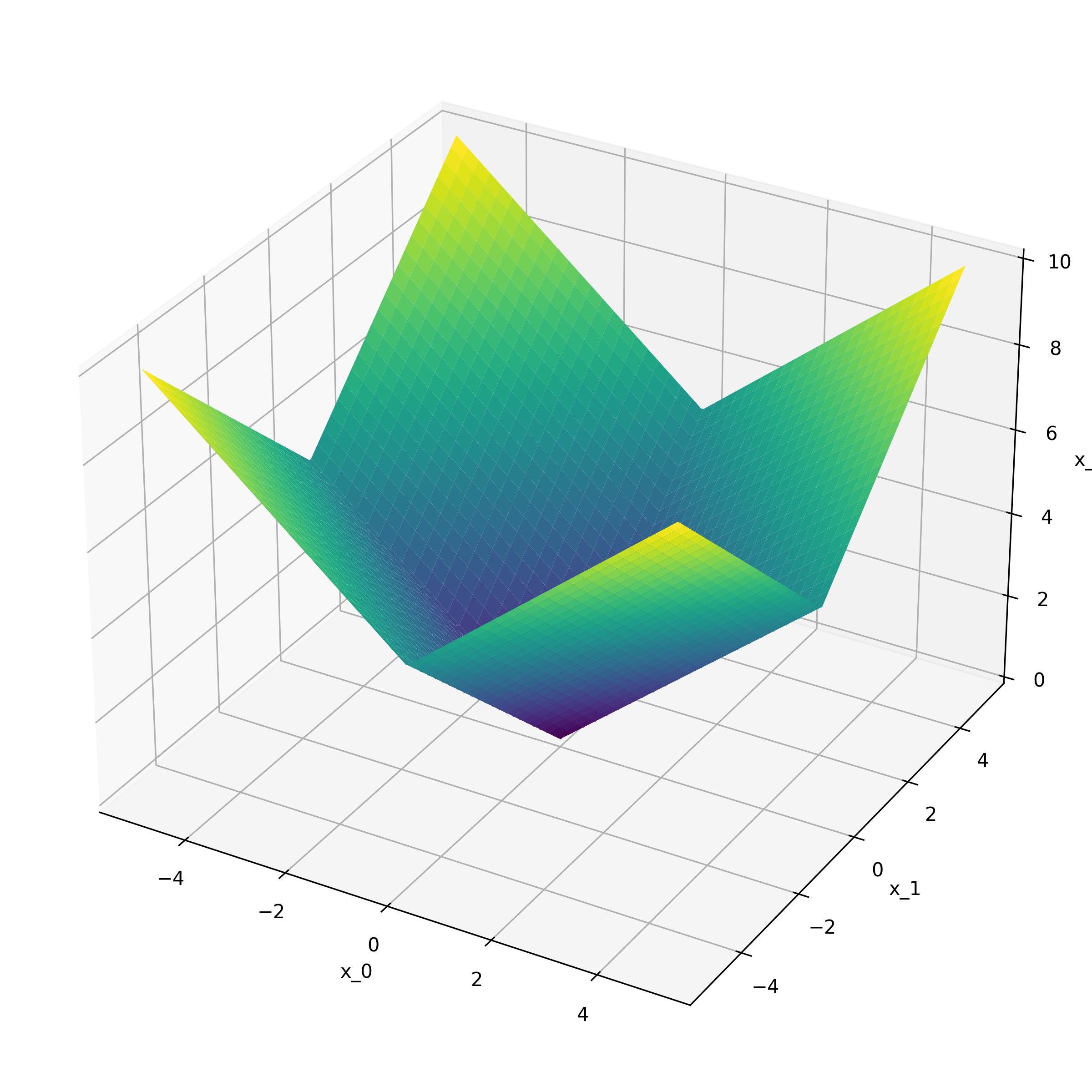
Absolute Bowl Function
Absolute bowl function.
Source code in src/umf/functions/optimization/bowl_shaped.py
class AbsoluteBowlFunction(OptFunction):
    r"""Absolute bowl function."""

    def __init__(self, *x: UniversalArray) -> None:
        """Initialize the absolute bowl function."""
        _validate_two_dimensional(*x, function_name="AbsoluteBowl")
        super().__init__(*x)

    @property
    def __eval__(self) -> UniversalArray:
        """Evaluate the absolute bowl function at x."""
        x_1, x_2 = self._x
        return np.abs(x_1) + np.abs(x_2)

    @property
    def __minima__(self) -> MinimaAPI:
        """Return the minima of the absolute bowl function."""
        return MinimaAPI(f_x=0.0, x=(0.0, 0.0))
 |
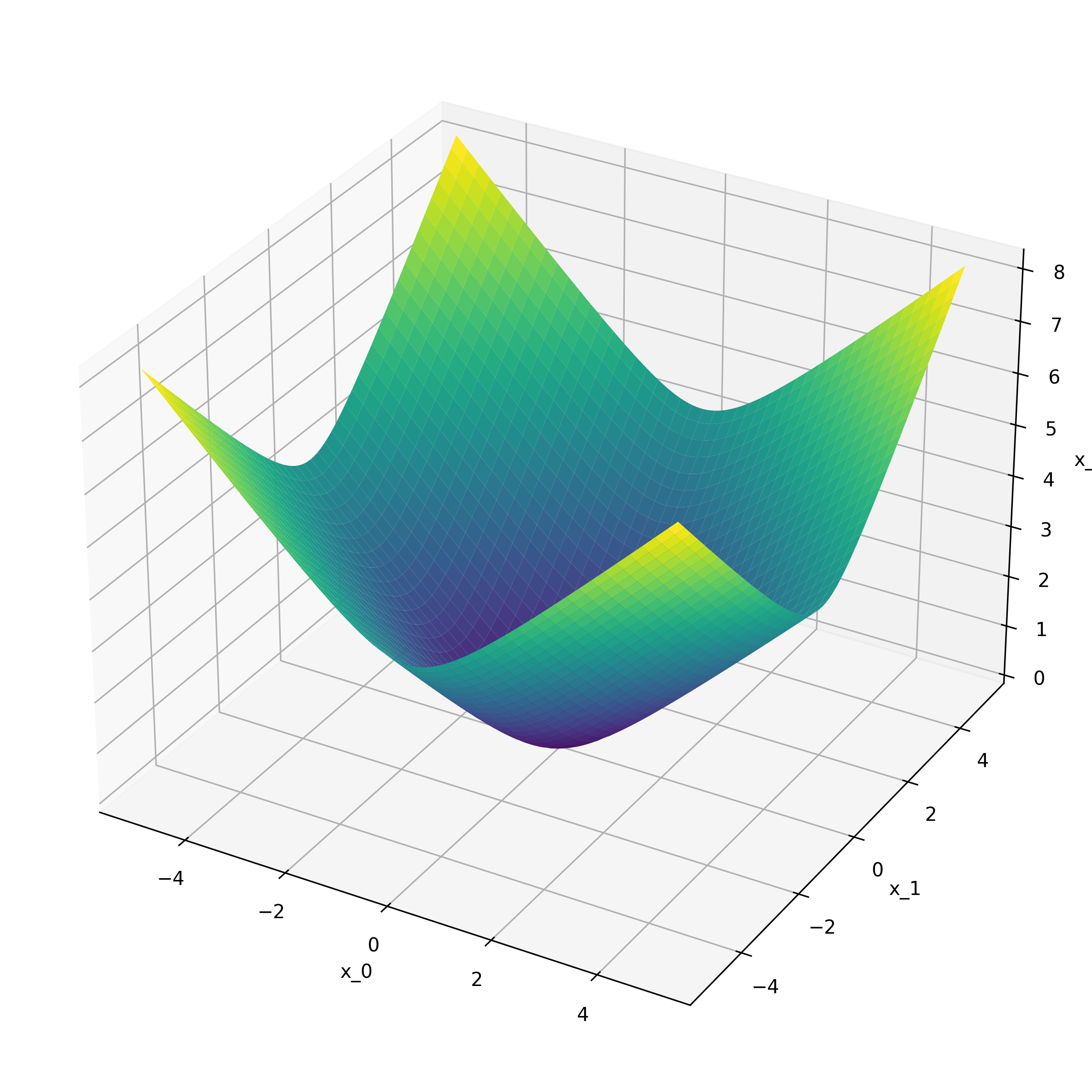
Elliptic Absolute Root Function
Elliptic absolute-root function.
Source code in src/umf/functions/optimization/bowl_shaped.py
class EllipticAbsoluteRootFunction(OptFunction):
    r"""Elliptic absolute-root function."""

    def __init__(self, *x: UniversalArray) -> None:
        """Initialize the elliptic absolute-root function."""
        _validate_two_dimensional(*x, function_name="EllipticAbsoluteRoot")
        super().__init__(*x)

    @property
    def __eval__(self) -> UniversalArray:
        """Evaluate the elliptic absolute-root function at x."""
        x_1, x_2 = self._x
        return np.sqrt(1 + x_1**2) + np.sqrt(1 + x_2**2) - 2

    @property
    def __minima__(self) -> MinimaAPI:
        """Return the minima of the elliptic absolute-root function."""
        return MinimaAPI(f_x=0.0, x=(0.0, 0.0))
 |
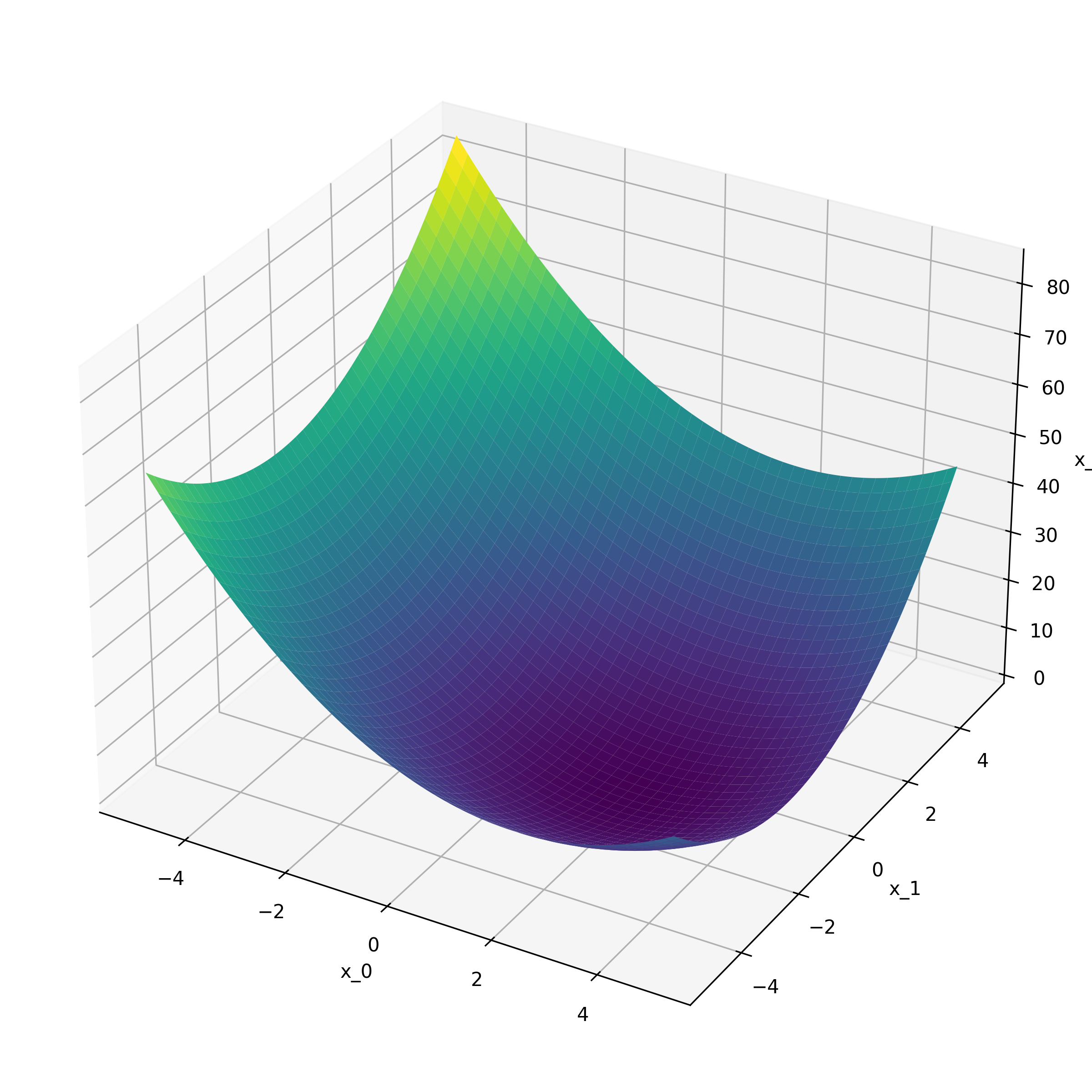
Shifted Sphere 2D Function
Shifted 2D sphere function.
Source code in src/umf/functions/optimization/bowl_shaped.py
class ShiftedSphere2DFunction(OptFunction):
    r"""Shifted 2D sphere function."""

    def __init__(self, *x: UniversalArray) -> None:
        """Initialize the shifted 2D sphere function."""
        _validate_two_dimensional(*x, function_name="ShiftedSphere2D")
        super().__init__(*x)

    @property
    def __eval__(self) -> UniversalArray:
        """Evaluate the shifted 2D sphere function at x."""
        x_1, x_2 = self._x
        return (x_1 - 2) ** 2 + (x_2 + 1) ** 2

    @property
    def __minima__(self) -> MinimaAPI:
        """Return the minima of the shifted 2D sphere function."""
        return MinimaAPI(f_x=0.0, x=(2.0, -1.0))
 |
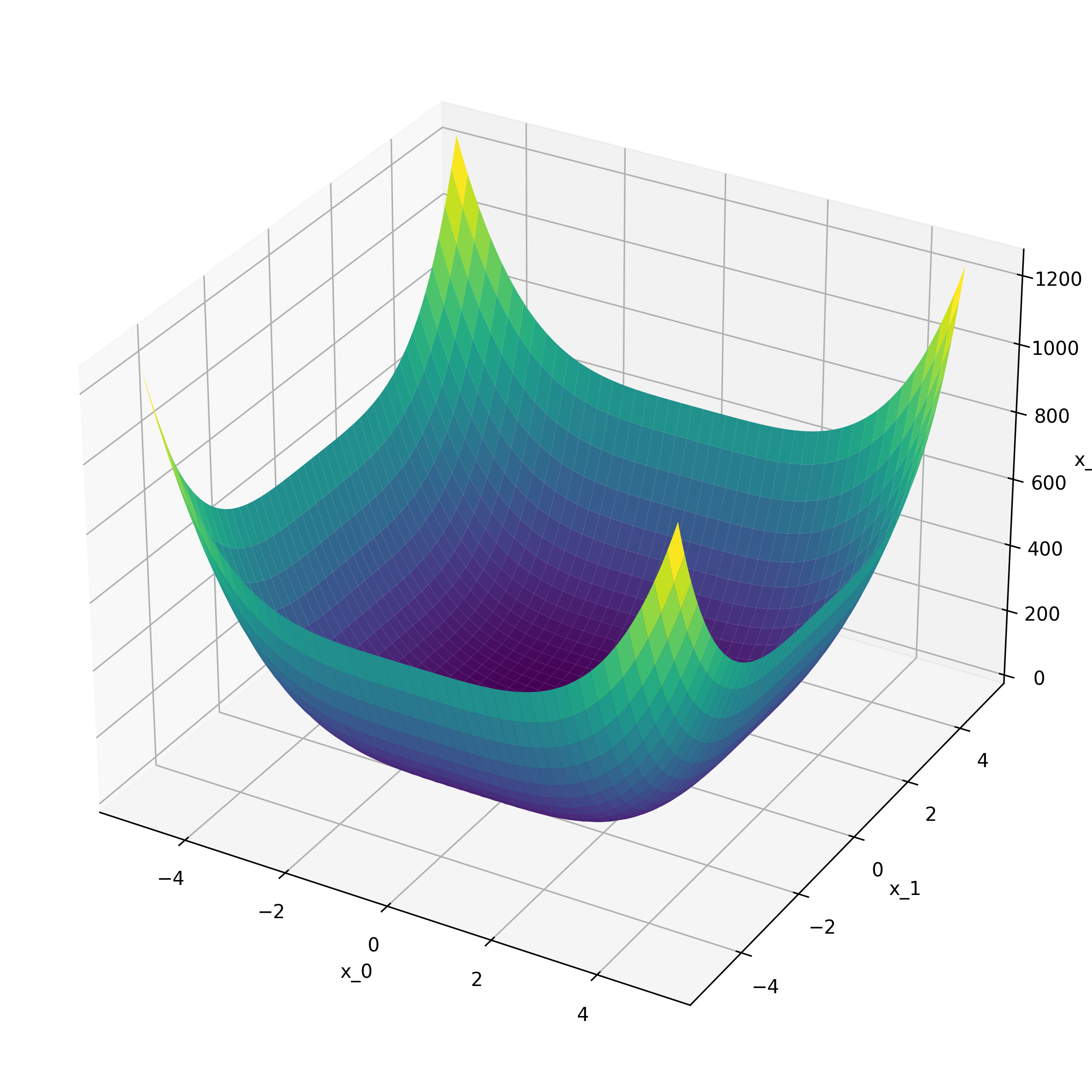
Quartic Bowl Function
Quartic bowl function.
Source code in src/umf/functions/optimization/bowl_shaped.py
class QuarticBowlFunction(OptFunction):
    r"""Quartic bowl function."""

    def __init__(self, *x: UniversalArray) -> None:
        """Initialize the quartic bowl function."""
        _validate_two_dimensional(*x, function_name="QuarticBowl")
        super().__init__(*x)

    @property
    def __eval__(self) -> UniversalArray:
        """Evaluate the quartic bowl function at x."""
        x_1, x_2 = self._x
        return x_1**4 + x_2**4

    @property
    def __minima__(self) -> MinimaAPI:
        """Return the minima of the quartic bowl function."""
        return MinimaAPI(f_x=0.0, x=(0.0, 0.0))
 |
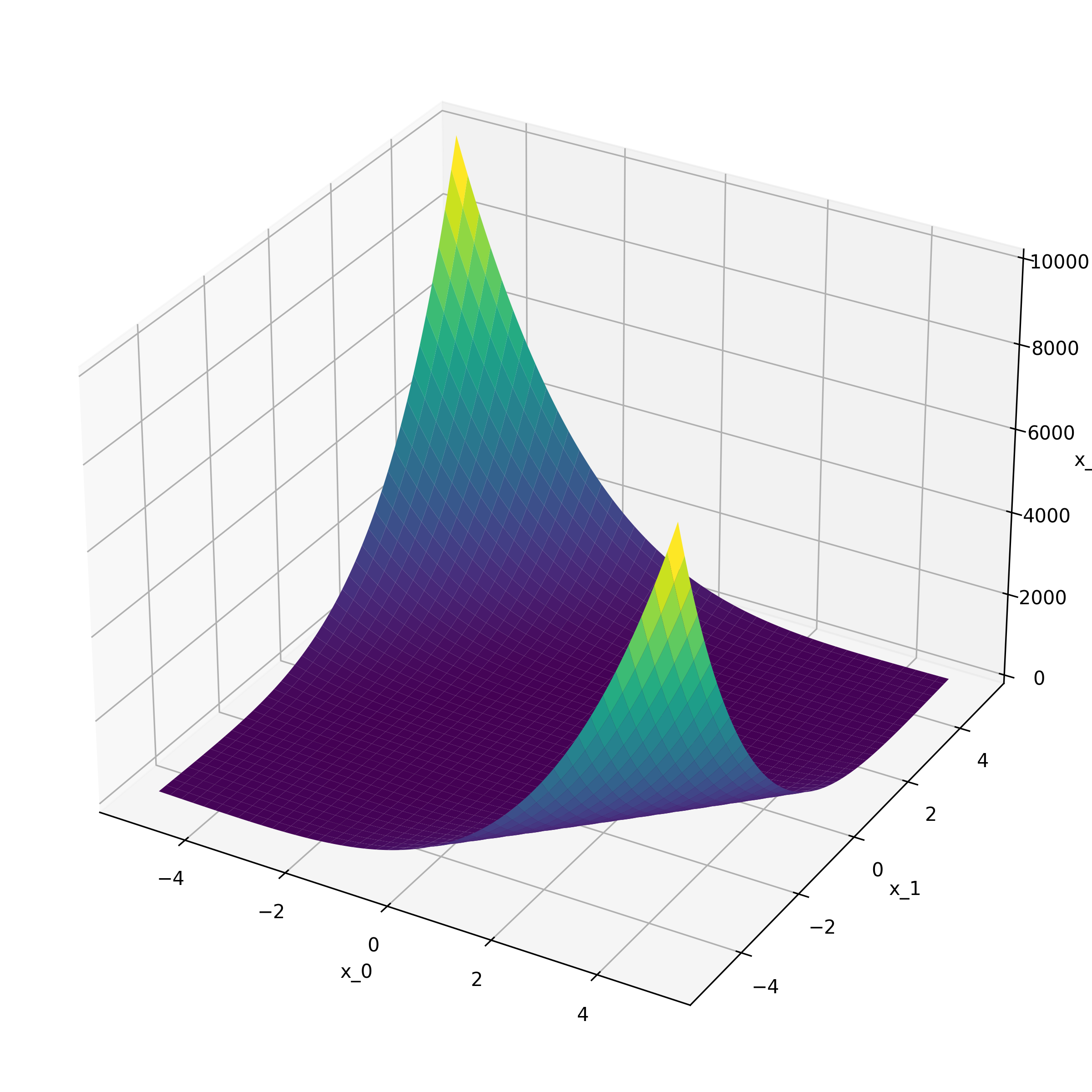
Cross Quadratic Function
Cross-quadratic function.
Source code in src/umf/functions/optimization/bowl_shaped.py
class CrossQuadraticFunction(OptFunction):
    r"""Cross-quadratic function."""

    def __init__(self, *x: UniversalArray) -> None:
        """Initialize the cross-quadratic function."""
        _validate_two_dimensional(*x, function_name="CrossQuadratic")
        super().__init__(*x)

    @property
    def __eval__(self) -> UniversalArray:
        """Evaluate the cross-quadratic function at x."""
        x_1, x_2 = self._x
        return (x_1 + x_2) ** 2 + (x_1 - x_2) ** 4

    @property
    def __minima__(self) -> MinimaAPI:
        """Return the minima of the cross-quadratic function."""
        return MinimaAPI(f_x=0.0, x=(0.0, 0.0))
 |
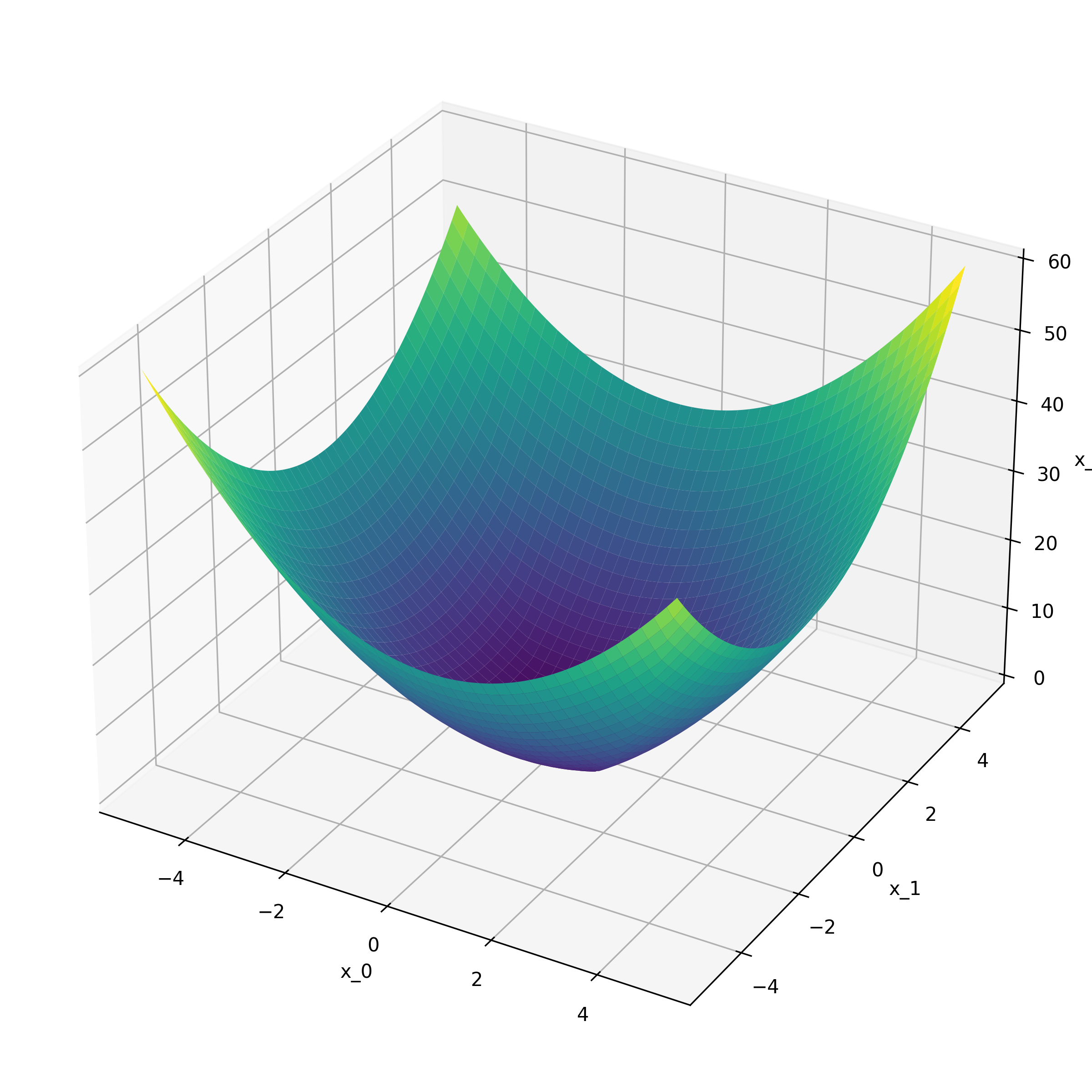
Weighted L1 L2 Function
Weighted mixed-norm function.
Source code in src/umf/functions/optimization/bowl_shaped.py
class WeightedL1L2Function(OptFunction):
    r"""Weighted mixed-norm function."""

    def __init__(self, *x: UniversalArray) -> None:
        """Initialize the weighted mixed-norm function."""
        _validate_two_dimensional(*x, function_name="WeightedL1L2")
        super().__init__(*x)

    @property
    def __eval__(self) -> UniversalArray:
        """Evaluate the weighted mixed-norm function at x."""
        x_1, x_2 = self._x
        return x_1**2 + x_2**2 + np.abs(x_1 + x_2)

    @property
    def __minima__(self) -> MinimaAPI:
        """Return the minima of the weighted mixed-norm function."""
        return MinimaAPI(f_x=0.0, x=(0.0, 0.0))
 |
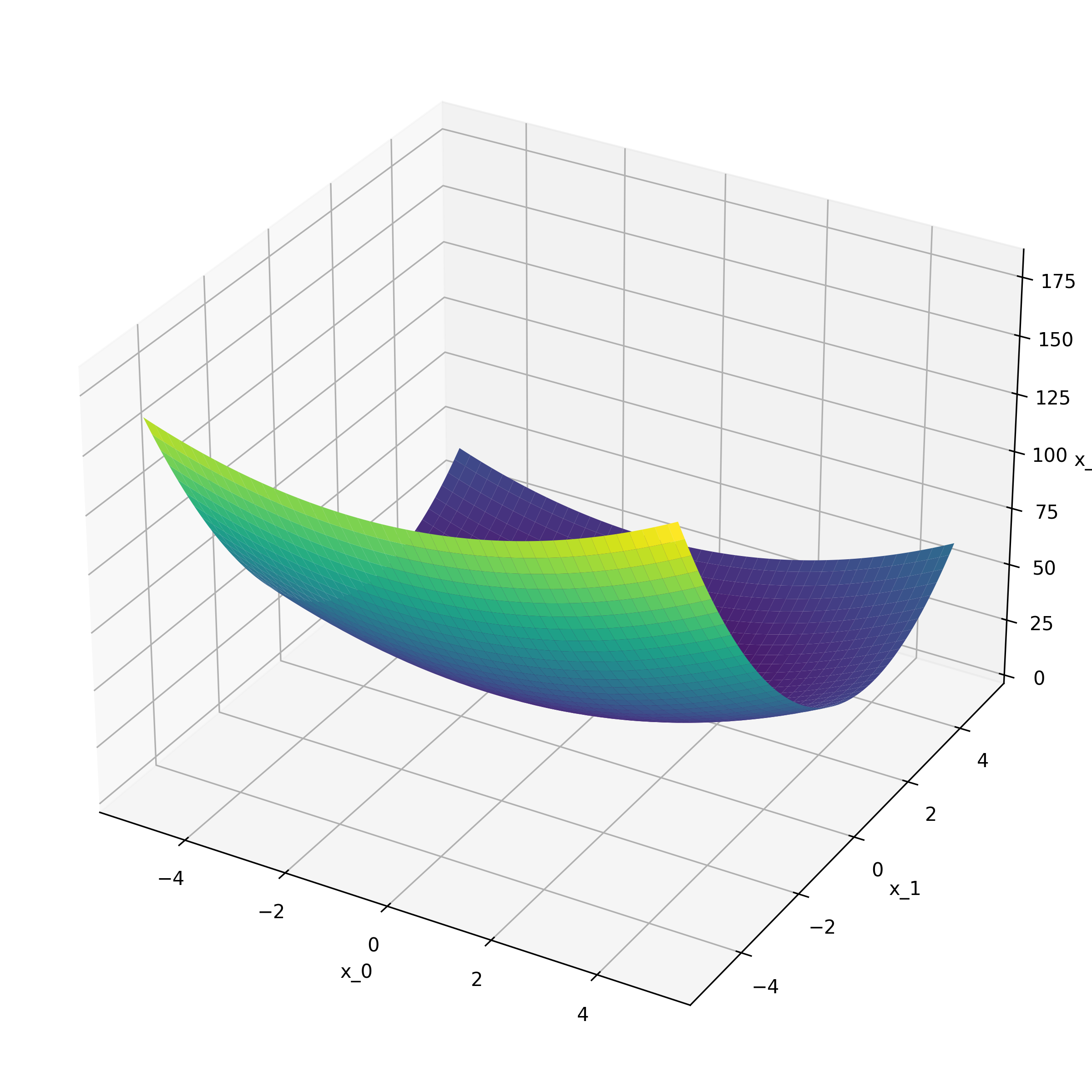
Offset Quadratic Function
Offset quadratic function.
Source code in src/umf/functions/optimization/bowl_shaped.py
class OffsetQuadraticFunction(OptFunction):
    r"""Offset quadratic function."""

    def __init__(self, *x: UniversalArray) -> None:
        """Initialize the offset quadratic function."""
        _validate_two_dimensional(*x, function_name="OffsetQuadratic")
        super().__init__(*x)

    @property
    def __eval__(self) -> UniversalArray:
        """Evaluate the offset quadratic function at x."""
        x_1, x_2 = self._x
        return (x_1 + 1) ** 2 + 3 * (x_2 - 2) ** 2

    @property
    def __minima__(self) -> MinimaAPI:
        """Return the minima of the offset quadratic function."""
        return MinimaAPI(f_x=0.0, x=(-1.0, 2.0))
 |
Saddle Suppressed Function
Saddle-suppressed function.
Source code in src/umf/functions/optimization/bowl_shaped.py
class SaddleSuppressedFunction(OptFunction):
    r"""Saddle-suppressed function."""

    def __init__(self, *x: UniversalArray) -> None:
        """Initialize the saddle-suppressed function."""
        _validate_two_dimensional(*x, function_name="SaddleSuppressed")
        super().__init__(*x)

    @property
    def __eval__(self) -> UniversalArray:
        """Evaluate the saddle-suppressed function at x."""
        x_1, x_2 = self._x
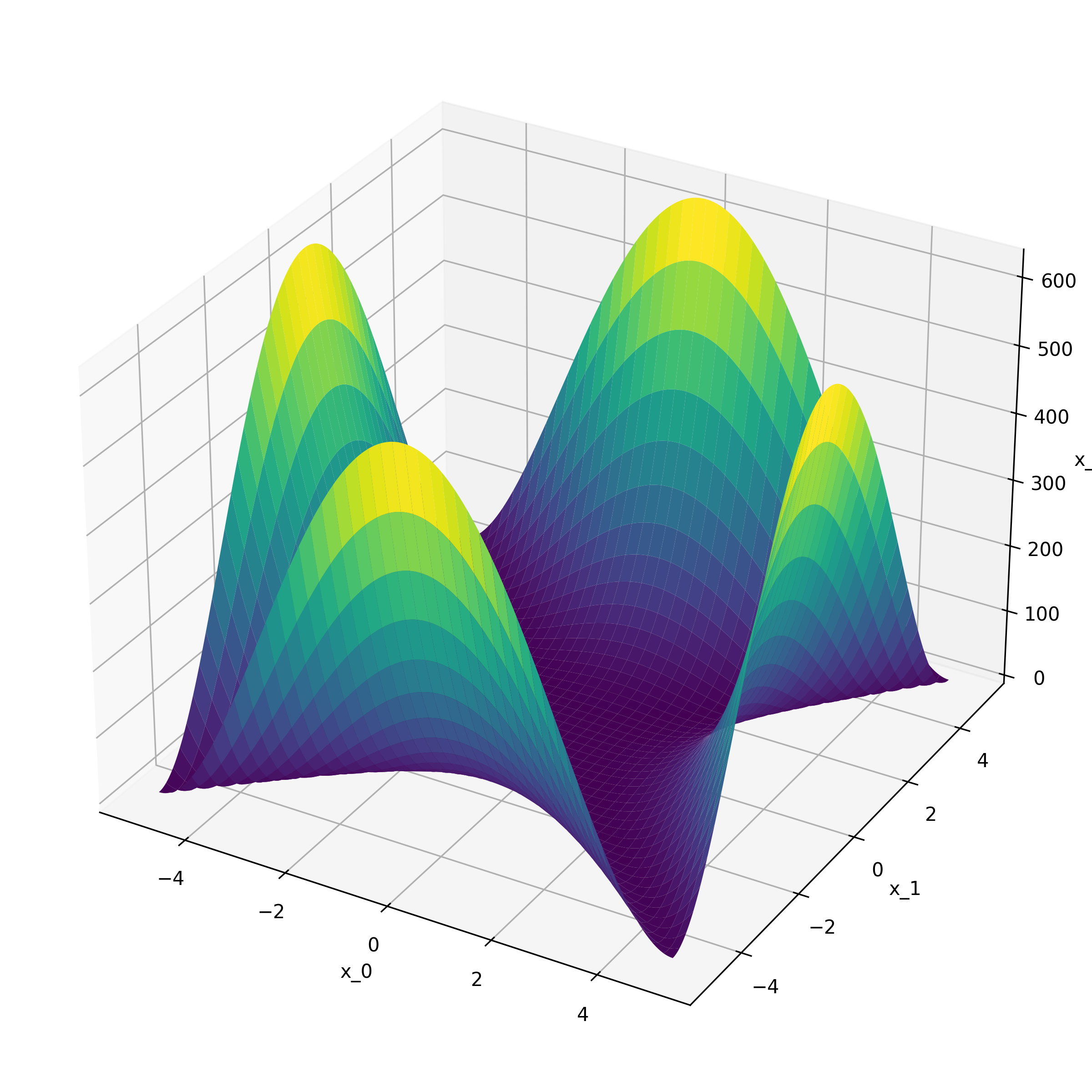
        return (x_1**2 - x_2**2) ** 2 + 0.1 * (x_1**2 + x_2**2)

    @property
    def __minima__(self) -> MinimaAPI:
        """Return the minima of the saddle-suppressed function."""
        return MinimaAPI(f_x=0.0, x=(0.0, 0.0))
 |
Shifted Hyper Sphere Function
Shifted hypersphere function.
Source code in src/umf/functions/optimization/bowl_shaped.py
class ShiftedHyperSphereFunction(OptFunction):
    r"""Shifted hypersphere function."""

    def __init__(self, *x: UniversalArray) -> None:
        """Initialize the shifted hypersphere function."""
        _validate_three_or_higher(*x, function_name="ShiftedHyperSphere")
        super().__init__(*x)

    @property
    def __eval__(self) -> UniversalArray:
        """Evaluate the shifted hypersphere function at x."""
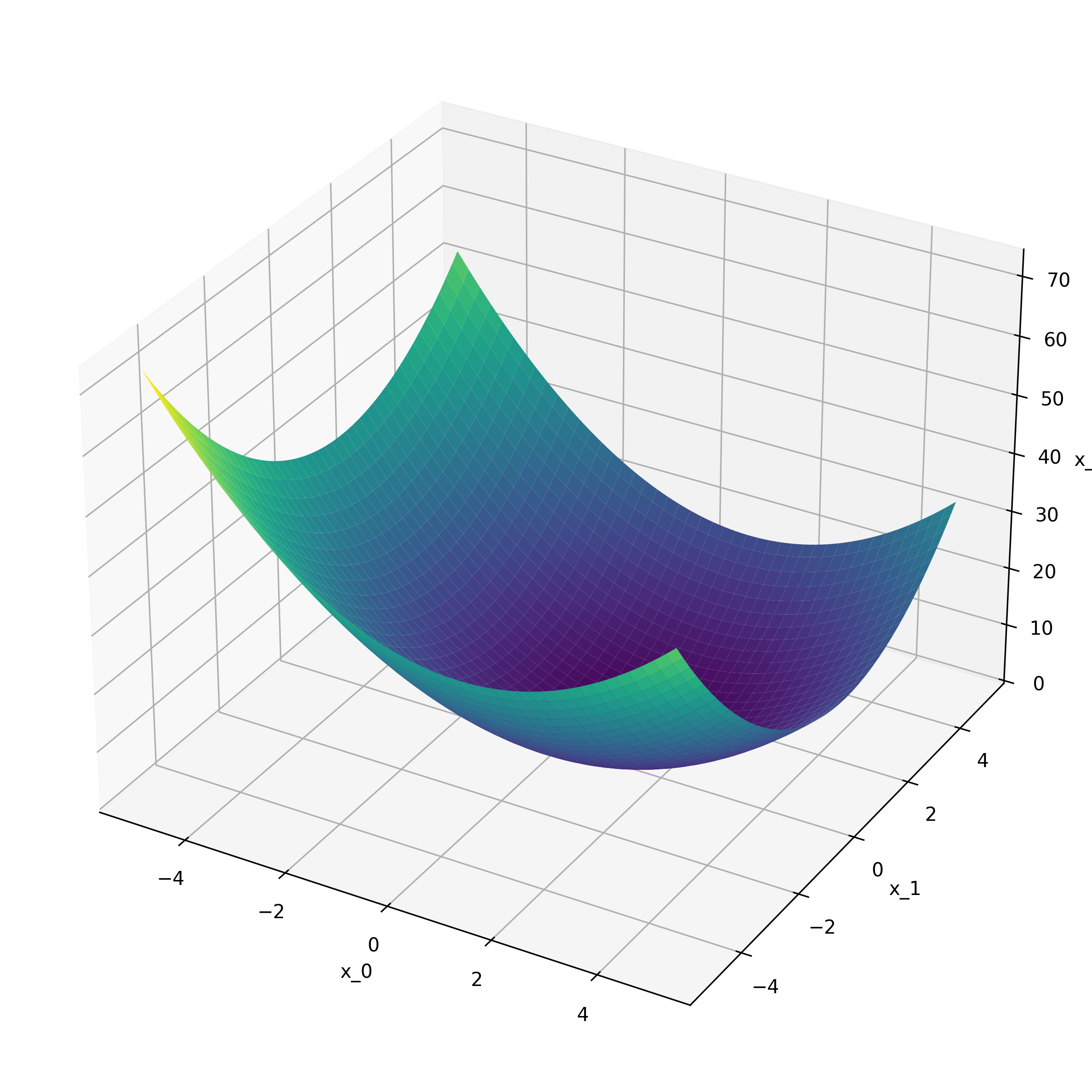
        return np.array(sum((axis - 1) ** 2 for axis in self._x))

    @property
    def __minima__(self) -> MinimaAPI:
        """Return the minima of the shifted hypersphere function."""
        return MinimaAPI(f_x=0.0, x=tuple(1.0 for _ in range(self.dimension)))
 |
Exponential Norm Function
Exponential norm function.
Source code in src/umf/functions/optimization/bowl_shaped.py
class ExponentialNormFunction(OptFunction):
    r"""Exponential norm function."""

    def __init__(self, *x: UniversalArray) -> None:
        """Initialize the exponential norm function."""
        _validate_three_or_higher(*x, function_name="ExponentialNorm")
        super().__init__(*x)

    @property
    def __eval__(self) -> UniversalArray:
        """Evaluate the exponential norm function at x."""
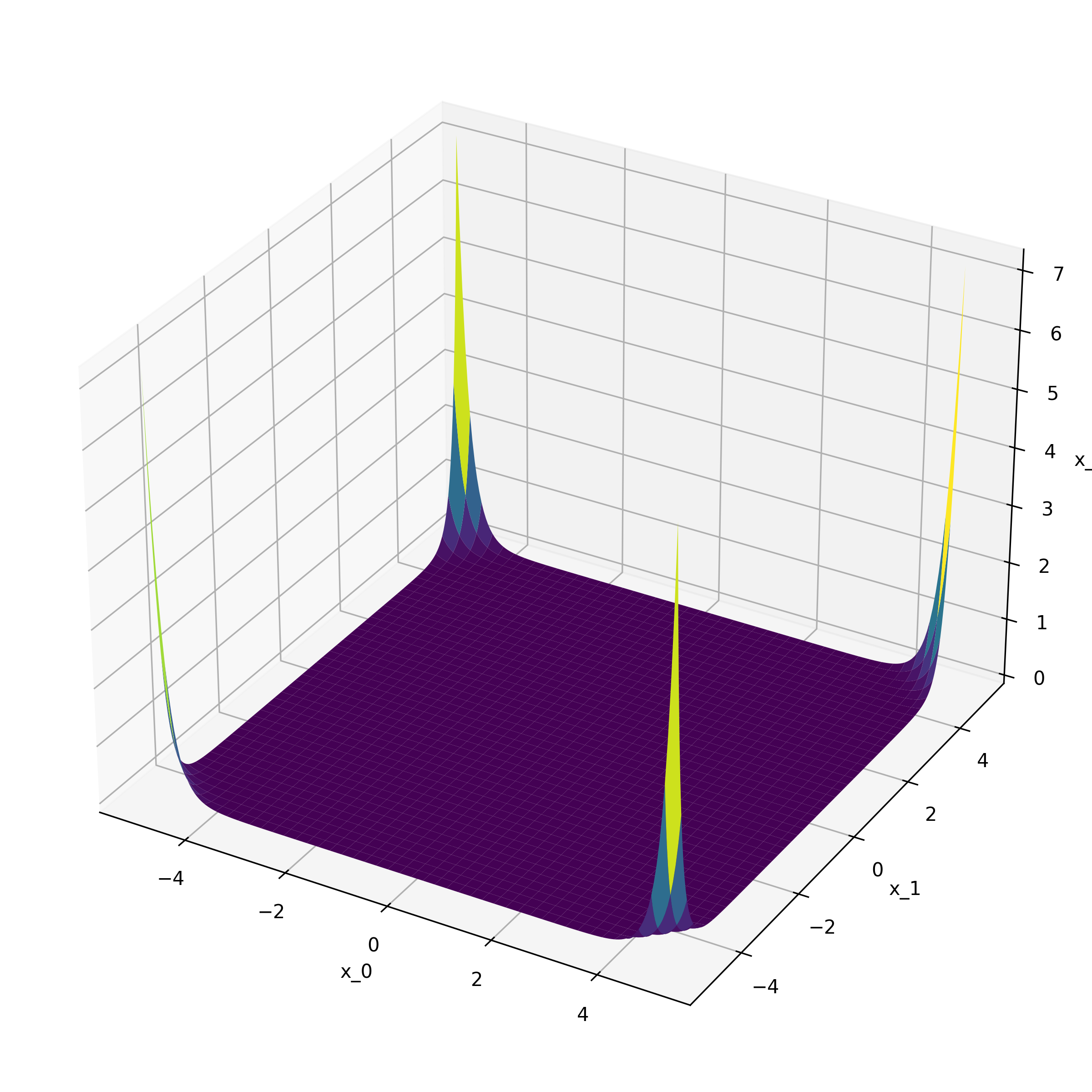
        squared_norm = np.array(sum(axis**2 for axis in self._x))
        return np.exp(0.5 * squared_norm) - 1

    @property
    def __minima__(self) -> MinimaAPI:
        """Return the minima of the exponential norm function."""
        return MinimaAPI(f_x=0.0, x=tuple(0.0 for _ in range(self.dimension)))
 |
Cubic Norm Function
Cubic norm function.
Source code in src/umf/functions/optimization/bowl_shaped.py
class CubicNormFunction(OptFunction):
    r"""Cubic norm function."""

    def __init__(self, *x: UniversalArray) -> None:
        """Initialize the cubic norm function."""
        _validate_three_or_higher(*x, function_name="CubicNorm")
        super().__init__(*x)

    @property
    def __eval__(self) -> UniversalArray:
        """Evaluate the cubic norm function at x."""
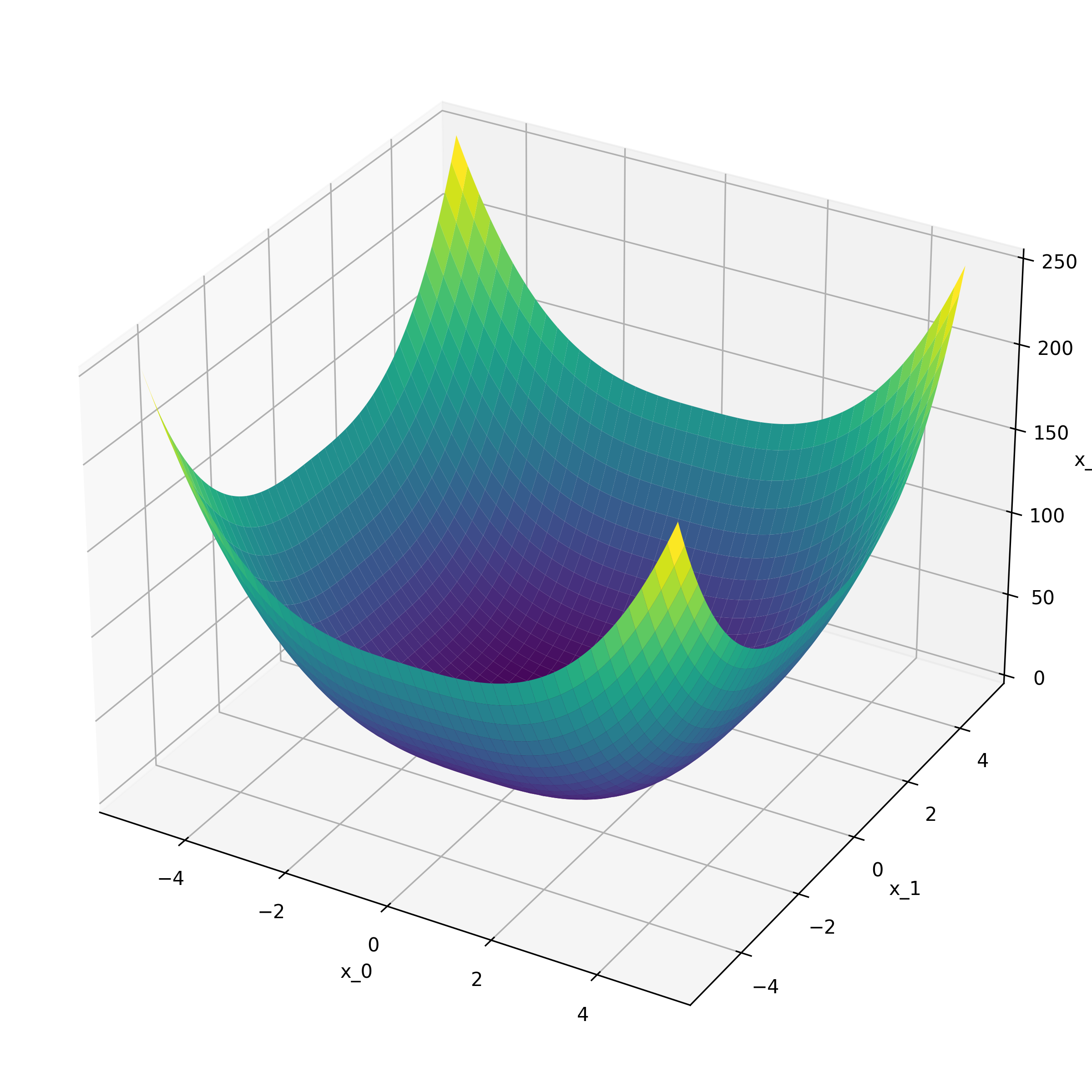
        return np.array(sum(np.abs(axis) ** 3 for axis in self._x))

    @property
    def __minima__(self) -> MinimaAPI:
        """Return the minima of the cubic norm function."""
        return MinimaAPI(f_x=0.0, x=tuple(0.0 for _ in range(self.dimension)))
 |
Sum And Product Function
Sum-and-product function.
Source code in src/umf/functions/optimization/bowl_shaped.py
class SumAndProductFunction(OptFunction):
    r"""Sum-and-product function."""

    def __init__(self, *x: UniversalArray) -> None:
        """Initialize the sum-and-product function."""
        _validate_three_or_higher(*x, function_name="SumAndProduct")
        super().__init__(*x)

    @property
    def __eval__(self) -> UniversalArray:
        """Evaluate the sum-and-product function at x."""
        sum_term = np.array(sum(np.abs(axis) for axis in self._x))
        product_term = np.ones_like(self._x[0])
        for axis in self._x:
            product_term *= np.abs(axis) + 1
        return sum_term + product_term - 1

    @property
    def __minima__(self) -> MinimaAPI:
        """Return the minima of the sum-and-product function."""
        return MinimaAPI(f_x=0.0, x=tuple(0.0 for _ in range(self.dimension)))
 |